Overview
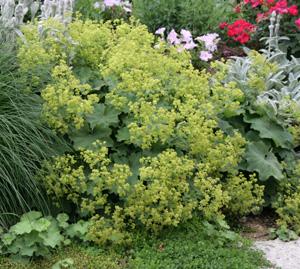
Lady’s mantle, Alchemilla mollis, is an old-fashioned, tough, and adaptable European garden perennial grown for both its interesting foliage and sprays of flowers. It is the most commonly planted of nearly 300 species in this genus in the rose family (Rosaceae). Its common name may be in reference to froits scalloped leaves resembling the Virgin Mary’s cloak, although other explanations exist. Native to Turkey and the Carpathian Mountains, A. mollis has been used medicinally and as a dye plant. Be aware that lady’s mantle can reseed somewhat aggressively in favorable sites. It is hardy in zones 3a to 8b.
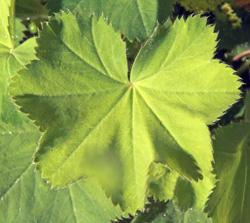
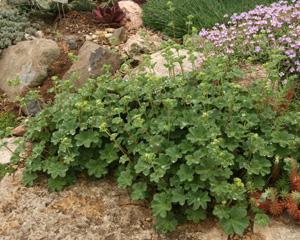
The soft, velvety leaves are up to 6 inches across with serrated edges. Each leaf is palmately veined with 7 to 11 partially folded lobes, making it appear pleated. The foliage is light green to olive green in color. Plants spread very slowly by rhizomes, forming mounds 12 to 15 inches tall that spread to two feet or more.
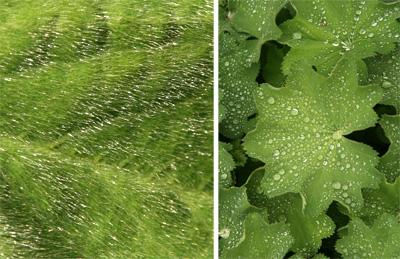
The dense hairs on the leaves catch and hold water droplets, making them very attractive after a rain or in the morning when drops of dew collect on the textured leaves.
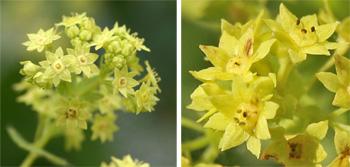
Airy sprays of yellow to chartreuse flowers cover the plants in early to midsummer. The individually inconspicuous, ¼ inch wide, star-shaped flowers have no petals. The effect is fairly subtle, compared to many perennials with bold, brightly colored flowers, and some gardeners prefer to cut off the flowers. Stems make good fillers in cut flower arrangements, but fresh and dried. To dry, just hang cut stems in bundles upside down in a cool, ventilated spot until dry. They resist shattering and last longer than many dried flowers.
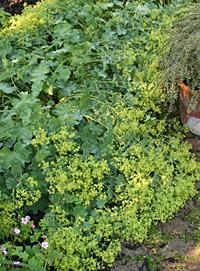
The flower stems tend to flop over after a while, making the plants look somewhat messy. There are no seedpods; the tiny brown seeds are held in the calyx, which becomes brown and papery when the seeds are ripe, with one seed per flower. Shear after blooming to improve the plant’s appearance and prevent self-seeding. New, lush basal growth will begin growing soon after trimming and this foliage should remain attractive through the remainder of the season.
An easy-care perennial, it does well in sun or partial shade. In hot climates it may scorch in full sun, but this is rarely a problem in the upper Midwest. It tolerates most soils, except overly moist conditions, and does well in clay.
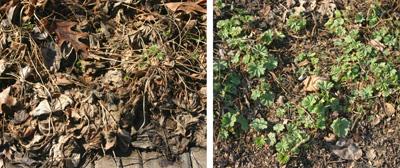
It is not drought tolerant and requires watering when soil moisture is lacking. The foliage will turn completely brown over the winter and new leaves appear in spring. It is best to shear the old leaves from the crowns in early spring before new growth starts.
Landscape Use of Lady’s Mantle
Use lady’s mantle at the front of the border, in cottage gardens, or as a groundcover. It works well spilling over the edge of a path, especially when in bloom. It can even be used in large containers.
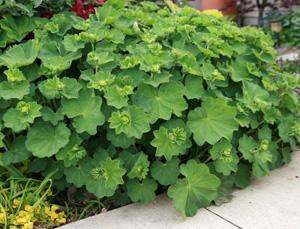
The soft, mounding appearance of this plant contrasts nicely with vertical perennials such as iris, liatris, ferns, and salvia (when in bloom) and the boldly textured, soft-colored foliage looks great in combination with dark green or purple leaved plants, and with finer textured plants. The cooling yellow-green or green-yellow of the flowers is a superb companion to almost all colors, but especially violet, blue, and pink. The blooming plants complement pink shrub roses nicely.
Lady’s mantle has almost no pests and is not favored by deer.
Propagating Lady’s Mantle
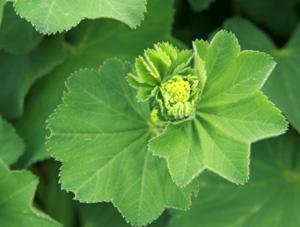
A. mollis is easily propagated by seed (and readily self seeds in many gardens, potentially aggressively in ideal growing conditions). Seedlings are easily identifiable, as they have the same three-lobed leaves as the adult plants. Volunteers are easily weeded out or moved. It will take at least two years from seeding until plants bloom. Established clumps can be divided in spring or fall, although early spring is best.
Cultivars of Lady’s Mantle
A. mollis is the most widely grown of the genus and only a few cultivars are available (and all are fairly similar in appearance):
- ‘Auslese’ is a European selection, chosen for its more upright, lime-green flowers. The plant is larger than the species, growing 15 to 18 inches tall.
- ‘Irish Silk’ grows to 2 feet tall and is particularly florerous.
- ‘Robusta’ is more upright with larger leaves than the species, growing 2 feet tall and wide.
- ‘Thriller’ is a slightly more compact variety with flowers that tend more toward green than yellow.
Other species sometimes available include:
- A. alpina (mountain lady’s mantle) is a mat-forming species growing only 4 to 8 inches tall that needs good drainage, so is a good species for rock gardens. The deeply lobed leaves have silvery-white margins. Native to northeastern Canada to Greenland and in subarctic parts of Europe. Hardy in zones 3a to 7b.
- A. conjuncta (silver lady’s mantle) appears similar to A. alpina, but is larger and is hardy in zones 3a to 7b.
- A. ellenbeckii (creeping lady’s mantle) is a low-growing species (2 inches high) with red stems and sliver-edged foliage that is only hardy to zone 6a.
- A. erythropoda (dwarf lady’s mantle) looks like a miniature version of A. mollis with yellow flowers, only growing 4 to 6 inches tall. It is a good choice for rock gardens, troughs, and small spaces. Zones 3a to 7b.
- A. faroensis (Faroese lady’s mantle) is a dwarf species from Iceland and the Faroe Islands that only grows a few inches tall and is hardy in zones 3a to 7b.
- A. sericata ‘Gold Strike’ is a German variety with smaller, deeply lobed leaves on 12 to 14 inch plants suitable for rock gardens and use as a groundcover.
Author: Susan Mahr, University of Wisconsin—Madison
Reviewers: Allen Pyle, Horticulture Outreach Specialist, Bruce Spangenberg, Horticulture Outreach Specialist, UW—Madison Extension
Revised: October 2026