Overview
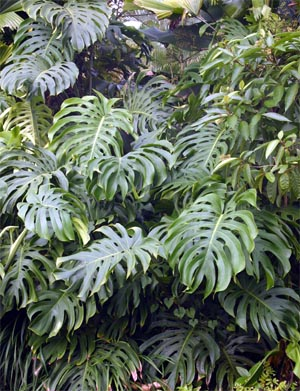
Monstera, sometimes called Swiss-cheese plant, (Monstera deliciosa) is a tender tropical plant native to rainforests of Central America from southern Mexico to Panama, and commonly grown as a foliage houseplant. It is the only ornamental aroid also grown for its fruit.
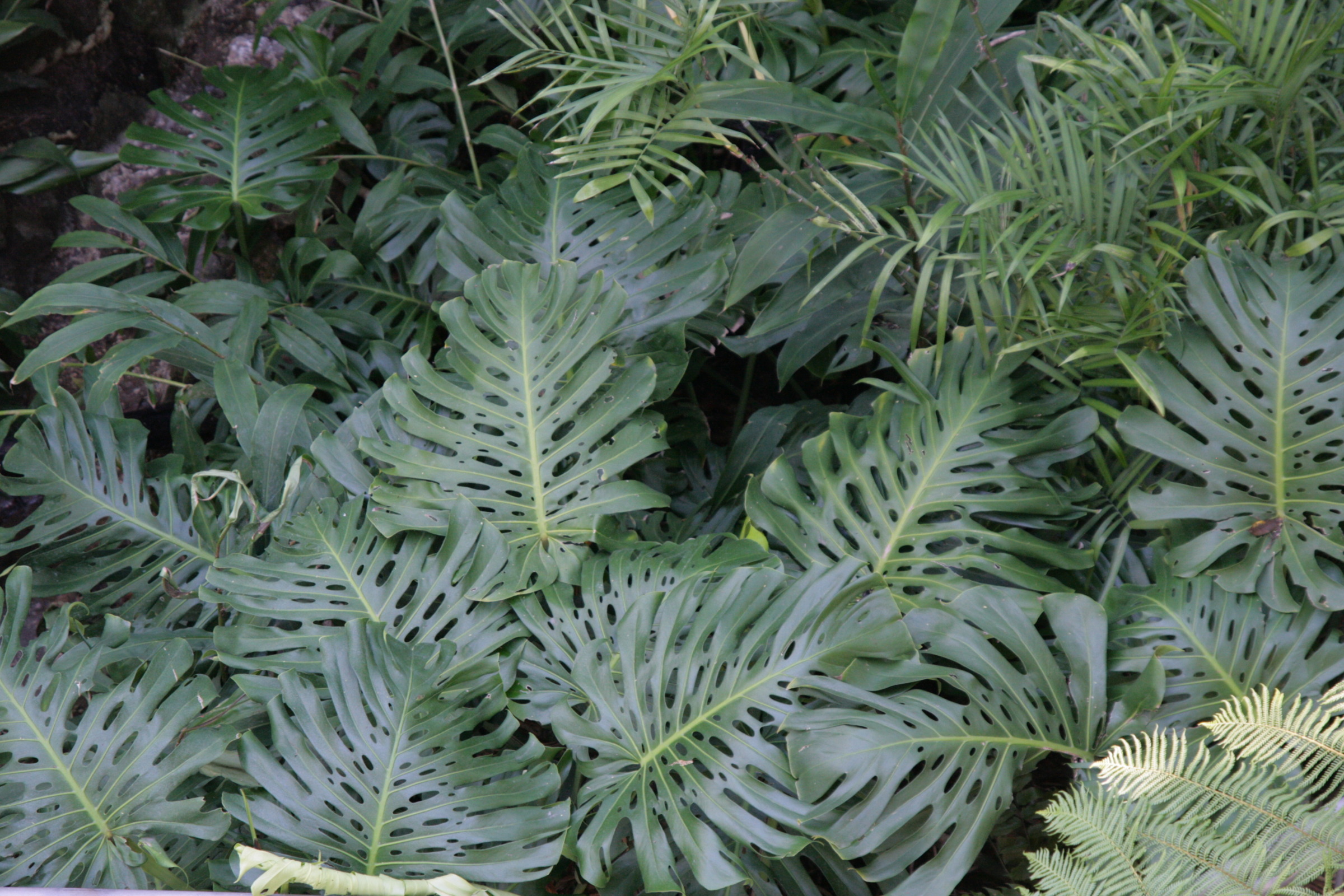
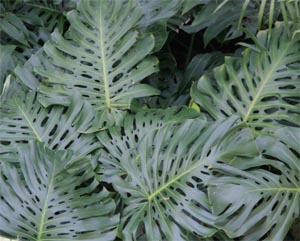
This member of the Araceae familyi was formerly classified in the genus Philodendron. It has glossy, heart-shaped or rounded, leathery leaves that develop deep clefts and oblong perforations as they grow. The leaves may be as much as 18 inches wide on foot-long leafstalks. The cultivars ‘Variegata’ and ‘Albovariegata’ have variegated foliage, and the leaves tend to be somewhat smaller than the species. Other related species, such as M. obliqua, have smaller leaves.
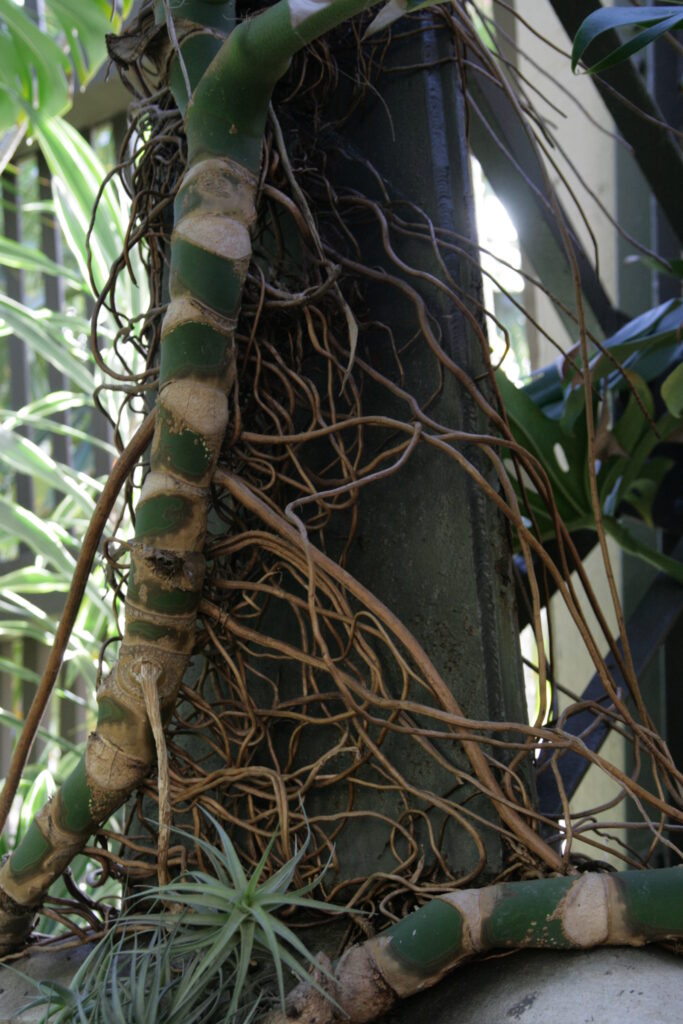
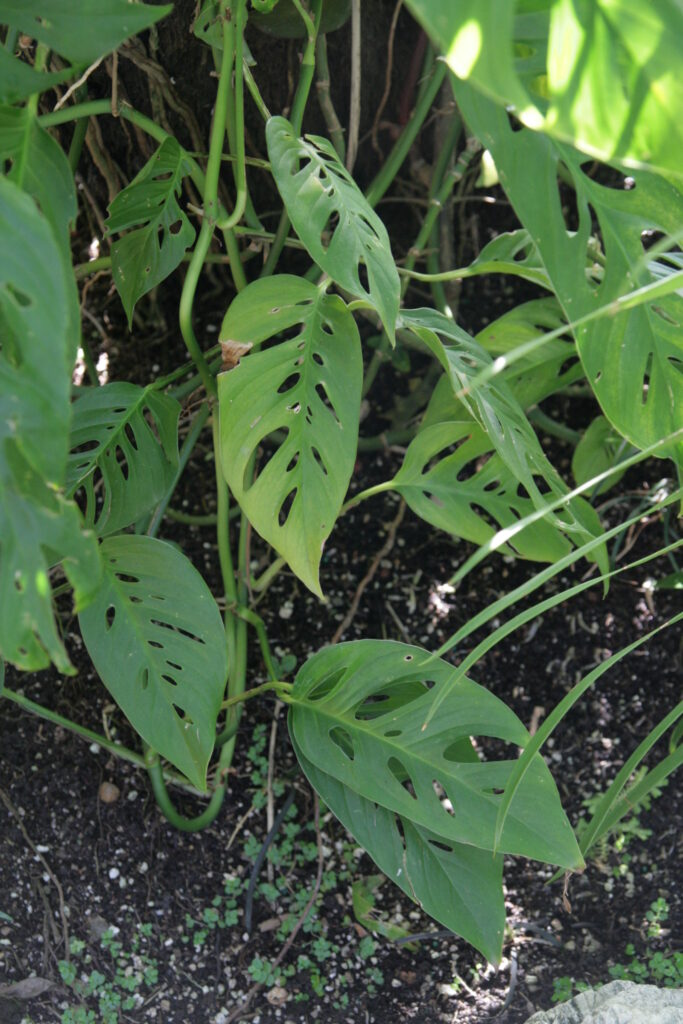
In nature, this species is an evergreen liana, a trailing or climbing epiphytic vine, which grows high into the rainforest canopy. It can grow 70 feet or more and rarely branches. The heavy, cylindrical, 2½ to 3 inch stems are rough with leaf scars.
It produces numerous, long, tentacle-like aerial roots as it grows upward which attach to nearby branches and tree trunks. The tough roots grow downward from the thick stem and will root if they reach the ground.
The young plants appear very different. Seedlings grow toward the darkest area until they encounter a tree, then they grow upwards. The leaves are small and without lobes or holes, and they grow closely overlapping each other up the tree trunk in a stage called “shingle plants.” As plants grow older, they develop the characteristic foliage of a mature plant. The fenestrations (holes in the leaves) theoretically are a way of allowing high winds to pass through the large leaves without tearing them.
The flowers, which are rarely if ever seen on houseplants, are a 8 to 12 inches long, creamy-white, Jack-in-the-pulpit type. The fleshy upright spike (spadix) with tiny flowers is surrounded by the boat-shaped spathe. It takes a little over a year for the fruit to mature, swelling into a 9 inch cone-like structure that looks sort of like a green cob of corn with hexagonal kernels.
The edible fruits, called cerimans or monsteras, reportedly taste like a combination of banana, pineapple, and mango and are high in potassium and Vitamin C. The fruit is used to flavor drinks and ice cream, and can be eaten fresh. The fruit ripens from the bottom up. Once the thick, hard rind of hexagonal plates or “scales” covering the individual segments begin to dry out and fall away, the off-white, custard-like pulp underneath is cut away from the inedible core to eat. There usually are no seeds, but occasionally pale-green, hard seeds the size of large peas, may occur in some of the segments.
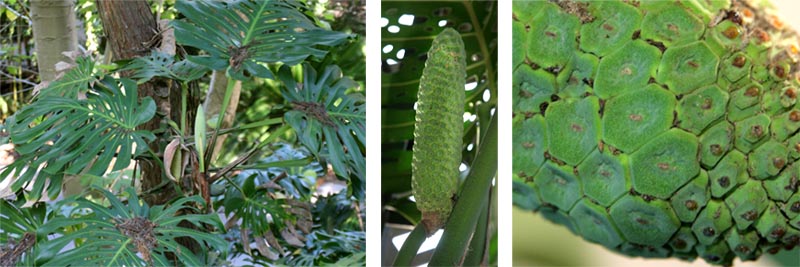
The plant contains oxalic acid, so all parts are poisonous except the ripe fruits. Young fruit, that still has the covering firmly attached, contains enough glass-like calcium oxalate crystals to cause immediate and painful irritation to the throat.
Growing Swiss-Cheese Plant
As a houseplant, Monstera does best in bright light in summer and direct sun in winter. It can be grown under florescent light, but will not develop the leaf perforations when light is inadequate. It prefers warm room temperature and medium to high humidity, but is fairly tolerant of a wide range of conditions once acclimated. Plants do not grow below 50 °F, however, and frost will kill them.
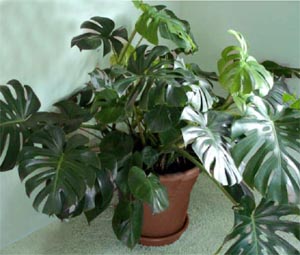
Grow Monstera in a fertile soilless mix, with ample root room to promote larger leaf growth. They can be very vigorous growers and need support to keep the stems from breaking. Provide a tree bark or strong, moss-covered support sunk into the pot for the aerial roots to attach to. Sphagnum moss wrapped around a wooden slat, secured with monofilament fishing line or nylon thread, will work well.
Water thoroughly and allow the growing medium to dry slightly between waterings, being sure to also water the moss-covered support so the aerial roots can obtain water and nutrients. The leaves will “sweat” if the growing medium is too moist. If this happens, reduce watering to prevent root rot.
Plants kept on the dry side grow slower. Water less in winter. Fertilize regularly from spring until fall. The leaf edges will turn brown if humidity is too low. Wipe the dust from the leaves periodically. This plant has few pests indoors, but may be infested by aphids, mealybugs, scale insects or spider mites.
Container-grown plants need frequent repotting to accommodate the root system. They can be moved outside for the summer, but need to be acclimated to higher light levels gradually or the leaves will suffer sunburn.
Propagating Swiss-Cheese Plant
Propagate from stem cuttings from mature plants or by air layering or simple layering any time of the year. Cut the tip of the stem just below an aerial root and pot the cutting. For more plants, cut the vine into 1-foot sections, press the sections half way into the surface of a bed of rooting medium and then transplant when roots have developed.
Plants can be grown from seed, but seedlings require warm temperatures and are slow to develop.
Author: Susan Mahr, University of Wisconsin—Madison
Reviewers: Allen Pyle, Horticulture Outreach Specialist, UW—Madison Extension, Bruce Spangenberg, Horticulture Outreach Specialist, UW—Madison Extension
Revised: October 2026
Acknowledgement:
Lauren Mortensen for general support and web editing.
Photos by Susan Mahr.