Landscape Design Principles
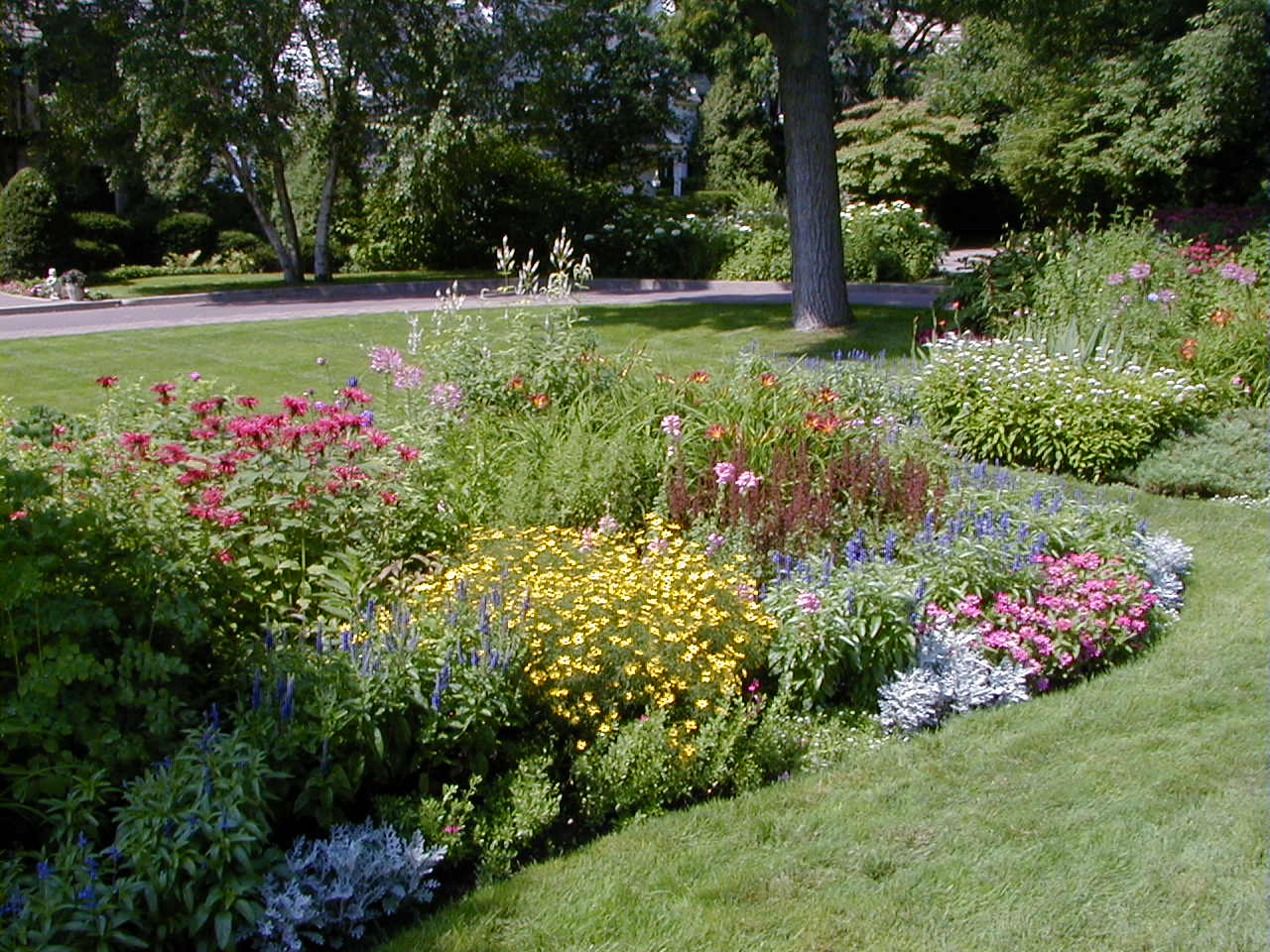
Home landscape designs vary according to family needs and preferences, but successful designs have certain underlying principles in common, including unity, balance, emphasis, scale, space, and lines.
Unity
A landscape has unity when its predominant features have some visual characteristics in common. For example, plants with similar forms, colors, and textures can create unity, both on your lot and in your neighborhood. This is also true of lawns and paving materials. Repeating a design pattern, color, or texture in several different locations helps create unity. Planting beds and turf areas are very important to tie the landscape together and create a sense of unity.
Balance
Plants and landscape structures of similar visual importance help create balance in a landscape design. With color, form, texture, size, and other features, you can direct attention to several areas of the yard. Balance may be symmetrical (formal), in which each side of the yard is similar in pattern, or asymmetrical (informal), in which each side attracts the same attention, even though objects and spacing are not repeated.
Emphasis
Accent areas or focal points to which attention is drawn create emphasis and keep a design’s unity and balance from becoming monotonous. A single contrast in color, texture, form, or height—such as that provided by a bench, tree, pool, or flowerbed—can provide emphasis.
Scale
Scale refers to the size relationships among plants, structures, and open spaces. A four-foot-high shrub with a four-foot spread may be too large— and therefore out of scale—in front of low windows. However, next to a high-rise building, the same shrub would be out of scale because it is too small. In some home landscape situations, group plantings will compensate for plants with too little spread.
Space
Your entire lot can be considered a block of space with dimensions of length, width, and height. Plants, fences, and buildings are used to divide the lot into smaller living spaces analogous to the rooms of your house. These outdoor “rooms” should have separate identities and should meet your use area needs. The rooms should have openings that direct movement from one to another.
Lines
Lines may be straight or curved. Landscape designers frequently lay out patios, decks, and planting beds using straight lines that extend—or parallel—house and lot lines. Straight lines tend to create a more formal look for your landscape. Equally successful— and more naturalistic—designs can be created with curved lines. Loosely curved lines are easy to mow around and also provide a good flow through your landscape.
These design principles will help you shape the areas you identified in your general-use sketches. But you can’t design a landscape based only on the placement and size of plants and structures. The appropriate plants and construction materials must also be selected.
Both plants and building materials can be selected for their form, texture, and color. Keep these elements of landscape composition in mind as you proceed toward your final landscape design.
← Previous: Landscape Planning
Authors: Dan Wilson, Professors Emeritus, University of Wisconsin-Extension, Thomas Wilson, Professors Emeritus, University of Wisconsin-Extension, and Wayne Tlusty, Professor Emeritus, University of Wisconsin-Madison. Illustrations by Renee Graef.
Reviewed by: Christine Wen, UW-Extension Walworth County Horticulture Educator
Last revised: 5/10/2010
Item number: G1923
References and Additional Resources
Plant Selection
- A Guide to Selecting Landscape Plants for Wisconsin (A2865)
- Choosing the Right Landscape Plants: Factors to Consider (A3864)
- Container Gardening (A3382)
- Landscape Plants That Attract Birds (G1609)
- Lawn Establishment and Renovation (A3434)
- Lilacs for Cold Climates (A3825)
- Prairie Primer (G2736)
- Selecting Woody Landscape Plants for Fall Color: An Illustrated Guide (A3837)
Plant Care
- Caring for Deciduous Shrubs (A1771)
- Caring for Your Established Shade Trees (A1817)
- Do-It-Yourself Alternative Lawn Care (A3964)
- Growing Grass in Shade (A3700)
- Lawn Weed Prevention and Control (A1990)
- Mulches for Home Gardens and Plantings (A3383)
- Organic and Reduced-Risk Lawn Care (A3958)
- Organic Soil Conditioners (A2305)
- Sampling Garden Soils and Turf Areas for Testing (A2166)
- Selecting, Planting, and Caring for Your Shade Trees (A3067)
- Tree and Shrub Fertilization (A2308)
- Watering Your Lawn (A3950)
Yard Care and the Environment series
- Lawn and Garden Fertilizers (GWQ002)
- Lawn and Garden Pesticides (GWQ011)
- Lawn Watering (GWQ012)
- Lawn Weed Control (GWQ013)
- Managing Leaves and Yard Trimmings (GWQ022)
- Rethinking Yard Care (GWQ009)
- Shoreline Plants and Landscaping (GWQ014)
Other Publications
- Landscaping for Wildlife, available from the Minnesota Department of Natural Resources.
- Livable Landscape Design (141IB-211), available from Cornell University.