
Overview of Dusty Miller
Dusty miller is the common name of several plants with grey or silver leaves. The species most commonly used as an annual bedding plant is actually a tender (zone 7a or 8a) perennial subshrub native to the Mediterranean. It was once classified as Senecio cineraria but taxonomists now regard it as Jacobaea maritima. Some suppliers still list this species as Senecio cineraria or Senecio cineraria. It is typically grown for its ornamental foliage.
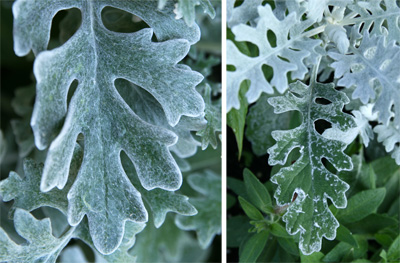
The leaves of dusty miller are covered with fine matted hairs, giving them a felted or woolly, silvery to white appearance. When wet, the underlying green leaf becomes more visible, and the white color is not as intense when grown in the shade. Coloration can also vary with the cultivar. The 2-6 inch long leaves are arranged alternately or spirally along the stiff, hairy stems. The simple leaves are lance shaped and variously indented or cut with numerous lobes, many times appearing pinnately compound. Cultivars vary tremendously in the amount of dissection from just slightly sinute to an almost lace-like appearance, offering a wide range of medium to fine textures.
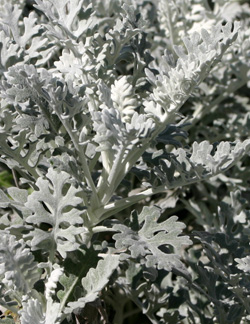
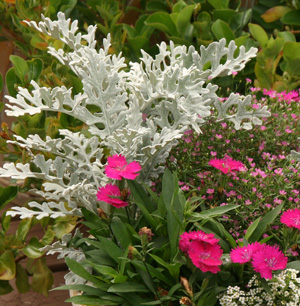
Plants can grow up to 2 feet tall and as wide but rarely achieve that stature when grown as an annual. When grown as an annual it normally forms a rounded mound 8-15 inches tall.
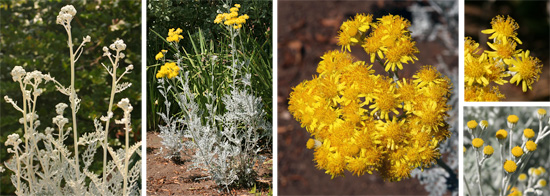
After the first-year dusty miller will bloom, producing yellow or cream composite flowers in terminal clusters. The ray flowers are highly reduced and the flowers are not particularly ornamental. Some cultivars do not flower and many gardeners prefer to remove any flowers as they can detract from the foliage. Seeds are produced in cylindrical achenes.
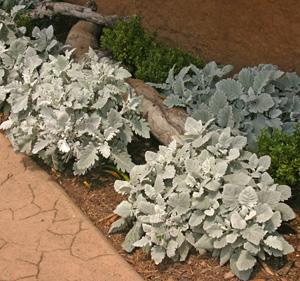
Being of Mediterranean origin, dusty miller is heat and drought tolerant and grows best in full sun. It will tolerate shaded conditions, but becomes leggy when grown in shade. Although it performs best in moist, well-drained, moderately fertile soils, it is tolerant of poor soils. It will last past the first frost, but the leaves die back when temperatures are consistently below freezing.
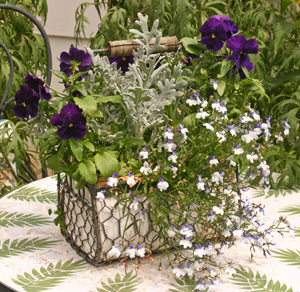
Landscape use of Dusty Miller
Dusty miller is an excellent complimentary foliage plant for flowering annuals in sunny sites. Use it as an accent plant in containers, as an edging, in borders or mixed plantings as a contrast for darker flowers or foliage. It combines well with other annuals, especially those that bloom in shades of pink, magenta, or violet. Mix it with other foliage plants, such as the deep purple Purple Heart (Tradescantia pallida) for season-long color and contrast. They are also good in “moon gardens” as their foliage reflects moonlight. Dusty miller has few pests and is not favored by deer.
Dusty miller foliage can also be used as a filler in cut flower arrangements.
Propagating Dusty Miller
Most people purchase dusty miller as bedding plants but plants can be grown from seed or from cuttings. Take tip cuttings from semi-hard wood in the summer. Sow on the surface of the growing medium (do not cover) and germinate at 68 to 77 °F.
Cultivars of Dusty Miller
- ‘Candicans’ – a vigorous seed propagated variety that grows to 16 to 24 inches tall, with large, lobed leaves. A good variety for cut foliage use in flower arranging.
- ‘Cirrus’ – a seed propagated cultivar with a very compact habit and undissected leaves. Grows 8 inches tall.
- ‘New Look’ – a seed propagated cultivar with large, wide leaves and a compact habit, growing about 10 inches tall.
- ‘Quicksilver’ – a compact seed propagated cultivar with dissected leaves. Grows 8 to 10 inches tall.
- ‘Silverdust’ – a seed propagated cultivar with highly dissected leaves that grows 10 to 12 inches tall.
– Susan Mahr, University of Wisconsin – Madison
Last Update: Allen R. Pyle, UW-Madison Extension, 2026