Overview
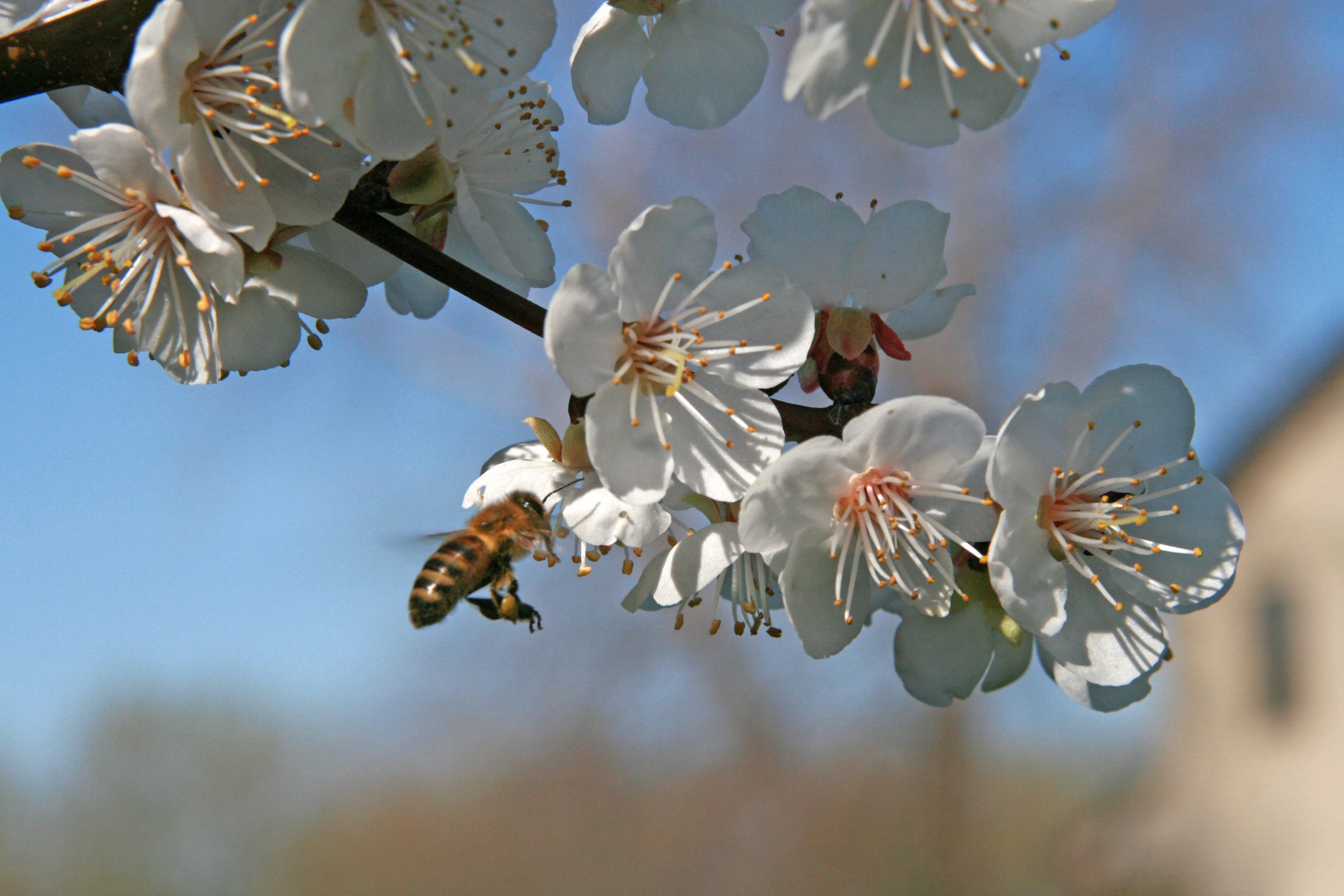
Pollinators are very important throughout the world. Over 80% of the world’s flowering plants require an insect or animal to move its pollen. In particular, insects pollinate 2/3 of the world’s crops and account for 1/3 or more of the food we eat. Insect pollinators include bees, wasps, butterflies, moths, beetles, flies, ants, and true bugs (Hemiptera). Other animals pollinate flowers, including bats and our native ruby-throated hummingbird. Many bird species utilize insects, especially caterpillars and larvae to feed their young. Fruit and seeds produced after pollination and fertilization of the flowers comprise around 25% of the diets of birds and mammals, hence pollination of these crops is critical for their survival.
Bees are considered the most important pollinator responsible for pollinating $235-577 billion worldwide and $24 billion in U.S. food crops each year, especially our fruit and some of our vegetable crops. Honey bees make honey that is a delicacy in any kitchen. Wisconsin has over 400 species of native bees that are responsible for pollinating many plants. Unlike honey bees and bumble bees, most native bees do not live in large colonies. Instead, most of them are solitary and construct their nests below ground in burrows or above ground in cavities or hollow stems. Unfortunately, both native bees and introduced honey bees and other pollinators are facing significant declines in their population due to loss of habitat and habitat fragmentation, diseases and mites, poor nutrition due to plant monocultures (lack of diverse food sources), climate change, pollution, excessive pesticide use or misuse, especially neonicotinoids and for honey bees, poor management practices.
What makes a flower attractive to a pollinator?
Bees
Bees are attracted to bright white, yellow, blue, and purple flowers that bloom during the day, have a mild to sweet or minty fragrance, and possess a nectar source. Bees are unable to see the color red. Bees commonly pollinate flowers that are tubular-shaped or with a shallow, landing platform. Ultraviolet light reveals nectar guides that point to the nectar source near the center of the flower.
Wasps
Wasps are attracted to dull-colored white or yellow, sweetly scented flowers with a nectar source. Wasps are often attracted to flowers that are less attractive to bees and butterflies. They are the primary pollinators of figs, orchids and other flowering plants. In addition, wasps can be predators and parasites of various insects, including the tomato hornworm.
Butterflies
Butterflies are attracted to red, orange, yellow, pink, and purple flowers that bloom during the day that either have no fragrance or have a spicy fragrance and produce lots of nectar. Flowers visited by butterflies have a narrow tube or are wide, flat-topped or in clusters with smaller flowers that provide a landing pad for the insect. Spots, lines, and blotches in flowers or near the center of the flower can act as nectar guides for butterflies.
Moths
Moths are attracted to dull colors or white flowers that are very fragrant and produce lots of nectar. The flowers open later in the afternoon or at night, though, some moths are active during the day. Flowers are often in clusters that provide a landing platform.
Beetles
Beetles are found on a variety of flowers, but are strongly attracted to day-blooming, large, bowl-shaped, green or white flowers with exposed stamens and pistils, like a magnolia flower. Flowers can also be in clusters with small, individual flowers. The flowers often have a strong spicy or fruit-scent and nectar may or may not be present.
Flies
Flies are attracted to smaller, pale, dull to dark brown or purple flowers, often with a putrid scent. Flies are attracted to shallow, bowl-shaped, funnel-like or trap-like flowers that bloom during the day and/or night. They rarely are attracted to flowers with nectar, but the flowers provide lots of pollen. Some fly species, called hover flies or syrphid flies, mimic bees in their appearance.
Ants
Ants, though not as important for pollination as the above insects, visit low-growing, small, inconspicuous flowers positioned close to the stem with a nectar source. They do not tend to have a color preference.
Hummingbirds
Hummingbirds are notoriously attracted to day-blooming flowers with bright colors such as red, orange, yellow, and pink, though, they will visit blue and purple flowers. The flowers are typically large, funnel or cup-shaped, or tubular. Flowers do not need to be fragrant, but they must produce lots of nectar. Some hummingbirds also feed on small insects. Their nests are often in nearby trees, protected from predators.
How can we help pollinators?
These steps below can be taken by communities and individuals to help pollinators’ populations thrive in our urban and rural environments.
- Plant a wide variety of trees, shrubs, perennials, and annuals with overlapping and sequential blooming periods throughout the entire growing season. Trees can provide a good source of protein-rich pollen in early spring when bees are laying their eggs. Throughout the summer, bees require both nectar and pollen. Spring pollen and nectar are important for overwintering bumble bee queens that need to feed themselves and their first young, but also spring bees, such as orchard bees, that are only active in the spring. Other pollinators, such as butterflies, moths and wasps, use nectar from flowers as a carbohydrate source.
- Plant the right plant in the right place: Choose plants that are appropriate to the area you are planting to reduce the incidence of diseases and insect pests. Whenever possible, choose plants that are cold-hardy, non-invasive, including native and non-native plants and cultivars that may have improved resistance to insect pests and disease pathogens.
- To attract as many pollinators as possible, choose both woody and herbaceous plants with different colored flowers, shapes, and sizes, but avoid double flowers that have the pollen and nectar sources hidden or absent. Plants that produce only sterile flowers, such as some cultivars of hydrangeas, do not attract pollinators. Flowers do not need to be large as tiny flowers produced in clusters attract a number of pollinators.
- Keep plants healthy with proper watering, mulching, and pruning. Fertilize only if a soil and/or foliar test indicates a need and use slow-release nitrogen (N) fertilizers to avoid excessive soft, succulent growth that is more susceptible to insect feeding. Some areas in southern and eastern Wisconsin typically have soil with plenty of phosphorus (P), potassium (K), calcium (Ca), and magnesium (Mg) and may only require supplemental nitrogen (N).
- If an insect or disease problem occurs on your plants, think twice before reaching for the pesticide shelf. Many insects and diseases cause cosmetic problems that are not serious enough to warrant spraying. If in doubt as to whether to spray or not, consult an International Society of Arboriculture (ISA) certified arborist, extension agent or educator, or trustworthy person in the Green Industry who knows what the pest is and how to manage it, preferably without pesticides. An integrated pest management (IPM) approach that uses chemicals only as a last resort will go a long way toward protecting our birds and pollinators.
- Do not forget to plant larval host plants for caterpillars, especially in early spring. If you want monarch butterflies in your garden, you will need to plant our native milkweeds as this is the only group of plants that the larvae will feed upon. Other host plants for other pollinators include trees, shrubs, vines, and other herbaceous plants including bulbs.
- When bees are pollinating flowers, reduce or avoid the use of pesticides, especially broad-spectrum insecticides. Avoid spraying trees during bloom time, especially when lindens and fruit trees are in bloom as these trees are some of many bees’ favorite choices for food. Even fungicides and herbicides not intended to kill insects, can still harm pollinators’ reproductive capacities, foraging ability and longevity.
- Avoid pesticide dusts, long-residual and systemic pesticides. Instead, try to use the lowest risk and lowest labeled concentrations of pesticides. Even organic pesticides can be highly toxic to bees and other pollinators. Always read the label and within it the advisory box regarding when the product can be applied to protect pollinators.
- Provide more food choices for pollinators. Monoculture yards that consist mainly of turfgrass do not help pollinators. Plant a variety of trees, shrubs, evergreens, vines, groundcovers, bulbs, herbaceous perennials, herbs, fruit, vegetables, and annuals to provide diverse sources of pollen and nectar. Plant flowering plants in large patches to attract pollinators rather than small patches.
- Try to retain or create undisturbed, bare soil for ground nesters. Minimize soil disturbance in untilled areas, and clear away some plants from well-drained slopes.
- Provide shelter for pollinators, including hummingbirds. Many pollinators will shelter from bad weather conditions and predators in trees, shrubs and nearby ornamental grasses and other tall herbaceous vegetation.
- Provide cavities by retaining a part of an old, dead tree trunk or branches, or create artificial, small, wooden bee boxes drilled with holes and hung on the side of trees or placed strategically in the yard on a post in a sunny, open space. Bundles of hollow stems from bamboo, reeds, or woody stems, can also be used and are perfect for solitary bees. Cut stems into 4-6” long pieces and bundle them together with wire or strong twine. Create nesting sites for bumble bees with the use of native bunch grasses and maximize wild spaces.
- Provide a clean water source somewhere in the yard for pollinators and birds. Birdbaths, fountains, ponds, decorative trays, and dishes set on long stakes placed in the yard that can hold at least an inch of water will attract birds and pollinators at the edges of the water. Make sure to keep the water reservoir refilled on a regular basis with fresh, clean water, which will help deter mosquitos from laying eggs. Use a small fountain, bubbler, or solar-powered water circulator in the water source for agitation to also deter mosquito egg laying.
- Delay spring garden cleanup until later in May as insect pollinators overwinter in hollow flower stems and plant debris on the ground. Refrain from mowing dandelions and other early spring flowering plants early in the season.
- In autumn, avoid trimming back perennial plants. The hollow stems will provide shelter for overwintering insects. These plants may have seed clusters that help feed small mammals and birds.
- Leave a layer of fallen leaves in garden beds as this provides shelter for overwintering pollinators and other beneficial insects. Avoid shredding the leaves with the lawnmower. Shredded leaves will not provide adequate leaf cover for pollinators compared to leaving the leaves intact as eggs, caterpillars, and cocoons will be destroyed. Use a rake or leaf blower to move leaves off the grass and into beds or around trees. To keep the leaves in place, use temporary short fencing or chicken wire around the beds or trees, or put the leaves into your compost pile. The addition of an organic mulch layer in the fall, such as leaves, provides essential nutrients to the soil as it decomposes and improves soil structure with the addition of organic matter. Early spring germinating weed seeds will be suppressed and soil moisture is better maintained during the growing season with the addition of an organic mulch.
- For growers and garden centers, provide sales areas and signage for plants that attract pollinators. This can provide increased marketing and sales for your business throughout the season. Homeowners need guidance in their plant selections particularly for attracting pollinators.
Which plants attract pollinators?
Most recommendations for species to plant to attract pollinators have focused on annual and native perennial species with little regard for woody trees and shrub species. However, a single tree or shrub can provide thousands of flowers with high quality pollen and nectar. Research conducted by Mach and Potter (2018) reported different woody plants that attract different bee communities. Some woody plants attract many different bee species, only few bee species or none at all. They also reported both native and non-native plants attract diverse communities of bees and other pollinators.
The research demonstrated that flower architecture matters. Flowers with single row to semi-double rows of petals (more petals, but not fully double) with exposed reproductive parts were more favored by bees and other pollinators than plant species and cultivars with double flowers (no visible reproductive structures in center of flower). Flowers with only sterile flowers (lacking reproductive structures or are genetically sterile through breeding efforts) or with double flowers do not attract bees or other pollinators as they cannot access the pollen or nectar. Further, analysis of the pollen and nectar from bee-attracting, native and non-native plants showed the nutrients varied by plant species, but there were no significant differences between native and non-native woody plants thus both can provide the same quality food for bees and other pollinators.
Below is a list of tree, shrub, evergreen, and woody vine species that are known for their source of either pollen or nectar critical to sustaining pollinator health and survival. This list is not a complete list but includes species that were reported to attract pollinators. There are many other native and non-native herbaceous perennials and annuals that attract pollinators but are not included below due to space limits.
Pollinator plants by bloom time
Early Spring Blooms
*Indicates native to Wisconsin
1a. Early Spring Flowering Trees (mid-April to early May)
- *Acer spp.: maples, especially red maple, silver, Freeman, sugar, black, mountain, and boxelder, attract bees, butterflies
- *Amelanchier spp.: serviceberries, juneberry, attract bees, butterflies, flies
- Asimina triloba: pawpaw, attracts flies, beetles, butterflies
- *Betula spp.: birch, attract bees, butterflies
- Carpinus betulus: European hornbeam, attracts bees, butterflies
- *Carpinus caroliniana: American hornbeam, musclewood, attracts bees, butterflies
- *Carya spp.: hickories, attract bees, butterflies
- Cercis canadensis: eastern redbud, attracts bees, flies, butterflies, hummingbirds
- Cornus mas: corneliancherry dogwood, attracts bees
- Corylus colurna: Turkish hazelnut, Turkish filbert, attracts bees, butterflies
- *Fraxinus spp.: ash, including green, white, black, and blue ash, but all very susceptible to emerald ash borer (EAB), attract butterflies
- *Juglans nigra: black walnut, attracts bees, butterflies
- *Larix laricina: American larch, tamarack, attracts bees, butterflies
- Larix decidua: European larch, attracts bees, butterflies
- Larix kaempferi: Japanese larch, attracts bees, butterflies
- *Ostrya virginiana: American hophornbeam, ironwood, attracts bees, butterflies
- Platanus × acerifolia: London planetree, attracts bees, butterflies
- *Platanus occidentalis: American sycamore, American planetree, attracts bees, butterflies
- *Prunus spp.: cherries, plums, peaches, apricots, nectarines (some bloom in mid-spring), (a few are native), attract bees, butterflies, moths
- *Populus balsamifera: balsam poplar, popple, attracts bees, flies, butterflies
- *Populus deltoides: eastern cottonwood, attracts bees, flies, butterflies
- *Populus tremuloides: quaking aspen, attracts bees, flies, butterflies
- *Salix spp.: willows (some are native), attract bees, butterflies
- Sassafras albidum: sassafras, attracts butterflies, moths
- *Ulmus spp.: elms, (some are native), attract bees, butterflies
1b. Early Spring Flowering Shrubs (mid-April to early May)
- *Alnus incana subsp. rugosa: speckled alder, attracts bees, butterflies
- *Alnus serrulata: tag alder, smooth alder, attracts bees, butterflies
- *Amelanchier spp.: shrub serviceberries, attract bees, butterflies, flies
- Berberis aquifolium (formerly Mahonia): Oregon grape-holly, attracts bees
- Buxus spp.: boxwood, attract bees
- Chaenomeles speciosa: flowering quince, attracts bees, hummingbirds
- *Comptonia peregrina: sweetfern, attracts bees, butterflies
- *Corylus spp.: hazelnuts, filberts, attract bees, butterflies
- *Dirca palustris: leatherwood, attracts bees
- *Epigaea repens: trailing-arbutus, attracts bees
- *Gaylussacia baccata: black huckleberry, attracts bees, butterflies
- Hamamelis vernalis: Vernal witchhazel (flowers start in late winter to early spring), attracts bees, butterflies
- Lindera benzoin: spicebush, attracts bees, butterflies
- Morella pensylvanica (formerly Myrica): northern bayberry, attracts bees, butterflies
- Prunus spp.: cherries and plums (some bloom in mid-spring, single flowers only), attract bees, butterflies, moths
- Rhododendron spp.: deciduous and evergreen rhododendrons, attract bees (honey is poisonous), butterflies, hummingbirds
- *Rhus aromatica: fragrant sumac, attracts bees, flies, butterflies
- *Salix spp.: shrub willows (some are native), attract bees, butterflies
Mid-Spring Blooms
*Indicates native to Wisconsin
2a. Mid-Spring Flowering Trees (mid- to late May)
- Aesculus spp., especially Aesculus pavia: red buckeye and horsechestnuts, attract bees, attracts hummingbirds
- *Celtis occidentalis: common hackberry, attracts bees, butterflies
- Chionanthus virginicus: white fringetree, attracts butterflies
- Diospyros virginiana: common persimmon, attracts bees, butterflies, moths
- *Fagus grandifolia: American beech, attracts bees, butterflies
- Fagus sylvatica: European beech, attracts bees, butterflies
- *Gleditsia triacanthos f. inermis: thornless honeylocust, attracts bees, butterflies
- Halesia tetraptera: Carolina silverbell, attracts bees
- Liquidambar styraciflua: American sweet-gum, attracts bees
- Malus spp.: apples and flowering crabapples (single flowers only), attracts bees, butterflies
- *Nyssa sylvatica: black gum, tupelo, sour gum, the source of tupelo honey, attracts bees
- *Prunus spp.: cherries (some bloom in early spring, single flowers only), attract bees, butterflies, moths
- Pyrus spp.: pears, attract bees, butterflies
- Robinia pseudoacacia: black locust (invasive, on DNR NR-40 list), source of locust honey, attracts bees, butterflies, hummingbirds
- *Quercus spp.: oaks, attract bees, butterflies, and moths (one of the best for attracting pollinators)
2b. Mid-Spring Flowering Shrub (mid-to late May)
- Aronia arbutifolia: red chokeberry, attracts bees, butterflies, beetles, and flies
- *Aronia melanocarpa: black chokeberry, attracts bees, butterflies, beetles, and flies
- *Chamaedaphne calyculata: leatherleaf, attracts bees, butterflies, flies
- Cotoneaster spp.: cotoneaster, attract bees
- Fothergilla gardenii: dwarf fothergilla, attracts bees
- Fothergilla x intermedia: hybrid fothergilla, attracts bees
- Fothergilla major: large fothergilla, attracts bees
- *Ilex verticillata: winterberry, Michigan holly, attracts bees, flies
- Kalmia latifolia: mountain laurel, attracts hummingbirds
- Kolkwitzia amabilis: beautybush, attracts bees, hummingbirds
- *Lonicera canadensis: American fly honeysuckle, Canadian fly honeysuckle, attracts bees, butterflies, hummingbirds
- *Lonicera involucrata: twin-berry honeysuckle, bearberry honeysuckle, attracts bees, butterflies, hummingbirds
- *Lonicera oblongifolia: swamp fly honeysuckle, attracts bees, butterflies, hummingbirds
- *Lonicera villosa: mountain fly honeysuckle, attracts bees, butterflies, hummingbirds
- Pieris floribunda: mountain pieris, attracts bees
- Pieris japonica: Japanese pieris, attracts bees
- Rhododendron spp.: deciduous azaleas and evergreen rhododendrons, attract bees (honey is poisonous), butterflies, hummingbirds
- *Ribes spp.: currants and gooseberries (some are native, and some are alternate hosts for white pine blister rust), attract bees, flies, beetles, butterflies, hummingbirds
- *Shepherdia canadensis: russet buffaloberry, Canada buffaloberry, attracts bees
- Spiraea x cinerea ‘Grefsheim’: garland spirea, Grefsheim spirea, attracts butterflies
- Syringa spp.: lilacs, attract butterflies, hummingbirds
- Viburnum spp.: non-native viburnums, attract bees, butterflies
- *Viburnum acerifolium: maple-leaved viburnum, dockmackie, attracts bees, butterflies
- *Viburnum cassinoides: northern wild-raisin, withe-rod viburnum, attracts bees, butterflies
- Viburnum dentatum: arrowwood viburnum, attracts bees, butterflies
- *Viburnum edule: moose-berry viburnum, squash-berry viburnum, attracts bees, butterflies
- *Viburnum lentago: nannyberry viburnum, attracts bees, butterflies
- *Viburnum prunifolium: smooth black-haw viburnum, black-haw viburnum, attracts bees, butterflies
- *Viburnum rafinesquianum: downy arrowwood viburnum, attracts bees, butterflies
- *Viburnum trilobum: American cranberrybush viburnum, attracts bees, butterflies
Late Spring Flowering Blooms
*Indicates native to Wisconsin
3a. Late Spring Flowering Trees (early to mid-June)
- Castanea spp.: chestnuts, attract bees, butterflies
- Cladrastis kentukea: American yellowwood, attracts bees
- *Crataegus spp.: hawthorns (some are native), attract bees, flies, butterflies, and hummingbirds (only Crataegus laevigata)
- *Gymnocladus dioicus: Kentucky coffeetree, attracts bees
- Liriodendron tulipifera: tulip-tree, yellow-poplar, the source of tulip-tree honey, attracts bees, butterflies, hummingbirds
- Magnolia virginiana: sweet bay magnolia, attracts butterflies, hummingbirds
- *Ptelea trifoliata: wafer-ash, hop-tree, attracts bees, butterflies
- *Sorbus spp.: mountainashes (some are native), larval food source, attract bees, flies, and butterflies
- *Tilia americana: American linden, basswood is the food source for bees that make basswood honey, attracts bees, butterflies
- Tilia spp.: lindens (not native), attract bees, butterflies
3b. Late Spring Flowering Shrubs (early to mid-June)
- *Arctostaphylos uva-ursi: bearberry, attracts bees, hummingbirds, butterflies
- *Cornus canadensis: bunchberry, groundcover for acidic soil, attracts bees, butterflies, flies, beetles
- *Cornus spp.: red or yellow-twig, silky, gray, round-leaved, rough-leaved dogwoods, attract bees, butterflies, flies, beetles
- Philadelphus spp.: mockorange, attracts bees, butterflies
- *Physocarpus opulifolius: eastern ninebark, attracts bees, butterflies
- Rhododendron spp.: rhododendrons and azaleas (some bloom in earlier in spring), attract bees (honey is poisonous), butterflies, hummingbirds
- *Sambucus racemosa subsp. pubens: American red elderberry, scarlet elder, attracts bees, butterflies, hummingbirds
- Sambucus racemosa: European red elderberry, attracts bees, butterflies, hummingbirds
- Spiraea fritschiana: Korean spirea, Fritsch’s spirea, attracts butterflies
- Spiraea nipponica ‘Snowmound’: ‘Snowmound’ spirea, attracts butterflies
- Spiraea thunbergii: Thunberg’s spirea, baby’s breath spirea, attracts butterflies
- Spiraea x vanhouttei: Vanhoutte spirea, attracts butterflies
- Spiraea virginiana: Virginia spirea, attracts bees, butterflies
- Weigela florida and hybrids: weigela, attracts bees, butterflies, hummingbirds
Early Summer Flowering Blooms
*Indicates native to Wisconsin
4a. Early Summer Flowering Trees (early June to mid-July)
- Catalpa speciosa: northern catalpa, attracts bees, hummingbirds
- *Cornus alternifolia: pagoda dogwood, attracts bees, butterflies
- Magnolia tripetala: umbrella magnolias, attracts beetles
- Syringa pekinensis: Peking lilac, attracts bees, butterflies
- Syringa reticulata: Japanese tree lilac, attracts bees, butterflies
4b. Early Summer Flowering Shrubs (early June to mid-July)
- Aesculus parviflora: bottlebrush buckeye, attracts bees, butterflies, hummingbirds
- Calycanthus floridus and hybrids: Carolina allspice, attracts butterflies
- *Gaultheria procumbens: American wintergreen, teaberry (groundcover), attracts bees
- Itea virginica: Virginia sweetspire, attracts bees, butterflies
- Pyracantha coccinea: scarlet firethorn, attracts bees
- *Rhus spp.: includes shining, staghorn, smooth, and fragrant sumacs, attract bees, flies, butterflies
- Rosa spp.: hybrid roses (single flowers only, not double), attract bees, butterflies
- *Rosa acicularis: bristly rose, acicular rose, prickly rose, attracts bees, butterflies
- *Rosa arkansana: dwarf prairie rose, prairie rose, wild prairie rose, attracts bees, butterflies
- *Rosa blanda: early wild rose, meadow rose, smooth rose, attracts bees, butterflies
- *Rosa carolina: Carolina rose, pasture rose, attracts bees, butterflies
- *Rosa palustris: swamp rose, attracts bees, butterflies, flies, wasps
- Rosa setigera: climbing prairie rose, Illinois rose (not native), attracts bees, butterflies
- Rosa virginiana: Virginia rose, attracts bees, butterflies
- *Rosa woodsii: Wood’s rose, western rose, attracts bees, butterflies
- *Rubus spp.: red and black raspberries, blackberries, boysenberries, dewberry, attract bees, butterflies, beetles
- *Rubus parviflorus: thimbleberry, western thimbleberry, attracts bees, butterflies
- *Spiraea alba: meadowsweet, attracts bees, butterflies, moths
- *Symphoricarpus albus: snowberry, attracts bees
- *Syphoricarpus occidentalis: western snowberry, wolfberry, attracts bees
- Symphoricarpus orbiculatus: Indiancurrant coralberry, attracts bees
- *Vaccinium spp.: blueberries, cranberries, attract bees, butterflies
Mid- to Late Summer Blooms
*Indicates native to Wisconsin
5a. Mid- to Late Summer Flowering Trees (late July to early September)
- Koelreuteria paniculata: golden raintree, attracts bees
- Maackia amurensis: Amur maackia, attracts bees
- Oxydendrum arboreum: sourwood, sorrel-tree, the source of sourwood honey, attracts bees
- Styphnolobium japonicum: Japanese pagoda-tree (formerly Sophora japonica), attracts bees
5b. Mid- to Late Summer Flowering Shrubs (late July to early September)
- Abelia x grandiflora: glossy abelia, attracts bees, hummingbirds (continues into fall)
- *Amorpha canescens: lead plant, attracts bees
- *Amorpha fruiticosa: false indigo, attracts bees
- Buddleia davidii: butterfly bush, attracts bees, butterflies, hummingbirds
- Caryopteris x clandonensis: blue-mist spirea, bluebeard (dieback shrub), attracts bees, butterflies, hummingbirds
- *Ceanothus americanus: New Jersey-tea, attracts bees, butterflies, beetles, wasps, flies, hummingbirds
- *Cephalanthus occidentalis: buttonbush, attracts bees, butterflies, hummingbirds
- Clethra alnifolia: summersweet clethra, sweet pepperbush, attracts bees, butterflies, hummingbirds
- *Dasiphora fruticosa (formerly Potentilla fruticosa): potentilla, bush cinquefoil, attracts bees, butterflies, flies
- *Diervilla lonicera: dwarf bush-honeysuckle, northern bush-honeysuckle, attracts bees, butterflies, moths, hummingbirds
- Diervilla rivularis: Georgia bush-honeysuckle, attracts bees, butterflies, hummingbirds
- Diervilla sessilifolia: southern bush-honeysuckle, attracts bees, butterflies, hummingbirds
- Diervilla × splendens: hybrid bush-honeysuckle, attracts bees, butterflies, hummingbirds
- Hibiscus syriacus: rose-of-Sharon, althea (single flowers only, not double), attracts bees, butterflies, hummingbirds
- Hydrangea arborescens: smooth hydrangea (lace cap types only, not double), attracts bees, butterflies, flies, wasps
- Hydrangea macrophylla: bigleaf hydrangea (lace cap types only, not double), attracts bees, butterflies, flies, wasps
- Hydrangea paniculata: panicle hydrangea (mixture of sterile and fertile flowers only), attracts bees, butterflies, flies wasps
- Hydrangea quercifolia: oakleaf hydrangea (mixture of sterile and fertile flowers only), attracts bees, butterflies, flies, wasps
- Hypericum frondosum: golden St. Johnswort, attracts bees, butterflies, hummingbirds
- *Hypericum kalmianum: Kalm’s St. Johnswort, attracts bees, butterflies, hummingbirds
- Lespedeza thunbergii: Thunberg bushclover (dieback shrub), attracts bees
- Rosa spp.: roses (especially the ones with single or semi-double row of petals in flowers) (a few are native), attract bees, butterflies
- *Sambucus canadensis: American elderberry, attracts bees, butterflies, hummingbirds
- Sambucus nigra: European elderberry, attracts bees, butterflies, hummingbirds
- Spiraea japonica: Japanese spirea, attracts butterflies
- *Spiraea tomentosa: hardhack spirea, attracts bees, butterflies
- Vitex agnus-castus: chastetree, attracts bees, butterflies, hummingbirds
- Yucca filamentosa: Adam’s needle yucca, attracts bees, butterflies, moths, hummingbirds
Early to Mid-Fall Blooms
*Indicates native to Wisconsin
6a. Mid- to Late Summer Flowering Trees (mid-September to October)
- Heptacodium miconioides: seven-son flower, late-season food source for pollinators, attracts bees, butterflies
6b. Mid- to Late Summer Flowering Shrubs (mid-September to October)
- Abelia x grandiflora: glossy abelia, (also blooms in summer), attracts bees, hummingbirds
- Buddleia davidii: butterfly bush (also blooms in summer), attracts bees, butterflies, hummingbirds
- Caryopteris x clandonensis: blue-mist spirea, bluebeard, zone 5b-6a (also blooms in summer), attracts bees, butterflies, hummingbirds
- *Dasiphora fruticosa: potentilla, bush cinquefoil (also blooms in summer), attracts bees
- *Hamamelis virginiana: common witchhazel, larval food source, attracts bees, butterflies, moths
- Hibiscus syriacus: rose-of-Sharon, althea (also blooms in summer), attracts bees, butterflies, hummingbirds
- Hydrangea arborescens: smooth hydrangea (lace cap types only, not double), attracts bees, butterflies, flies, wasps
- Hydrangea macrophylla: bigleaf hydrangea (lace cap types only, not double), attracts bees, butterflies, flies, wasps
- Hydrangea paniculata: panicle hydrangea (mixture of sterile and fertile flowers only), attracts bees, butterflies, flies wasps
- Hydrangea quercifolia: oakleaf hydrangea (mixture of sterile and fertile flowers only), attracts bees, butterflies, flies, wasps
- Lespedeza thunbergii: Thunberg bushclover (also blooms in summer), attracts bees
- Rosa spp.: roses (especially the ones with single or semi-double row of petals in flowers) (a few are native), attract bees, butterflies
- Vitex agnus-castus: chastetree (also blooms in summer) attracts bees, butterflies, hummingbirds
Vines for Bees
*Indicates native to Wisconsin
- Actindia kolomikta: kolomikta actinidia (blooms in mid-spring), attracts bees
- Aristolochia macrophylla: Dutchman’s pipe (blooms hidden by leaves in late spring to early summer), attracts bees, butterflies
- Campsis radicans: trumpet-creeper (blooms in mid-summer), very aggressive vine, attracts bees, hummingbirds
- Clematis spp.: hybrid clematis, many cultivars (blooms in late spring to summer), attract bees, butterflies, hummingbirds
- *Clematis virginiana: virgin’s bower (blooms in mid-summer only), attracts bees, hummingbirds
- Hydrangea petiolaris: climbing hydrangea (blooms early to mid-summer), attracts bees, butterflies
- Lonicera × brownii: Brown’s honeysuckle, scarlet trumpet honeysuckle, ‘Dropmore Scarlet’ and ‘Bailelle’ (Honeybelle™) (bloom mid-summer to early fall), attracts bees, butterflies, hummingbirds
- *Lonicera dioica: limber honeysuckle, red honeysuckle, attracts bees, butterflies, hummingbirds
- Lonicera × heckrottii: Goldflame honeysuckle, attracts bees, butterflies, hummingbirds
- *Lonicera hirsuta: hairy honeysuckle, attracts bees, butterflies, hummingbirds
- Lonicera ‘Mandarin’: ‘Mandarin’ honeysuckle (bloom late spring to summer), attracts bees, butterflies, hummingbirds
- Lonicera periclymenum ‘Scentsation’: ‘Scentsation’ woodbine honeysuckle, fragrant (blooms in late spring to summer), attracts bees, butterflies, hummingbirds
- *Lonicera reticulata ‘Kintzley’s Ghost’: ‘Kintzley’s Ghost’ grape honeysuckle (blooms in late spring), attracts bees, butterflies, hummingbirds
- Lonicera sempervirens: trumpet honeysuckle, coral honeysuckle, cultivars ‘Flava’, ‘Magnifica’, ‘Major Wheeler’ (blooms in mid to late summer), attracts bees, butterflies, hummingbirds
- *Parthenocissus quinquefolia: Virginia creeper (flowers not showy), attracts bees, flies
- Rosa spp.: climbing roses (especially the ones with single or semi-double row of petals in flowers), blooms early summer to fall, depending on species, attract bees, butterflies
- Wisteria frutescens: American wisteria (blooms mid-summer), attracts bees, butterflies, hummingbirds
- Wisteria macrostachya: Kentucky wisteria (blooms late spring to early summer), attracts bees, butterflies, hummingbirds
- *Vitis spp.: grapes (flowers not showy, some are native), larval food source, attract bees, butterflies
Evergreens that serve as a food source for butterfly/moth larvae
*Indicates native to Wisconsin
- *Abies spp.: firs (balsam fir is native), attract bees, butterflies
- *Juniperus spp.: junipers (eastern red-cedar, oldfield common and creeping junipers are native), attract bees, butterflies
- *Picea spp.: spruce (white and black spruce are native), attract bees, butterflies
- *Pinus spp.: pines (red, white and Jack pines are native), attract bees, butterflies
- Pseudotsuga menziesii var. glauca: Rocky Mountain Douglas-fir, attracts bees, butterflies
- *Thuja occidentalis: American arborvitae, northern white-cedar, attracts bees, butterflies
- *Tsuga canadensis: eastern hemlock, Canadian hemlock, attracts bees, butterflies
Author: Laura Jull, Woody Ornamental Horticulture Extension Specialist, Associate Professor, UW-Madison Department of Plant and Agroecosystem Sciences
Published: December 2025
References
- Chalker-Scott, L. 2015. Non-native, non-invasive woody species can enhance urban landscape biodiversity. Arboriculture and Urban Forestry 41(4):173-186.
- Guédot, C. and J. van Zoeren. 2018. Protecting pollinators and improving pollination on Wisconsin cranberry marshes. UW-Madison Division of Extension publication A4155, 14 pgs.
- Mach, B. M. and D. A. Potter. 2018. Quantifying bee assemblages and attractiveness of flowering woody landscape plants for urban pollinator conservation. PLoS ONE 13(12):1-18, e0208428.
- Pollinator Partnership. Ecoregional planting guides. Accessed Mar. 1, 2025 at: https://pollinator.org/guides
- Potter, D. A. and B. M. Mach. 2022. Non-native, non-Apis bees are more abundant on non-native versus native flowering woody landscape plants. Insects 13(3):238-248.
- U.S.D.A. Forest Service Pollinators. Accessed Mar. 1, 2025 at: https://www.fs.usda.gov/managing-land/wildflowers/pollinators
- Xerces Society for Invertebrate Conservation. Native plants for pollinators and beneficial insects lists. Accessed Mar. 15, 2025 at: https://xerces.org/pollinator-conservation/pollinator-friendly-plant-lists
- Xerces Society for Invertebrate Conservation. Leave the leaves! Accessed Nov. 1, 2025 at: https://xerces.org/blog/leave-the-leaves