Selecting Landscape Plants
Three things to consider in selecting plants are, in the order you should consider them: plant hardiness, site conditions, and visual and functional suitability for your landscape design.
Wisconsin is divided into hardiness zones based on lowest winter temperatures. Many plants cannot survive Wisconsin winters.
All plants require specific growing conditions. The site conditions will determine what plants will grow well there. These include soils, sunlight, wind, topography, and pollution.
Soils vary greatly in acidity, drainage, and fertility. Sandy soils are usually well-drained, while clay soils may become water-logged. Few plants do well in both situations. Use the soil information from your soil test results and site analysis in selecting plants. It’s better to select plants for your soil than to try to change the soil.
Plants vary in their sunlight requirements. For example, the Japanese yew does well in shade, but junipers need full sunlight to grow well and look their best. As you evaluate alternative landscape designs, consider shade patterns created by buildings and neighboring plants.
Some evergreen trees and shrubs will not tolerate the drying effect of winter winds. On the other hand, most hardy deciduous plants (those that drop their leaves in fall) will tolerate full exposure.
Topography. Some plants have adapted to cooler northern slopes, while others do better with hot, dry, south-facing exposure.
Be aware of possible air and soil pollution when selecting plants. De-icing salt damages many plants, either as a soil contaminant or as a spray created by traffic or snow plowing. Pollutants such as sulfur dioxide, ozone, and fluoride from industries and cars also damage plants.
Select plants that will grow well under your conditions or you’ll have trouble keeping them healthy from the outset.
Choosing the Right Landscape Plants: Factors to Consider and Winter Salt Injury and Salt-Tolerant Landscape Plants contain more information on these subjects.
Design considerations
Plants have different forms, or growth habits. Basic forms and their common uses are:
- Vertical—usually used sparingly as accents or to provide height
- Horizontal—the spreading habit of the plant
- Weeping—usually used only as accents (tend to create a calm feeling)
- Pyramidal—sometimes used as accents or combined with rounded and horizontal plants
- Rounded—often used to create large masses, borders, or enclosures

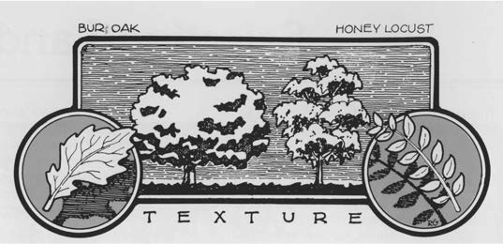
The size of a plant’s leaves, twigs, and branches determines its texture. Fine-textured plants have small leaves and twigs, coarse-textured ones have large, and medium-textured ones are in between. Blending plants of all three textures will create interest and variety. Often, the size of a landscape space will determine what texture is appropriate; for example, a small space will seem larger with fine-textured plants rather than coarse-textured plants.
The dominance of one color provides harmony in a home landscape and throughout an entire neighborhood. For most people, green foliage creates a restful landscape. Foliage of other colors, such as burgundy, yellow, or variegated, should be used as accents or focal points. Pockets of the same colored annuals also add splashes of color and unity in the landscape. You may want to select plants with particular fruit, bark, and leaf colors to serve as accents as the seasons change. The UW-Extension publication Selecting Woody Landscape Plants for Fall Color: An Illustrated Guide provides an extensive list of commercially available woody plants that offer spectacular fall color.
You may want to consider using some native plants in your design. Plants native to Wisconsin can be just as beautiful as non-native ones and are often better adapted to our growing conditions. There are many stunning native plants that do well in formal and informal landscapes. Don’t be afraid to combine native plants with non-native ornamental plants.
Trees
Trees—both deciduous and evergreen—put a house and its surrounding into proper scale. They should be planted where they will enhance the overall appearance of your home’s setting and provide shade in summer and wind protection in winter. Large canopy trees, such as oaks and maples, can provide a “ceiling,” making your outdoor space feel more like an outdoor room. Frequently, trees are used to frame a good view or to screen a poor one.
A variety of small to medium trees may be used as accent plants. You can base your choice on a combination of visual characteristics, including foliage and flower color, fruit, bark, fragrance, and texture. Berries and bark can also add winter interest to your landscape and provide a food source for wildlife. Fruit trees may be used as accent plants, but they can be messy and require regular management for insect and disease control.
Consider planting several types of trees to minimize the risks of insects and diseases. But don’t overdo it; too many types of trees may deprive your landscape of unity. Finding a good balance would be planting multiples of several different tree species, depending on their expected mature size.
Or, for a more natural, forest-like landscape, vary tree spacing from 5 to 50 feet. Irregular tree placement creates an informal setting. To obtain the best shade patterns and to avoid foundation, siding, and roof damage, plant trees 15–25 feet from the house.
In urban areas, check with municipal officials before planting trees in the space between streets and sidewalks.
Shrubs
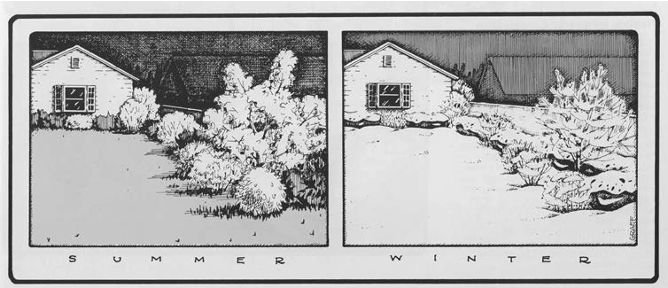
Deciduous and evergreen shrubs are an important part of most home landscapes. Planted in groups, they create screens and barriers and serve as foundation plantings or understory plants beneath trees. Although most shrubs work best in groups, they may also be used as accents; for example, accent shrubs can help lead visitors to your entrance.
Masses of shrubs effectively delineate different use areas in the yard, much as walls delineate the rooms of a house. A heavy planting of shrubs at house corners softens the transition between vertical walls and horizontal ground lines.
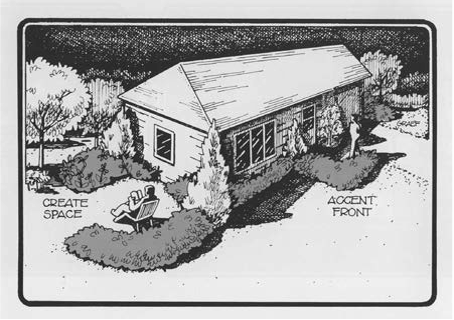
Foundation plantings should enhance your overall landscape design, and not just be a row of plants surrounding the house. Unless specifically needed to screen windows, select foundation plants that at mature size will not block windows or doors, spill over the edge of planting beds, shade out grass, interfere with mowing, or block pathways. Again, use a variety of plant types to achieve this.
Understory plants can be small to medium, shade-tolerant trees or shrubs that, at mature height, do not interfere with the branches of the taller trees above them.
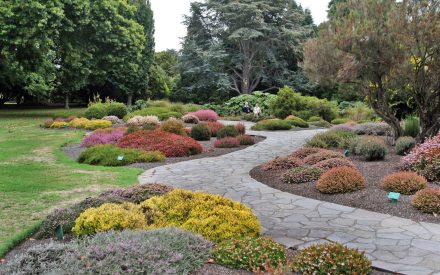
You can create seasonal variety with combination plantings of evergreen and deciduous shrubs. Remember that landscapes have a more attractive appearance when green-foliage plants dominate and shrubs with colorful flowers, interesting fruit, bark, and leaf color are incorporated as accents or focal points. Unify your landscape by planting the same type of accent plant in several different locations.
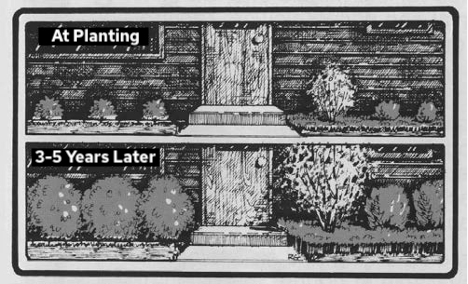
Avoid planting shrubs too close together—size at maturity should determine spacing. Don’t give in to the desire to achieve the mass effect of a group planting too rapidly. A mature landscape cannot be created in one growing season. It will require at least three years—and perhaps five—before a group planting achieves its intended effect. Space shrubs according to their mature size and spread, so that once they mature, they will just barely touch. Place shrubs slightly more than one-half their ultimate spread away from the foundation, so they can attain their natural forms.
Ground covers, vines, flowers, and grasses
Ground covers, vines, flowers, and ornamental grasses complement most home landscape designs.
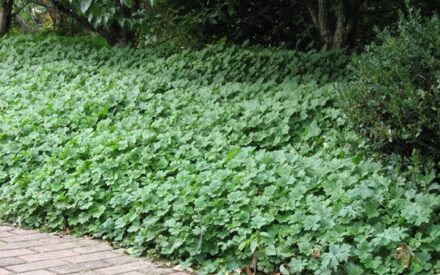
Ground covers help unify tree and shrub plantings and provide a contrast between lawn and planting beds. Mass plantings of perennial ground covers can reduce landscape maintenance. Plants planted in odd number groupings and in a staggered or irregular pattern tend to be more aesthetically appealing. For example, a grouping of three or five clumps of daylilies planted in a triangular pattern will look better than a group of four planted in a box pattern.
Vines soften the texture of brick and stone and shade house walls. They will cover chain link fences and help provide screening where space for trees and shrubs is limited.
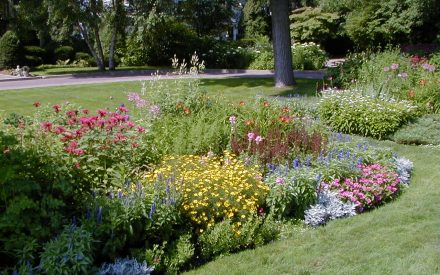
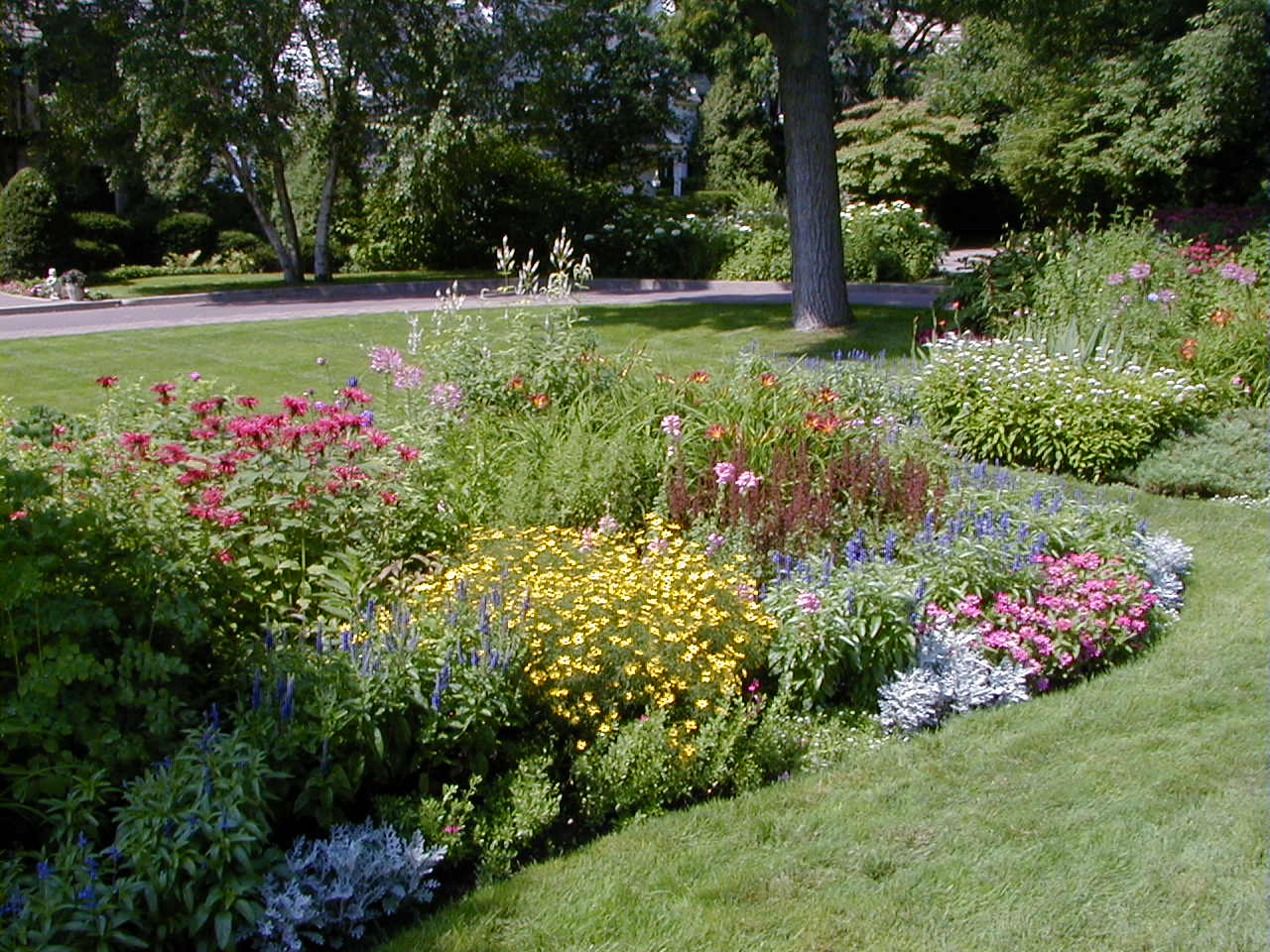
Flowers add color to your yard. They can be planted in beds and borders, in front of shrub masses, and to fill in open areas while shrubs are growing. Flowers look best against a simple background, such as taller green foliage, ornamental grasses, or a fence or shrub planting, so they’re not recommended for the middle of a lawn. Both perennial and annual flowers can require relatively high maintenance.
Ornamental grasses are commonly used in landscapes to provide structure, screening, or a background for other plants. They require little maintenance and add winter interest to the landscape. Planted with flowers, shrubs, and trees, they complement many garden situations.
Lawns
Lawns can serve an extremely important role in your outdoor space and can be high-maintenance. A central open lawn area can be a gathering space for entertaining, an area for various recreational activities, or a travel route through the yard. Well-shaped lawns create interest and eye movement in the landscape. A lawn adds unity to a landscape design by linking together the various rooms of a landscape. Lawn areas should be functional and designed for ease of maintenance.
Avoid small pockets of lawn that serve little function but require regular mowing or string trimming. The mower should be able to easily maneuver through the area and around garden beds. Be sure to allow enough space for mower access.
Energy conservation
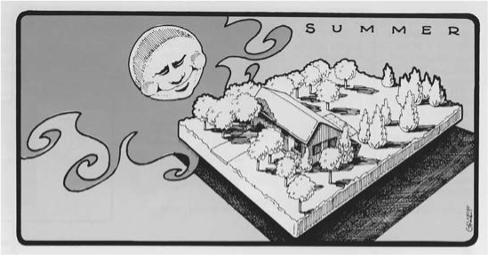
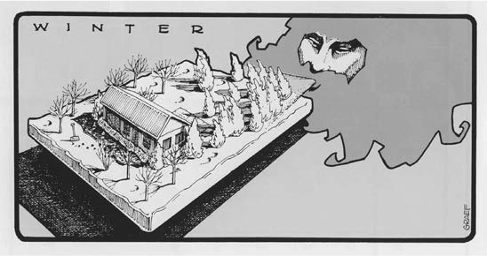
Proper plant selection and placement can reduce home energy consumption. Deciduous trees planted 15–25 feet away from the house on the east, south, and west sides shade the roof and walls in summer, reducing surface temperatures. After the trees have dropped their leaves in fall, winter sunlight can reach the house to provide passive solar heating.
Windbreaks, mainly evergreen plantings, located 4–6 times their ultimate height away from the house on the north and west sides can reduce winds and winter fuel consumption. Foundation plantings also reduce winter heat loss. Vines can shade and cool house walls during summer. Maximum energy savings will not occur until your plants reach maturity.
← Previous: Landscape Design Principles
Authors: Dan Wilson, Professors Emeritus, University of Wisconsin-Extension, Thomas Wilson, Professors Emeritus, University of Wisconsin-Extension, and Wayne Tlusty, Professor Emeritus, University of Wisconsin-Madison. Illustrations by Renee Graef.
Reviewed by: Christine Wen, UW-Extension Walworth County Horticulture Educator
Last revised: 5/10/2010
Item number: G1923
References and Additional Resources
Plant Selection
- A Guide to Selecting Landscape Plants for Wisconsin (A2865)
- Choosing the Right Landscape Plants: Factors to Consider (A3864)
- Container Gardening (A3382)
- Landscape Plants That Attract Birds (G1609)
- Lawn Establishment and Renovation (A3434)
- Lilacs for Cold Climates (A3825)
- Prairie Primer (G2736)
- Selecting Woody Landscape Plants for Fall Color: An Illustrated Guide (A3837)
Plant Care
- Caring for Deciduous Shrubs (A1771)
- Caring for Your Established Shade Trees (A1817)
- Do-It-Yourself Alternative Lawn Care (A3964)
- Growing Grass in Shade (A3700)
- Lawn Weed Prevention and Control (A1990)
- Mulches for Home Gardens and Plantings (A3383)
- Organic and Reduced-Risk Lawn Care (A3958)
- Organic Soil Conditioners (A2305)
- Sampling Garden Soils and Turf Areas for Testing (A2166)
- Selecting, Planting, and Caring for Your Shade Trees (A3067)
- Tree and Shrub Fertilization (A2308)
- Watering Your Lawn (A3950)
Yard Care and the Environment series
- Lawn and Garden Fertilizers (GWQ002)
- Lawn and Garden Pesticides (GWQ011)
- Lawn Watering (GWQ012)
- Lawn Weed Control (GWQ013)
- Managing Leaves and Yard Trimmings (GWQ022)
- Rethinking Yard Care (GWQ009)
- Shoreline Plants and Landscaping (GWQ014)
Other Publications
- Landscaping for Wildlife, available from the Minnesota Department of Natural Resources.
- Livable Landscape Design (141IB-211), available from Cornell University.