Overview of Rosemary
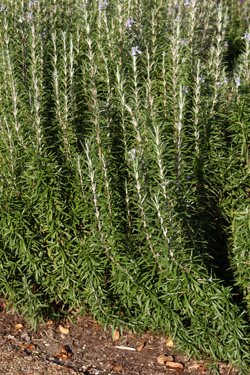
Rosemary (recently reclassified as Salvia rosmarinus, formerly – and sometimes still – listed as Rosemarinus officinalis) is an aromatic, tender perennial evergreen shrub in the mint family (Lamiaceae) native to the hills along the Mediterranean, Portugal, and northwestern Spain.

In its native habitat, rosemary grows to a tall shrub 4 to 6 feet high. The plant was also brought to Britain with the Roman armies. The name rosmarinus comes from the Latin ros maris or “dew of the sea,” from the dew-like appearance sea spray creates on plants growing close to the water.
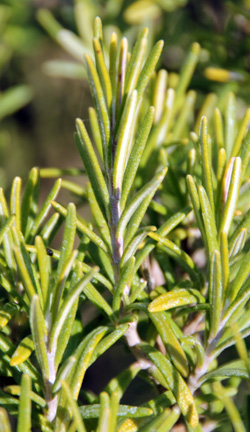
Even in ancient times, rosemary was associated with remembrance, memory, and fidelity. In Roman times, students wore springs of rosemary in hopes of improving their memory. In Shakespeare’s play Hamlet, Ophelia says “There’s rosemary, that’s for remembrance, pray you, love, remember.”
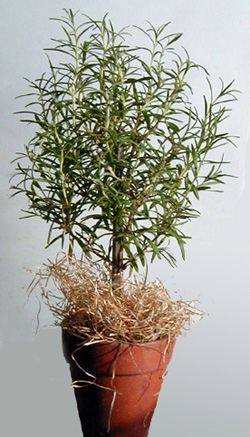
The plant has a grayish-green appearance. The thick, leathery leaves resemble needles, with a dark green upper surface and powdery white, hairy underside. The small, pale blue, pink, or white flowers grow in clusters of two or three along branches.
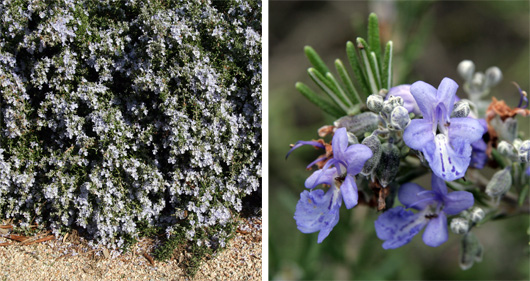
To harvest, pick small amounts as needed, but do not remove more than 20% of the growth at a time. Avoid cutting into woody parts of stems unless shaping the plant, as this can hinders development of the plant.
For drying, cut sprigs or branches before the plant flowers. Hang bundles upside down in an airy place. When dry, you can leave the sprigs whole or strip the leaves from the stem, and store in an airtight container.
Landscape Use of Rosemary
Because it is winter hardy only to zone 8a, rosemary is generally only grown as a potted plant in Wisconsin. Plants grow best in full sun in well-drained soil. Keep the soil moist, but good drainage is a requirement. Fertilize lightly, as excess fertilizer reduces flowering and fragrance. Good air circulation is important to prevent foliar disease. Potted plants can be moved outside to a sunny location during the summer, but should be brought inside before first frost.
There are two options on how to maintain rosemary outside in the summer. One option is to keep the plant in a pot and plant it, pot and all, in the garden with the pot rim below the soil line. This prevents damaging the roots when the plant is brought indoors. Another option is to transplant outside directly in the soil and dig plants 2 to 3 weeks before the expected first fall frost, repotting, and bringing inside.
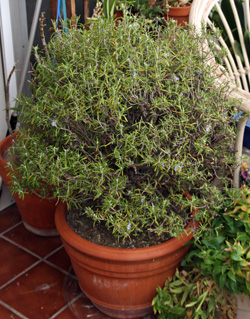
Rosemary can be grown as a topiary. Plants can be shaped or growth controlled by frequent tip pinching when plants are small. Older plants can be pruned lightly to desired size. Allowing a plant to become slightly pot-bound encourages flowering.
Rosemary generally has few pest problems, although it can be attacked by aphids, spider mites, mealybugs or scales. Root rot and botrytis are the most common disease problems. The biggest cause of plant decline and death is overwatering.
Propagating Rosemary
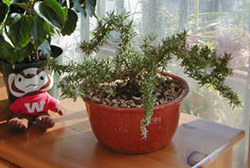
Rosemary can be started from seed, but seed propagation is not recommended because germination is very irregular and slow (even at an ideal 60 °F for 14 to 21 days) and it takes up to three years to produce plants large enough to provide a good harvest. In addition, plants grown from seed will not have the same characteristics as vegetative cultivars.
Cuttings taken from established plants is the best means of propagation. Take 4 to 6 inch tip cuttings from a flower-free shoot in late spring to early summer. Remove the lower leaves, then place the cuttings in a rooting medium such as perlite until roots have formed. Treating cuttings with rooting hormone before placing them in rooting medium can help improve rooting speed. Once the root system is established, transplant to pots or transplant outside in a sunny location.
Cultivars of Rosemary
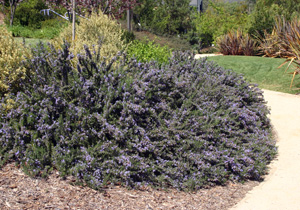
There are many different cultivars of rosemary, including both prostrate and upright forms. Flower color can be blue, pink and white. Certain cultivars are more hardy than others (but none can survive Wisconsin winters). Some of the more commonly offered varieties include:
- ‘Albus’ (sometimes listed as ‘Albiflorus’) has white flowers and upright, dense growth..
- ‘Arp’ has an upright growth habit and can reach 3 to 4 feet tall, with light blue flowers. Foliage is more grey in color than other cultivars, and it is hardy to zone 7a (potentially to zone 6a with protection). It was discovered in Arp, Texas in 1972 by professional herb grower Madeline Hill.
- ‘Barbeque’ (sometimes listed as ‘BBQ’) has an upright habit and sturdy, straight stems with good fragrance and flavor. Reaches 4 to 6 feet tall and 2 to 3 feet wide. Stems are sturdy enough to use as skewers when grilling.
- ‘Foxtail’ as dense, plumed, arching branches and grows 4 to 6 feet tall and wide. Its arching habit makes it especially attractive in containers.
- ‘Huntington Carpet’ has a low growing, training habit with small, dark green leaves and light blue flowers. Grows 6 to 12 inches tall and 4 to 6 feet wide and can be used as a groundcover in mild climates, and it is attractive in containers and hanging baskets. This variety was introduced by the Huntington Botanical Garden in San Marino, California.
- ‘Lockwood de Forest’ (sometimes listed as ‘Santa Barbara’) has a prostrate habit, light blue flowers, and pale green leaves. This variety was discovered in the garden of Lockwood and Elizabeth de Forest in Santa Barbara. Plants grow 1 to 2 feet tall and 3 to 6 feet wide.
- ‘Madeline Hill’ (also listed as ‘Hill Hardy’) has a rounded, somewhat compact habit, with light green leaves. It has improved hardiness, and can survive in zone 7a (or 6a in protected sites). Grows 3 feet tall and 1½ to 2 feet wide.
- ‘Majorca Pink’ has upright growth, pinkish purple flowers, and grows 2 to 3 feet tall and 1 to 2 feet wide. Leaves are dull green and curled upward.
- ‘Prostratus’ (sometimes listed as Prostrata Group or creeping rosemary) has a prostrate habit, dark blue flowers and a long bloom period. Plants grow 6 to 12 inches tall and 24 to 36 inches wide.
- ‘Rosy’ is a seed propagated variety selected for more reliable and rapid germination. It has rosy pink flowers and grows 2 feet tall.
- ‘Spice Island’ has thick leaves, blue flowers, and an upright growth habit. Highly aromatic, and a good culinary variety. Grows 2 to 3 feet tall and 1.5 feet wide.
- ‘Tuscan Blue’ has a vigorous, narrow, upright habit with deep blue-violet flowers and wide leaves. Can grow up to 6 feet tall and 5 feet wide.
Rosemary, both fresh and dried, has numerous cosmetic, decorative, medicinal, and culinary uses, besides its ornamental appeal. The aromatic oil is added to soaps, creams, lotions, perfumes, and toilet waters. The leaves can be used in sachets and potpourris, as well as in herbal baths, facial steams, hair rinses, and dyes. Rosemary is used as an astringent and cleanser in bath and beauty products.
As a culinary herb, rosemary is used to flavor poultry, fish, lamb, beef, tomatoes, mushrooms, cheese, eggs, potatoes, vinegars, and herbal butters. Both the flowers and leaves of rosemary can be used in cooking and for garnishes.
Author: Susan Mahr, University of Wisconsin—Madison
Reviewers: Allen R. Pyle, Horticulture Outreach Specialist, Bruce Spangenberg, Horticulture Outreach Specialist, UW—Madison Extension
Revised: June 2026