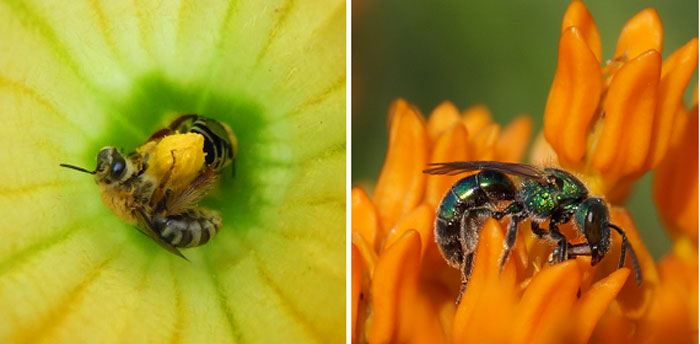
Why are pollinators important?
Approximately three quarters of the world’s major food crops require or benefit from animal pollination. This includes many fruit and vegetable crops, including strawberry, blueberry, raspberry, currant, plum, apple, cherry, pear, watermelon, cantaloupe, cucumber, squash, and pepper. Pollinators are also beneficial for seed production in crops such as carrot, onion, broccoli, cauliflower, cabbage, and many herbs.
What pollinators are common in Wisconsin?
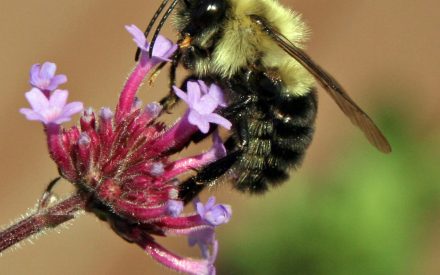
Pollinators in Wisconsin are primarily insects such as bees, flies, wasps, butterflies, moths, beetles, and ants, as well as hummingbirds. Bees are the most important pollinators for many plant species, and they feed almost exclusively on pollen and nectar. The non-native honeybee (Apis mellifera) is the most commonly used managed bee for pollination of crops. This bee is easily reared and transported, and a single colony can attain a size of 50,000 or more individuals.
The blue orchard bee (Osmia lignaria), also referred to as the mason orchard bee, is a native managed pollinator for orchards. Just 250 of these bees (as opposed to 20,000 honeybees) can pollinate an acre of apple trees. Wild native bees also contribute substantially to fruit and vegetable pollination. Home gardeners can have all of their pollination needs supplied by wild native bees, although if honeybee hives are located nearby, honeybees may also contribute to pollination.
How many types of bees occur in Wisconsin?
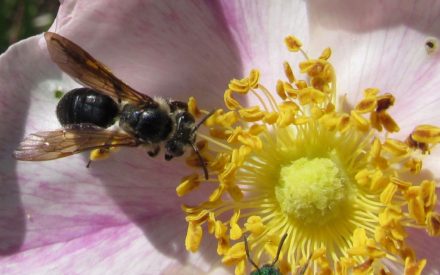
While most people associate the word “bee” with the honeybee or bumblebee, actually there are approximately 400 known species of bees in Wisconsin, and likely more that have not yet been identified. These include various species of miner bees, mason bees, leafcutter bees, and sweat bees among many others. While honeybees and most bumblebees live in large social groups with one queen, a worker caste of non-reproductive females, and (at various times in their life cycles) males, the vast majority of bee species are solitary. Each solitary bee makes her own nest, and provides for her offspring by herself. While social bees will readily sting to protect their nest, solitary bees rarely sting unless provoked.
How do I attract and support native pollinators?
Recent declines in honeybee populations have gained attention, but there also have been notable declines in some native bees, including many species of bumblebees. Local populations of all types of pollinators can be supported by cultivating flowering plants, providing nesting sites, and eliminating the use of pesticides.
Cultivating flowering plants
Provide food and nesting habitat for bees by landscaping with flowering plants. Portions of a lawn can be converted into pollinator habitats. Provide a diversity of plants that will bloom from early spring (when bees start to emerge) to late fall (when bees such as bumblebee queens are preparing to overwinter). Plants that are especially good for bees include pussy willow, plum, cherry, blueberry, New Jersey tea, American basswood, wild lupine, anise hyssop, purple prairie clover, pale purple coneflower, wild bergamot, Culver’s root, catmint, butterfly milkweed, woodland and prairie sunflower, prairie blazing star, great blue lobelia, showy and stiff goldenrod, and smooth blue aster. In addition, common garden herbs such as spearmint, oregano, sweet marjoram, basil, borage, lavender, and thyme are very attractive to pollinators.
Providing nesting sites for pollinators
Because bees transport food for their offspring to a central nesting site, having food and nesting sites near one another is critical. Most bees nest underground, digging their own tunnels. These bees prefer areas of bare ground with sandy or loamy soil. Bumblebees that nest underground use abandoned rodent nests rather than digging their own. Bumblebee species that nest above ground will make their homes in grass tussocks, piles of debris, or other cavities. Most of the remaining bee species nest in tunnels in twigs, plant stems, and in tree stumps and snags.
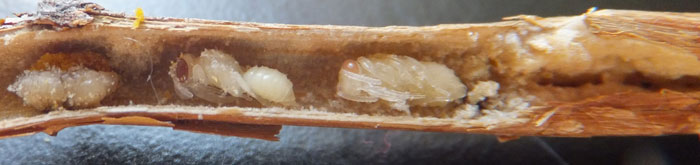
Provide natural nesting habitat for bees by leaving dead trees in place when possible. When pruning plants and shrubs, leave stems somewhere on your property, as many will have bee larvae in them. Do not mulch all areas of your yard; keep bare areas of ground for use by ground-nesting bees. Practice no-till methods in your vegetable garden (i.e., try not to dig or turn the soil) to allow bee larvae that are underground to develop into adult bees. You also can make or purchase artificial nests that will attract various species of bees such as mason bees, leafcutter bees, and yellow-faced bees.
Eliminating pesticides
Direct contact with insecticides or insecticide residues on plants can both be harmful, or even lethal, to bees and other pollinators. Most plants can easily tolerate some insect damage, and keep in mind that the insects that feed on plants are a source of food for birds and other wildlife.
When possible, use non-chemical alternatives for insect control such as row covers or physically removing insect pests from plants and placing them into a bucket of soapy water. When insecticides are necessary, apply when plants are not flowering and/or in the evening when temperatures are cooler and fewer pollinators are foraging. Also consider using insecticides that are less toxic to bees and other pollinators, such as those containing bacteria as active ingredients, insecticidal soap, horticultural oil, and narrow spectrum chemical insecticides.
Other types of pesticides, including herbicides and fungicides, can also have negative impacts on pollinators, so limiting their use is also helpful when protecting pollinators
Author: Christy Stewart, UW Horticulture and USDA-ARS
Revised: 7/2026 by Allen Pyle, Horticulture Outreach Specialist, UW—Madison Extension
Former Item number: XHT1213