Overview
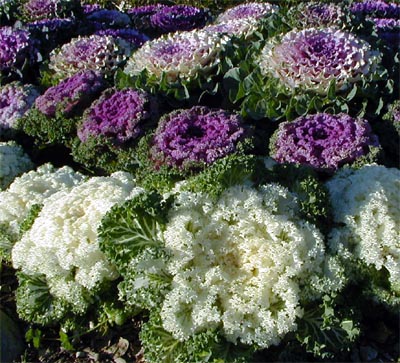
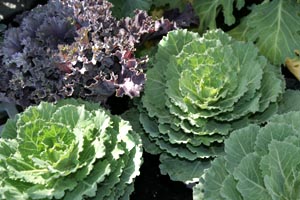
In the fall, chrysanthemums and pansies are the predominant plants offered for seasonal color. But another group of cold-tolerant plants can brighten the fall garden when almost everything else is looking tired and ready for winter. Ornamental cabbage and kale are the same species as edible cabbages, broccoli, and cauliflower (Brassica oleracea), but they have much fancier and more colorful foliage than their cousins from the vegetable garden.
While these plants are sometimes offered as “flowering” cabbage and kale, they are grown for their large rosettes of colorful leaves, not their flowers. These plants are very showy and come in a variety of colors, ranging from white to pinks, purples, and reds. Even though they are technically all kales (kale does not produce a head; instead, it produces leaves in a tight rosette), by convention those types with deeply-cut, frilly leaves are called ornamental kale, while those with broad, flat leaves often edged in a contrasting color are called ornamental cabbage. The plants usually grow about a foot wide and 15 inches tall.
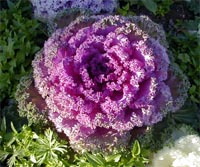
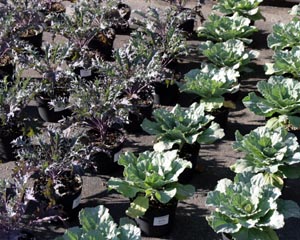
Ornamental cabbages and kales do not tolerate summer heat and plants set out in spring will likely have bolted or declined in appearance, so it is necessary to either start from seed in mid-summer or purchase transplants for a good fall show. Seed germinates at 70 to 75 °F, but seedlings prefer relatively cool conditions (60 to 65 °F or a bit cooler) to thrive, so this is a project best suited for a greenhouse where the temperature can be controlled. Sow seed indoors about 12 weeks before the first fall frost.
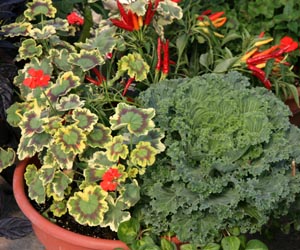
Until it gets cool, the plants won’t have much color. The white, pink, or red pigments really begin to show with frost and cold weather, getting great, vivid colors below 50 °F. They really are cool-weather plants, and once acclimated they can survive temperatures as low as 5 °F, so plants often last well into November and December.
When purchasing ornamental cabbage or kale, look for large, compact plants that are nearly or fully colored. The plants will generally not get much bigger after planting in the garden, particularly if the roots are pot bound, so try to buy the size you want (even though the biggest plants will cost more).
Landscape Use of Ornamental Cabbage and Kale
Wait until temperatures start cooling down, then plant in a sunny location in a moderately moist, fertile soil. Bury the stem so the lowest leaves are flush with the soil surface. Keep the plants well watered. Ornamental cabbage and kale are great for replacing fading summer annuals for a long-lasting fall color. Try to position them where you will see the colorful centers. Use them in mass plantings, in mixed or single container plantings and as edgings. They look beautiful in the front of a border, especially when combined with perennials that are at their peak in the fall, such as little bluestem grass (Schizacrium scoparium), tall, dark-leaved sedums, and fall blooming asters.
For an easy and attractive container planting, place an ornamental cabbage or kale in the center and pansies around the edge. Or try them with other plants that can tolerate light frosts, such as Swiss chard, snapdragons, or petunias.
Cabbageworms, cutworms, aphids, and slugs may damage these plants, but because of the late season, the plants will likely have few pest problems compared to spring planted vegetable crops.
Both ornamental cabbage and kale are edible, although they tend to be more bitter than the edible cultivars (and the pretty colors turn an unappetizing gray when cooked). Ornamental kale leaves are often used as a garnish on plates in place of parsley.
Cultivars of Ornamental Cabbage and Kale
There are many cultivars available. Some common round leaf (cabbage) varieties include:
- ‘Color Up’ series grows 10 inches tall and 12 inches wide. Plants color up early. Available in Pink, Purple, White, and a Mix of these colors.
- Coral™ series features feathered leaves (not as frilled as ornamental kale varieties) and grows 8 to 12 inches tall. Available in ‘Prince’ (white centers) and ‘Queen’ (red centers).
- ‘Crane’ series is a F1 hybrid seed series that grows 2 to 3 feet tall, with dense, vividly colored, rounded leaves. Available in Bicolor, Pink, Red, Rose, White, and a Mix of these colors. Can also be used as a cut flower.
- ‘Crane Ruffle’ series is a more vigorous, deeply ruffled leaves. Available in Bicolor, Red, Mix, and White.
- ‘Dream’ series is a tall series with overlapping, compact, round leaves and strong center color. Good for use as a bedding plant or cut flower. Available in either Red or White.
- ‘Osaka iQ’ series is an improved, more compact and vigorous, early coloring ‘Osaka’ that is late to bolt. Available in Pink Bicolor (light pink and white centers), Red (purple leaves with red center), White, and a Mix of these colors.
- ‘Pigeon’ series is a F1 hybrid seed series with compact habit and round, slightly wavy leaves. Available in Purple, Red, Victoria (pale pink centers), and White.
- ‘Tokyo’ Series has nearly perfectly rounded cabbage type with smooth, blue-green outer leaves and soft pink, red, or white centers.
Some common ornamental fringed leaf (“kale”) varieties include:
- Crystal™ series has shiny, non-waxy leaves and a compact habit, growing 6 to 10 inches tall. Available in Deep Red (with bronzy outer leaves), Pink, Red, and Snow (white centers).
- ‘Glamour Red’ is a F1 hybrid seed variety and the first cultivar to have shiny, wax-free foliage for improved color. It grows 10 to 12 inches tall and wide and was a 2011 All-America Selections winner.
- Kamome™ series is a F1 hybrid series with fringed leaves that grows 8 to 12 inches tall and 12 to 14 inches wide. Available in Pink, Red, White, Bright Red, and Bright White.
- ‘Nagoya’ series has round leaves with heavily frilled edges and a tight rosette that colors up early. Available in Red, Rose, White, and a Mix of these colors. Sometimes listed as ‘Emperor’ series.
- Peacock™ series has deeply serrated, feathery red or white leaves.
- ‘Yokahama’ series has a compact, mounded habit (5 to 7 inches tall and 8 inches wide), extra curly leaf edges, and improved cold tolerance. Available in Red, White, and a Mix of both colors.
Author: Susan Mahr, University of Wisconsin—Madison
Reviewers: Allen R. Pyle, Horticulture Outreach Specialist, Bruce Spangenberg, Horticulture Outreach Specialist, UW—Madison Extension
Revised: August 2026