Authors: PJ Liesch and Phil Pellitteri (retired) UW-Entomology
Revised: 1/28/2026
Item number: XHT1154
Magnolia scale is the commonest insect problem on magnolias in Wisconsin. Popular magnolia species such as star magnolia (Magnolia stellata) and saucer magnolia (Magnolia x soulangiana) are very susceptible to this insect. The ability of magnolia scale to move is limited, so infestations of this insect can be very spotty over space and time (e.g., a backyard magnolia could have a heavy infestation, while a magnolia in the front yard is unaffected).
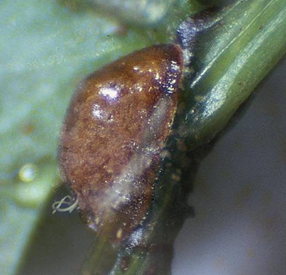
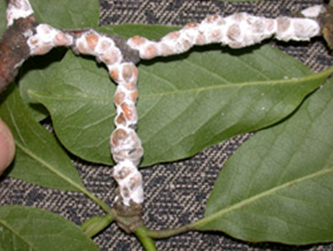
Appearance: Adult magnolia scale females are orangish-brown, elliptical and convex in shape, and up to 1/2 inch in diameter. They lack readily-visible legs, antennae, and mouthparts and can often be mistaken for plant buds or a fungus on the twigs. When alive, females are soft-bodied and leave a reddish stain when crushed. Immature magnolia scales are called nymphs and the youngest and smallest nymphs are referred to as “crawlers”, due to their ability to crawl and move around. Crawlers are yellow to reddish-brown in color and have an elliptical shape, but tend to be more flattened than adults. As nymphs mature, they secrete a white mealy wax on the outside of their bodies. This wax tends to disappear by late August. Nymphs and adults settle in place and do not move.
Symptoms and Effects: Magnolia scale possess needle-like mouthparts, which they use to suck fluids from plants. Excess, undigested sugars are excreted as a drippy, sticky substance known as honeydew. Honeydew provides an excellent growth medium for sooty mold fungi, and these fungi can give affected leaves and branches a black, sooty appearance. In addition, honeydew and sooty mold can stain lawn furniture and other items in the vicinity of an infested tree, and sugars in honeydew can attract wasps, ants, and other nuisance insects. Magnolia scale can slow plant growth and, on trees and shrubs that are heavily infested, substantial weakening of branches, branch dieback, and eventual plant death can occur.
Life Cycle: Magnolia scale has one generation per year and overwinters as nymphs on one and two year old branches. Nymphs mature in early June, when adult females begin to lay eggs that hatch in late August (from 1925 growing degree days onwards). The mobile crawler stage is typically active in late August or early September in Wisconsin. Each adult female can lay hundreds of eggs, which can cause dramatic changes in scale populations from one year to the next.
Management: Control of magnolia scale can be challenging. When severe infestations occur, it can be helpful to take a multi-pronged approach to manage magnolia scale. In addition, regular scouting can be helpful as catching and managing small infestations can be easier than large, established infestations.
Non-chemical management: The following non-chemical options can be considered on a case-by-case basis:
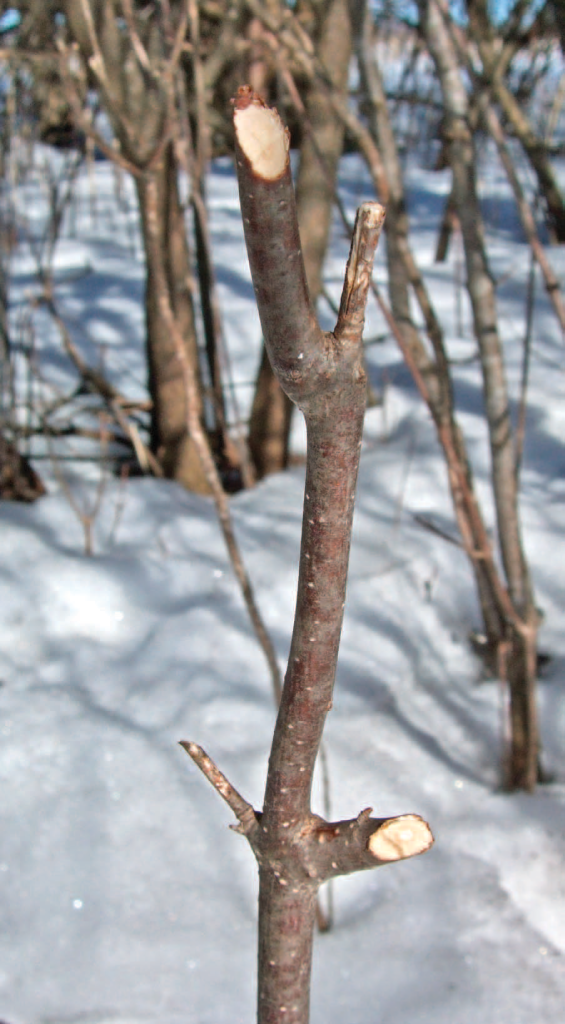
- Selective pruning of heavily-infested and/or dying limbs can be considered in some situations. Thoroughly inspect your magnolia(s) to assess the severity of the infestation. In some cases, infestations may be spread throughout a plant, but in other cases an infestation may be limited to specific branches or parts of branches.
- Physically scraping or squishing nymphs and young adults, before they produce eggs can be another approach. Avoid excessive pressure to prevent damaging the plant’s bark when doing this.
- Tolerance: Infestations of magnolia scale will often subside over the course of a few years due to the activity of natural enemies (parasitic and predatory insects and mites).
- Good plant-care practices, such as watering, proper pruning, etc. can help maintain plant health.
Chemical management: Older nymphs and magnolia scale adults are covered with a tough outer covering, which protects them from many pesticides. In contrast, the young, mobile crawlers lack substantial protection and are the easiest life stage to control. Proper timing of treatments to target the vulnerable crawler stage is critical. Apply spray treatments when crawlers become active in late August or early September and follow with a second treatment 10 to 14 days later. To more precisely monitor crawler activity, consider monitoring Growing Degree Days (eggs hatch around 1925 GDD) or consider wrapping tape (sticky side out) around branches to monitor for crawlers. Crawlers will appear as small, dark spots that have become caught on the tape. Once crawlers are active, they can be targeted in various ways:
- Organic and lower-risk spray options include insecticidal soap and horticultural oils (e.g., neem oil). These products have limited residual activity and work by direct contact, so spraying must be thorough to contact the crawlers. Pyrethrins are another organic option, but can also be hard on beneficial insects. With their very short residual activity, these spray options may need to be repeated multiple times in late August and early September to maximize effectiveness.
- Conventional spray options include malathion and various pyrethroid insecticides (e.g., bifenthrin, cyfluthrin, cypermethrin, cyhalothrin, permethrin, etc.). These products typically work for 1-2 weeks at a time, so a second application may be needed.
Systemic insecticides, such as those containing imidacloprid, are another option for managing magnolia scale. These products are typically drenched into the root zone in spring. It is best to apply these after the plant has bloomed to reduce risks to bees and other pollinators.
Dormant oils can also be used for control, but must be applied early in the season, before buds open. Dormant oil treatments work by contact to smother insects, so spraying must be thorough.
Be sure to read and follow all label instructions of the insecticide that you select to ensure that you use the insecticide in the safest and most effective manner possible.
When severe infestations occur, it may be helpful to consult a certified arborist. Arborists have additional products and application methods that are not available to the general public.