Overview
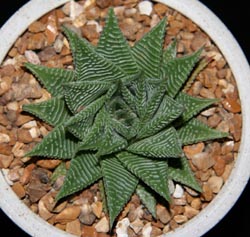
Haworthias are small and deservedly popular succulents native to southern Africa. They are generally easy-to-grow, small sized, more tolerant of modest lighting than many succulents, and come in many attractive variations. Though the small whitish flowers are less than spectacular, they are rewarding and are produced under diverse conditions. The real glory is in the succulent leaves, which, depending on species, are colored in greens, reds, or browns (to near black). Some have leaves that are thin and bristly, others thick and fat. Some are plain, others are marked with lines, bumps, stripes, or dots. Many readily produce offsets and therefore are easily passed along to friends or handed down from generation to generation.
What’s in a name – Haworthia
Many genera and species of plants are named after people; succulent plants are no exception. The genus name Haworthia commemorates Adrian Hardy Haworth, an accomplished British botanist and entomologist, who was born in 1768 and died in the London cholera epidemic of 1833. As an entomologist, Haworth is best known for his work on Lepidoptera (butterflies and moths). As a botanist, he is best known for his studies of succulent plants of diverse families (including New World cacti in his later years) and bulbs.
Haworth named many new plant genera and species, though some of his names have been changed over the years due to taxonomic refinement. Two of his genera that remain and are well known and beloved groups to cactophiles include Mammillaria and Epiphyllum. Haworth has had several plants named after him. In 1809, the new genus Haworthia was created by the Frenchman Henri Duval in honor of Haworth. Prior to the creation of the new genus, these plants were considered part of the genus Aloe.
The first written references to Haworthias date to the early 1600s when European colonists were discovering the botanical riches of southern Africa. Early explorers took Haworthias back to Europe and they have been in cultivation there for nearly 400 years.
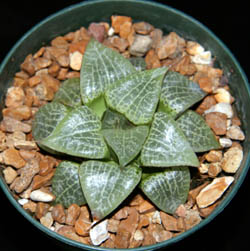
Haworthias are native primarily to South Africa, with a few species spilling over the borders of neighboring countries. At one time, aloe, Haworthia, and their relatives were considered part of the lily family (Liliaceae), but now they are placed in aloe family, Asphodelaceae. Two other related smaller genera are Gasteria, with red to orange flowers and about 15 species, and Astroloba, with about 10 species that have an elongated, columnar form.
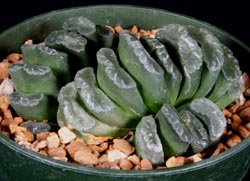
Besides their ease of cultivation, two other factors have made Haworthias a favorite group of both succulent growers and those interested in houseplants. The first of these factors is their great diversity in form, shape and color. While almost all are of a general rosette pattern (the fan-shaped H. truncata – photo at right – being the exception), there wide variation in the details.
It is generally recognized that there are about 60 named species and around 150 named varieties of Haworthia. Additionally, there are differences in nature from one population to another and even two plants growing side-by-side in the same population can have quite different coloration or markings. Nurserymen have selected particularly attractive forms and hybrids.
The other factor that results in their popularity is their small size. Individual single plants are usually in the range of 1 to 3 inches in diameter, and multiple plants will fit nicely in a 4 to 5 inch pot. This allows for a diverse collection in a small space, such as on a windowsill or under a set of plant lights.
Growing Haworthia
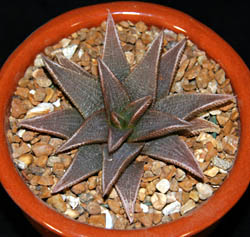
Haworthias are easy to grow and are generally forgiving of occasional lapses in care. Although some Haworthia species grow well in full, bright sun, many live in more protected spots and are adapted to thrive in partial shade (though few look their best without at least some direct sun or bright light). This makes Haworthias well adapted to lower light conditions found in homes.
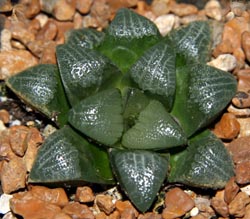
Haworthias grow well in an east or west facing window with a few hours of direct light daily, and bright indirect light through the remainder of the day. A south facing window may be acceptable, but can be too bright for some species unless the sun is filtered through light, sheer curtains. Haworthias do very well in sunrooms and greenhouses, though again many of them prefer locations out of continual direct sunlight, especially during the warmer part of the year. Haworthias also grow well under artificial plant lights.
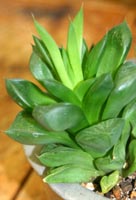
The darker and more intense coloration and the very compact growth which many growers find most attractive develop under brighter light conditions. In insufficient light, leaves will elongate and plants will lose the richness of their colors (see photo, right).
Haworthias make good accent plants on porch, patio, or deck and can be grown outdoors during frost-free periods. Be careful when moving plants outdoors. If they have spent the winter without much direct sunlight, don’t immediately put them into full sun outdoors or they may sunburn. Gradually acclimate plants to the more intense outdoor light over a period of a few weeks.
Some Haworthias can survive a light frost for a short period, but it is best not to take chances. They do best in the temperature range of 75 to 90 °F. They can tolerate temperatures into the low 40s °F, especially if they do not have continuously wet soil, and they will survive high temperatures into the low 100s °F, especially if they are somewhat shaded and provided with good air movement.
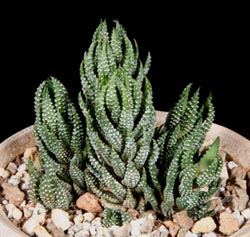
Like other succulent plants, Haworthia requires a well-drained potting medium. A good commercial potting medium can be mixed with equal amounts of drainage material, like perlite, aquarium gravel, poultry grit, or horticultural pumice. Do not use sand as it can be overly fine and clog soil pores. If using a peat-based mix, remember that peat breaks down and decomposes over time, resulting in an unhealthy soil. As some Haworthias are slow-growing and can stay in the same pot for years, there may be a tendency to forget to repot into fresh soil. Repotting is best done every 2 to 3 years.
If the soil mix is well drained, Haworthias can be watered weekly in the summer months. Water less frequently in the winter. Allow the medium to dry between waterings. Prolonged wet soil, especially when it is cool, under low light intensity, or when plants are not actively growing, can lead to root rot, a common problem with Haworthias. Symptoms of a weak or rotted root system include stoppage of growth, reduction in plant or leaf size, or leaf shriveling. Often though, root rot does not necessarily mean the plant will be lost. If the plant looks unhealthy, unpot it and inspect the roots. Remove any weak or decayed roots, even back to the stem of the plant. Allow the plant to lie out unpotted for a week, then repot into fresh soil and begin watering carefully until it is apparent that the roots have reestablished and the plant has regained its health.
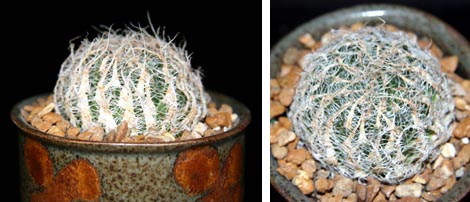
A healthy root system is the best method for removing excess soil moisture (through the transpiration process). When repotting, try to use a pot about the same volume as the root system. If the roots are diminished, or a larger pot is desired, water sparingly until the plants are reestablished.
It is difficult to generalize about the growing season of Haworthias. In nature, some come from winter rainfall areas and are winter growers, whereas others are from summer rainfall areas and are summer growers. For many species, the growing season is from late winter through spring, as day length increases.
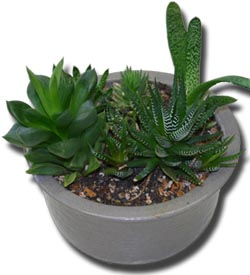
Haworthias can be grown in virtually any type of container, including plastic, ceramic, or terra cotta. Terra cotta pots are porous and dry out faster than ceramic or plastic pots. Shallow pots are generally better than deep pots, but some species have heavy, thick roots that require a deeper pot. Ensure that containers have drain holes and, when using saucers, empty any standing water promptly after watering.
Many Haworthias freely offset and eventually form clusters much larger than the individual plant. It is better to repot periodically as needed to provide additional space for the expanding plant rather than put a small plant in a large pot. Because they stay small and have interesting forms, Haworthias are frequently used in succulent dish gardens.
Haworthias are mostly pest free, but mealybugs can be a problem. They can be controlled by physical removal or with a houseplant insecticide. Always read, understand, and follow label directions when using pesticides. The most significant disease problems are root rots caused by poorly drained media or overwatering. Occasionally root rots can move into the plant stem, resulting in the death of the plant.
Propagating Haworthia
Vegetative propagation is the most common method of propagating Haworthias. Most Haworthia species cluster from the base, producing new young plants often referred to as offsets or “pups.” In many cases, as soon as the new young plants are formed by the parent plant, they develop roots. In some species, as soon as the new plant becomes well established, the original contact with the parent plant is broken; when the clump is unpotted, the individual plants fall away from each other. In other species, the attachment to the parent plant may remain; this can easily be broken or cut to separate the plants. If you create a subsoil wound during the separation process the plants should be allowed to air-heal for a few days before repotting to avoid the possibility of pathogenic organisms moving from the soil into the fresh wound.
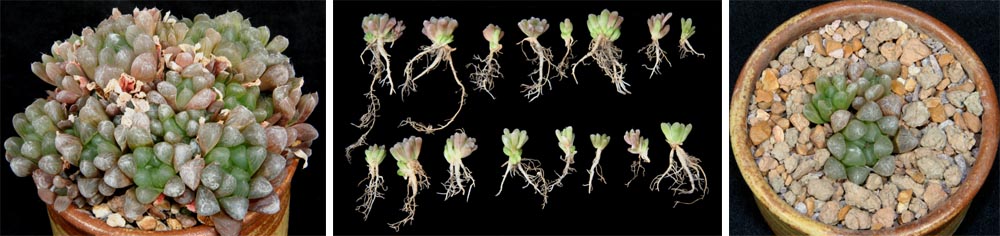
Another method of vegetative propagation is used for plants that never or only rarely offset. In such cases, individual mature leaves are carefully cut from the stem, along with a slight bit of attached stem tissue. Once the wound has dried, the leaf can be put into a well-drained potting medium and, in many cases, one or more new plants will slowly form from the severed leaf. This practice is primarily used by professional nurserymen to propagate rare or slow growing plants.
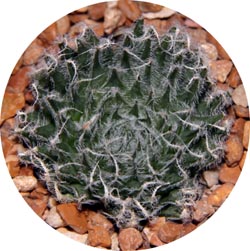
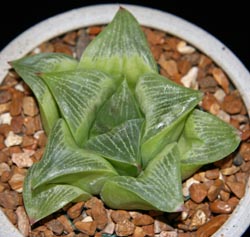
Haworthias can also be readily grown from seed, though seed is not commonly available except through specialist succulent dealers. Sow seed in a well-drained soil mix and keep moist until germination, usually within 1 to 2 weeks. Do not allow the medium to dry significantly while the young seedlings are getting established.
Author: Dan Mahr, University of Wisconsin-Madison
Reviewers: Allen R. Pyle, Horticulture Outreach Specialist, UW-Madison Extension, Bruce Spangenberg, Horticulture Outreach Specialist, UW-Madison Extension
Revised: October 2026
Thanks to Wolfgang Werk for the loan of plants for photographic purposes.