Authors: David Lowenstein, Russell Groves, and PJ Liesch UW-Madison Entomology
Revised: 1/28/2026
Item number: XHT1137
Flea beetles are early season pests commonly found on cole crops/crucifers (e.g., broccoli, Brussels sprouts, cabbage, cauliflower, horseradish, kale, kohlrabi, mustards, radish), as well as on other vegetables (e.g., spinach, beets, beans, potatoes, eggplant). There are several species of flea beetles that can cause problems and their common names typically reflect the host(s) on which they feed. For example, the crucifer flea beetle typically feeds on cole crops/crucifers, while the eggplant flea beetle typically feeds on eggplant. The table below lists some of the common flea beetles found in Wisconsin. While flea beetles are commonly discussed as vegetable pests, other flea beetle species (e.g., redheaded flea beetle) can be pests of landscape trees, shrubs, and flowers, fruit crops, and other plants.
| Common Name | Scientific Name | Description | Host Plant(s) |
|---|---|---|---|
| Crucifer flea beetle | Phyllotreta cruciferae | Greenish or bluish-black, 1/8 inch long | Cole/crucifer crops (cabbage, kale, horseradish, etc.) |
| Eggplant flea beetle | Epitris fuscula | Black, 1/16 inch long | Eggplant |
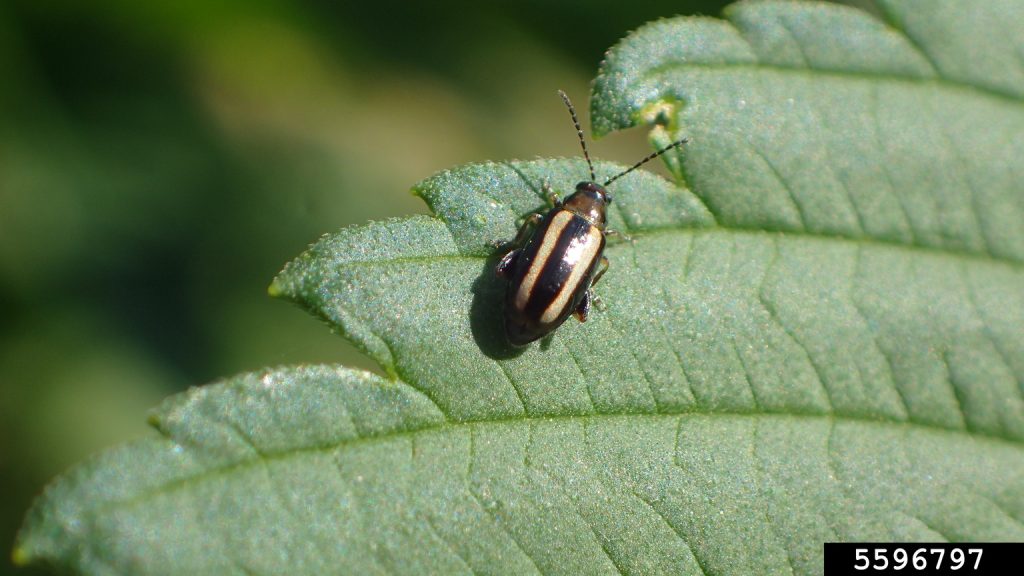
| Horseradish flea beetle | Epitris armoraciae | Black with yellow stripes, 1/8 inch long | Cole/crucifer crops (horseradish, etc.) |
| Palestriped flea beetle | Systena blanda | Dark brown with two broad white stripes down the back, between 1/8 and 1/4 inch long | Bean, beet, eggplant, lettuce, melon, pea, pepper, pumpkin, radish |
| Potato flea beetle | Epitrix cucumeris | Dull black, 1∕16 inch long | Solanaceous crops (potatoes, tomato, eggplant, peppers, etc.) |
| Spinach flea beetle | Disonycha xanthomelas | Greenish-black with a yellow thorax, between 1∕8 and 1/4 inch | Beets, spinach, Swiss chard |
| Striped flea beetle | Phyllotreta striolata | Black with two crooked yellow strips running down its back, 1∕12 inch | Cabbage |
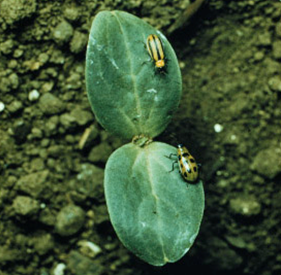
Appearance: Flea beetle adults are tiny (1/16 to 1/4 inch long) and are typically dark-colored. Some flea beetles have pale spots or stripes. Flea beetles have enlarged hind legs and readily jump when disturbed. Adults are particularly active on calm, warm, sunny days. Flea beetle larvae are small (1/16 – 3/16 inch long), pale (e.g., whitish, greyish, yellowish), have dark heads, and are worm-like in appearance. Larvae of most species live in the soil, but some species have larvae that live and feed on foliage (e.g., spinach flea beetle).
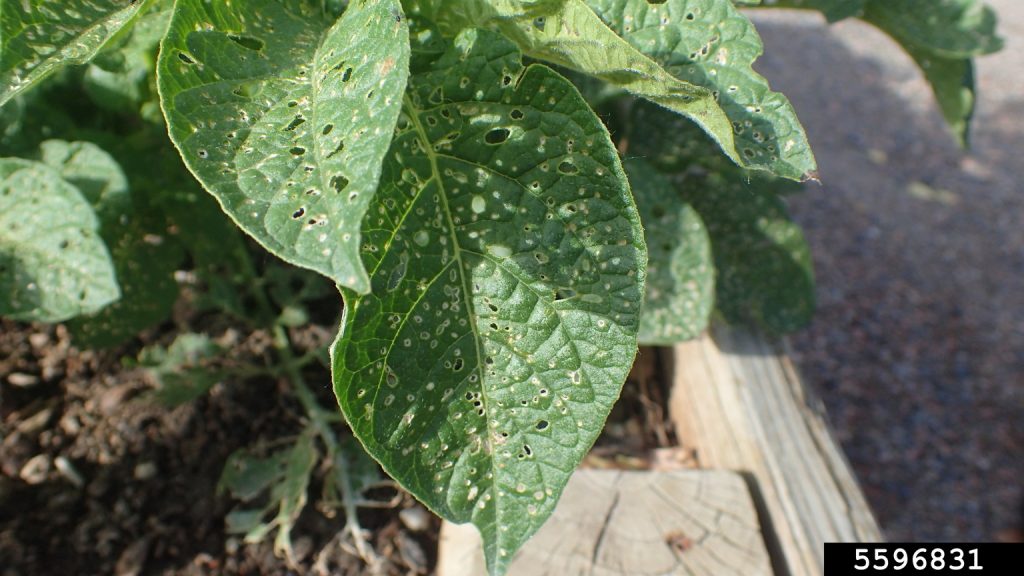
Symptoms and Effects: The most serious damage due to flea beetles is caused by adults feeding on leaves of young plants, typically on the undersides. Feeding appears as many tiny holes that may or may not penetrate the leaf. Often this damage is described as “shotholed” or looking as if the leaves had been peppered by a shotgun. Certain plant diseases can occasionally cause similar shotholes, so scouting is needed to confirm the cause. Recently emerged plants are most vulnerable to feeding damage and can even be killed by a heavy flea beetle infestation. Older plants are often able to withstand flea beetle damage. Crops grown for their foliage such as kale and spinach may be unmarketable if damage is extensive. Root feeding by flea beetle larvae typically causes minimal damage. For species that feed on foliage as larvae (e.g., spinach flea beetle), larvae feeding can result in additional small holes. Many flea beetles species can lead to additional damage by transmitting plant disease-causing organisms.
Life Cycle: Flea beetles overwinter as adults in the soil or under plant debris. They become active in early spring when temperatures reach 50°F and begin feeding on weeds or early-planted crops. Adults typically lay eggs in the soil at the base of host plants in May. Eggs hatch in seven to 14 days and larvae feed on various plant parts until fully grown. Larvae pupate in earthen cells for 11 to 13 days before emerging as adults. Depending upon the species, there may be one to three generations per year.
Scouting: Monitor flea beetle populations by visually scouting for adults and damage, and using yellow sticky traps. The number of beetles found on traps corresponds to the amount of feeding damage occurring nearby. Insect sweep nets can be used to monitor for flea beetles in some crops (e.g., potatoes). Scouting for damage should occur every one to two days in newly planted fields, because flea beetles can quickly become a problem for young plants.
Management:
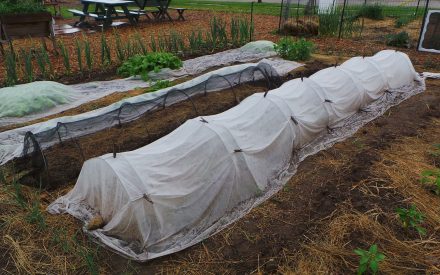
Non-chemical management: Because flea beetles overwinter near fields and gardens where vegetables are grown, planting after adult emergence or rotating to non-susceptible vegetables (or other crops) can help minimize flea beetle damage. When growing susceptible crops, floating row covers can prevent adults from feeding on leaves and laying eggs around plants. If you decide to use row covers, be sure to set them up just before the crop emerges or immediately after transplanting to prevent flea beetles from getting in. Water can help deter adult flea beetles, and watering at mid-day may reduce their feeding.
Flea beetles are often associated with nearby weedy plants, so good weed control can be a helpful component of an overall management strategy.
Products containing entomopathogenic (insect killing) nematodes have shown some success in reducing flea beetle numbers. These beneficial nematodes can be purchased through various vendors, but often have a limited shelf-life. A number of beneficial predators and parasites can also attack flea beetles.
Chemical Management: Chemical treatments are recommended when flea beetle populations exceed threshold levels (see the table below), particularly early in the season.
| Crop | Threshold |
|---|---|
| Beets | Treat when beetles cause stand reduction on small plants |
| Cole/Crucifer Crops (Broccoli, cabbage, etc.) | Undetermined |
| Eggplant | < 3 inches = 2 beetles/plant 3-6 inches = 4 beetles/plant > 6 inches = 8 beetles/plant |
| Horseradish | Treat only if beetles are found in high numbers early in the season |
| Potato | > 2 beetles/sweep |
| Tomato | > 2 beetles/plant |
In small-scale settings (e.g., home gardens), organic options such as insecticidal soap and horticultural oils (e.g., neem oil) can help control adults and larvae of foliar-feeding species. Spraying must be thorough—these products are short-lived and work by contact; they must be sprayed directly onto insects to maximize efficacy. Pyrethrins are another organic option, but can pose risks to pollinators and beneficial insects. The organic ingredient spinosad is another organic option for flea beetles. Common conventional ingredients for small scale settings include malathion and a number of pyrethroid ingredients (e.g., permethrin, zeta-cypermethrin, etc.). These conventional products will work for 1-2 weeks depending on the product.
For management of flea beetles on larger scales (e.g., commercial fields), see the University of Wisconsin-Madison Division of Extension bulletin A3422 (Commercial Vegetable Production in Wisconsin), for detailed insecticide recommendations. Foliar insecticides can provide quick control, but may also disrupt natural enemies of other pests of cole crops. Soil-applied, systemic insecticides will provide season-long control. Reduced-risk products should always be considered.