Overview
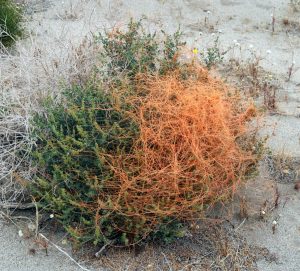
Dodder is a group of about 150 species of ectoparasitic plants in a single genus, Cuscuta, in the morning glory family (Convolvulaceae). They were formerly classed in the family Cuscutaceae. These pale green, yellow, bright orange, or red plants are found throughout tropical and temperate regions of the world. They have been given common names that allude to the string-like appearance of the plants, including angel hair, devil’s hair, devil’s ringlet, goldthread, hairweed, lady’s laces, strangleweed, witch’s hair, and many others.
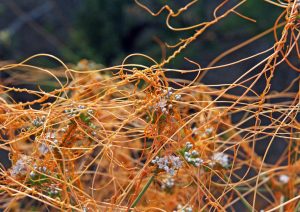
These plants have very thin, sting-like, twining stems that appear to be leafless. They actually do have leaves, but they are reduced to tiny scales that are barely visible. Most species have very low levels of chlorophyll, and are not green in color. Because of the lack of chlorophyll, most produce very little food on their own and therefore depend on their host plants for nutrition. The plants cover their host plants in a spreading, tangled mass of intertwined stems, especially where growing in full sun (twining and attachment is greatly reduced in shaded areas).
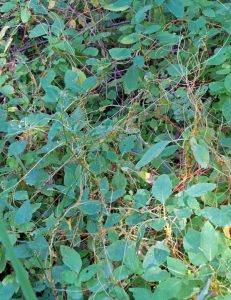
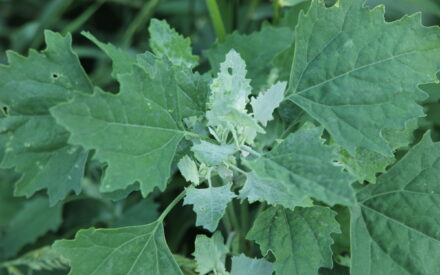
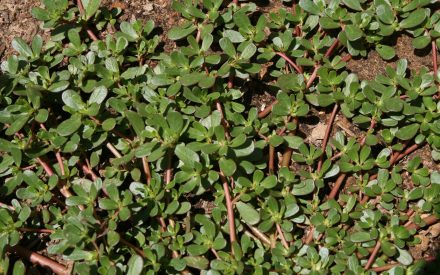
Dodder species are variable in the habitat they are found in naturally and the number of different host species they can infect, with some restricted to just a few host plant species and others able to infect a wide range of hosts. A wide variety of herbaceous and small woody plants can be parasitized by dodder, including many agricultural crops such as alfalfa, asparagus, carrots, cranberries, onions, and potatoes, as well as many ornamental plants, including chrysanthemum, dahlia, helenium, impatiens, periwinkle, petunia and trumpet vine, and many weed species including field bindweed (Convolvulus arvensis), lambsquarters (Chenopodium album), and pigweed (Amaranthus species).
Dodder can weaken or kill plants and reduce crops yields. The impact on the host plant varies considerably depending on the species of dodder, the growth stage and condition of the host plant, and the time of infection. Infected plants are also more susceptible to diseases and insect problems.
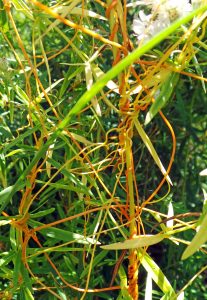
In temperate areas, dodder is an annual that grows from seeds each growing season. After germination at or near the soil surface, the seedlings grow quickly toward a host plant, possibly in response to volatiles released by preferred host plants, coiling around any object it encounters. If a suitable host plant is not reached within 5 to 10 days, the seedling will not survive.
Once a suitable host plant is reached, the seedling wraps itself around the plant and produces special structures, modified adventitious roots called haustoria, that are inserted into the host’s vascular system. Once the dodder is established on the host plant its original root in the soil dies. The dodder plant then continues to grow rapidly on that host plant, continually making new attachments to the host and eventually covering it – or spreading to adjacent plants – until the dodder plant is killed by frost. Since they re-establish from seedlings each year, species in temperate areas are only found in relatively low vegetation, whereas species in tropical areas, where plants can grow continuously, may reach high into the canopy of shrubs and trees.
Tiny 4 or 5-parted white, yellow or pink bell-shaped flowers are usually borne in clusters (occasionally singly) in late spring to early fall, depending on the species. These are followed by small rounded fruits or seed capsules the same color as the stems that contain 2 to 3 seeds. Dodder is a prolific seed producer, and a single plant can produce thousands of seeds. The small seeds have a hard, rough seed coat that enables them to survive in the soil up to 20 years or more, depending on the species and environmental conditions. Dodder seeds are spread primarily through the movement of soil and equipment by humans, in infested plant material, or as a crop seed contaminant. Seed of some species is spread in water.
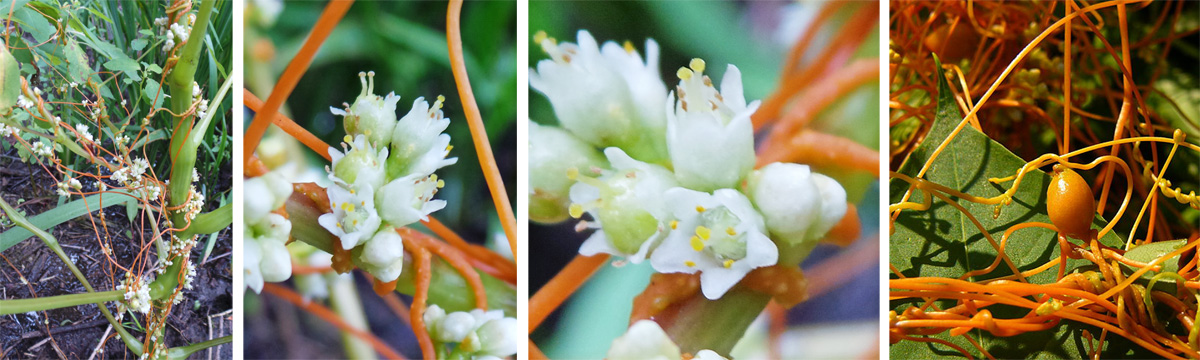
Control of Dodder
Dodder is not commonly found in gardens or ornamental landscapes, but if observed, remove it immediately, as it is difficult to control once established. Effective management requires a systematic approach combining several control methods over several years focused on reducing the current population, preventing seed production, and dealing with new seedlings in subsequent years. Pull any seedlings not yet attached to a host plant. Seedlings are generally difficult to find before they attach to hosts.
Once attached to a host plant, complete eradication from the host plant is usually not possible, as dodder can grow back from haustoria embedded in the plant. Pruning is of little benefit unless only one or two branches are affected and can be removed without destroying or disfiguring the entire plant. Unless the plant can be pruned significantly lower than the dodder, it is best to remove the entire host plant or kill both the dodder and host plant with a non-selective herbicide, such as glyphosate.
If the dodder plants have already set seed, burn them (if allowed locally) or dispose of them in the trash. In areas that have been infested previously, monitor the area closely for the presence of seedlings and pull and dispose of them as soon as they are seen. control any weeds that could serve as hosts for dodder. Soil can also be treated with a preemergent herbicide before seeds germinate in spring. Always read, understand, and follow label instructions when using herbicides or other pesticides.
If the area is planted annually, choose plants that are not susceptible to attack by dodder, such as ornamental grasses and other monocots, including lilies. In agricultural crops, dodder is managed by rotation to non-host crops, use of dodder-free seed, cleaning equipment between fields, control of weed hosts, and chemical control in infested areas.
Species of Dodder
There are several native species of dodder in Wisconsin, including common or swamp dodder, Cuscuta gronovii (= C. umbrosa), that is potentially invasive, but not all dodder species are pests that need to be controlled. There are several species of native dodders in Wisconsin that are Wisconsin Special Concern plants:
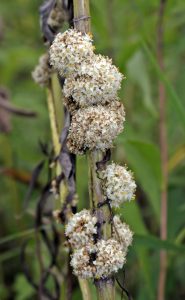
- Rope dodder (Cuscuta glomerata) is found in a variety of moist habitats and blooms from July through September. It can be distinguished from other Cuscuta by having the inflorescences densely bunched together giving the plant a thick, rope-like appearance. It is reported as having a preference for members of the Aster family, often on sunflower, Canada goldenrod, and spotted water hemlock or spotted cowbane (Cicuta maculata).
- Field or five-angled dodder (Cuscuta pentagona = C. arvensis) is found along fields and roadsides.
- Knotweed or smartweed dodder (Cuscuta polygonorum) is also found in moist habitats including wet prairies, coastal plain marshes, and the margins of commercial cranberry bogs. It is distinguished from other Cuscuta species by its very short styles and its host plants including Bidens spp., Polygonum spp., Panicum capillare, Setaria glauca, Rorippa islandica, and Hypericum boreale.
Most species of dodder are on the federal noxious weed list, except some native species and a few widespread non-native species, but all dodders, including the natives, require federal permits for importation or transportation of seed.
Author: Susan Mahr, University of Wisconsin—Madison
Reviewers: Allen R. Pyle, Horticulture Outreach Specialist, Bruce Spangenberg, Horticulture Outreach Specialist, UW—Madison Extension
Revised: October 2026