Overview
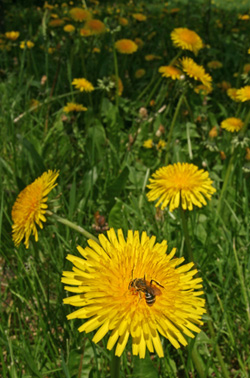
A sure sign of spring is dandelions in bloom. This ubiquitous yellow flower seems to spring up overnight to create a cheerful floral display followed by billowy seed heads floating on long stalks above the ground. The word “dandelion” is from the French dent de lion, or “lion’s tooth,” probably in reference to its jagged leaves.
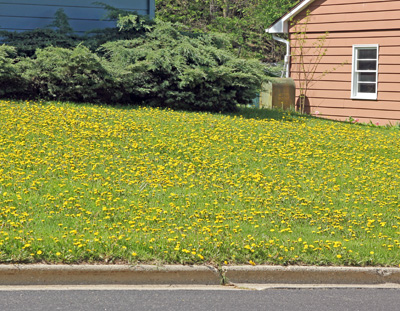
Taxaracum officinale, a common plant of grassland and cultivated ground, is native to Eurasia but has naturalized in all parts of the Northern Hemisphere, including all 50 states. Many people are less than enchanted with dandelions – particularly when they’re very numerous in a lawn. But dandelion is a cultivated plant in some places for use as both food and herbal remedies. Dandelion is a good colonizer that is excellent at dispersing its prolific seeds.
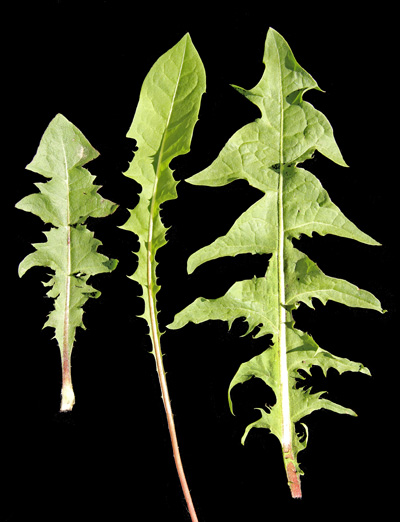
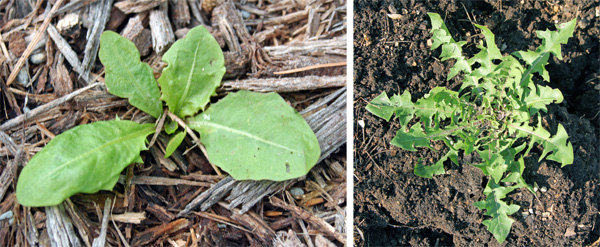
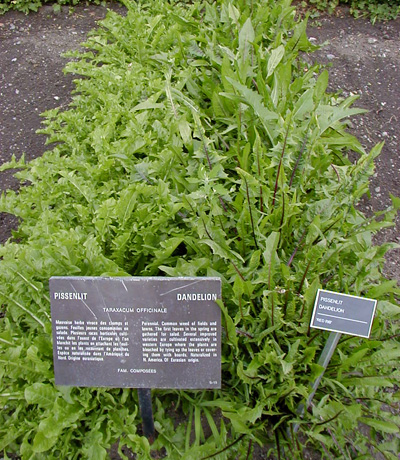
Dandelion is a short-lived perennial that will grow just about anywhere, regardless of soil conditions, but fertile soil will improve its growth. They withstand frost and freezes and tolerate crowding. Heat and insufficient moisture will cause the leaves to get bitter, but will not kill the plant. The lance shaped leaves grow in a rosette, emerging early in the spring from the crown. Individual leaves may be entire or lobed, with the toothed lobes anywhere from shallowly to deeply incised. Different lobe patterns may occur on the same plant. The rosette of leaves can be a food plant for the caterpillars of some butterfly and moth species.
A flush of bright yellow flowers are produced very early in the spring. Even though its flowers are more conspicuous early in the season, it can bloom irregularly throughout the growing season. Each solitary inflorescence consists of numerous ray and disc flowers borne together in a daisy-like flower on the end of a smooth, hollow stalk. The stem contains milky latex sap. The length of the flower stalk varies considerably depending on the conditions.
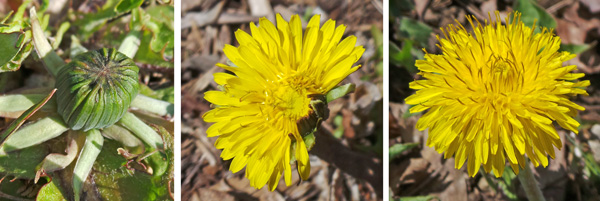
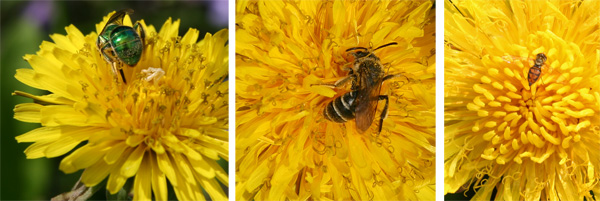
The flowers are utilized by bees and other pollinators and can be an important nectar source early in the season when few other flowers are blooming.
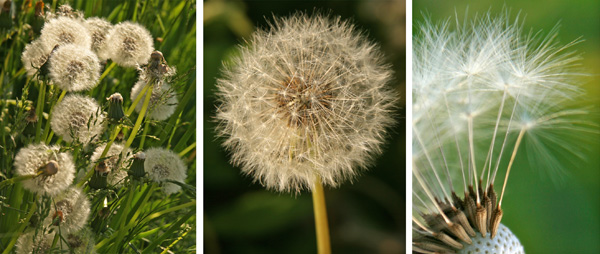
The flowerheads are followed by distinctive globe-shaped seed heads. Each seed has a pappus, a feathery parachute of soft, white hairs that makes it easily carried by the wind. Each dandelion flowerhead can contain 150 to 200 seeds, and a plant can produce up to 10 flowerheads. Dandelion seeds germinate readily, but typically do not persist long in the soil.
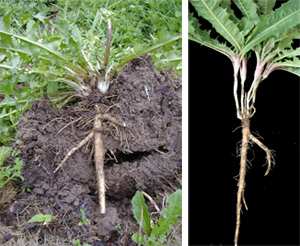
Dandelion can also reproduce vegetatively from pieces of taproot, with the upper sections of the root having greater viability. The deep taproot, up to 3 feet long (but usually 6 to 12 inches), allows it to survive drought and competition with other weeds.
Depending on your perspective, dandelion is either a weed or wild vegetable that is more nutritious than broccoli and spinach. Though never cultivated as a vegetable in Europe, plants were brought to market in England in the 19th century when lettuce and endive were scarce. Dandelions also appear on the menu in some locations. In Catalonia, pheasant or duck is often prepared with dandelions in the fall (el faisà o l’ànec amb queixals de vella) and in Macedonia Radíkia Me Rízi Tis Kyrías Agápis is a dish of dandelion and chicory cooked with rice and pine nuts.
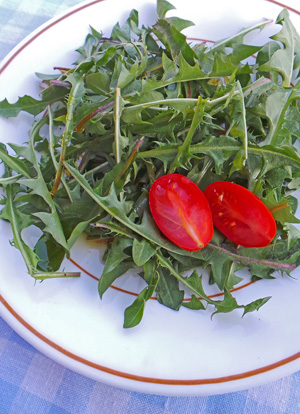
Leaves, buds, flowers, and roots of this plant are edible. Regardless of which part you intend to eat, make sure the dandelions have not been treated with pesticides and wash them thoroughly. The leaves, which are high in calcium, potassium, and iron, are best when they are young and tender, and are most flavorful in early spring before the first flower buds appear. Later in the season, they leaves become increasingly bitter in taste.
The roots can be eaten as a vegetable if dug in early spring. Be cautious of ingesting too many roots as they are reported to be both a diuretic and a laxative.
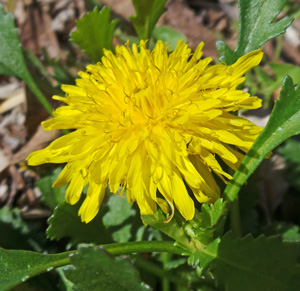
Blossoms, too, can be eaten fresh and are sweetest when picked early in the season. Use flowers immediately after picking because the flowers close up quickly.
Dandelion sap can cause contact dermatitis in susceptible individuals.
Growing Dandelion
Should you actually want to grow dandelion intentionally, sow the seeds on the soil surface or slightly covered from early spring (4 to 6 weeks before last frost) through late summer. They should germinate in ten days at 55 °F. Space the plants six to nine inches apart in rows twelve inches apart. You can also get a head start by sowing in early spring in a cold frame or indoors, then transplanting the seedlings into individual pots when they are large enough to handle (but use a pot deep enough to accommodate the tap root), and then plant them out in early summer. It’s essential to pick the flower heads, not only to keep the plant’s energy going to root and leaf production, but also to spare yourself future weeding. Your crop should be ready in 85 to 95 days.
Commercial seed is sometimes available, and seed can also be harvested from existing plants in a yard or a field. Some suppliers offer other dandelion species like T. pseudoroseum (pink dandelion) or T. albidum (white dandelion.) Note that dandelion varieties listed as “Italian dandelion” are actually a type of chicory, Chichorium intybus.
Dandelion Control
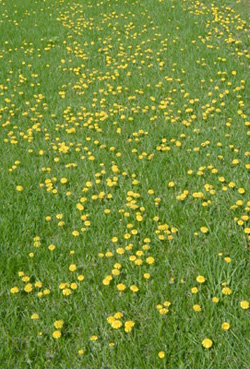
No matter how many dandelion leaves and flowers a gardener eats, this probably won’t be sufficient to control them in a yard. Dandelions are generally only a problem in lawns that are not growing vigorously enough to out-compete the weeds. The first step in dandelion control in turf is cultural practices that promote vigorous, healthy turf, which helps to prevent dandelions (and other weeds) from getting started in the first place. When having a dandelion issue, first look to cultural practices that improve lawn health, like proper mowing, fertilization, and aeration.

If there are only a few dandelions in an area, mechanical control may be the best option. Use a digging stick or other garden tool that can be inserted into the ground along the dandelion root to pop the dandelion and at least 2 to 3 inches of its root out of the ground. Plants will regenerate from root pieces, particularly from the top half of the root, so try to pull as much of the root out of the ground as possible.
Broadleaf weed killers, such as 2,4-D and MCPP, in the common “weed & feed” lawn fertilizer mixtures will kill dandelions whenever the plants are actively growing. Spot treating individual plants that occur sporadically throughout the yard may be more effective than broadcast treatments in well managed lawns.
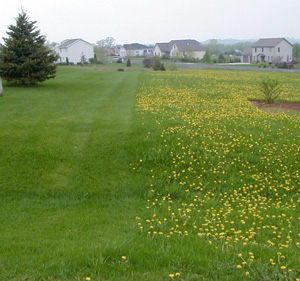
Although late summer and early fall is the best time to control dandelions with herbicides, but spring applications of 2,4-D also have some effect. Dry granular formulations must be applied to wet grass and weeds; the material is only effective if it sticks to the leaves. Liquid formulations can be applied anytime but choose a calm day so the material will not blow or drift onto other plants. Remember that broadleaf weed killers will kill many plants, not just weeds. Dicamba is potentially absorbed through the root system of nontarget plants, so keep products containing this herbicide away from shallow-rooted trees and shrubs to prevent injury. Regardless of the product, always read, understand, and follow pesticide label directions to ensure the products are used safely and effectively. For more weed management details see Managing Broadleaf Weeds in Lawns.
Author: Susan Mahr, University of Wisconsin-Madison
Reviewers: Allen R. Pyle, Horticulture Outreach Specialist, UW-Madison Extension, Bruce Spangenberg, Horticulture Outreach Specialist, UW-Madison Extension
Revised: September 2026