Overview of Ageratum
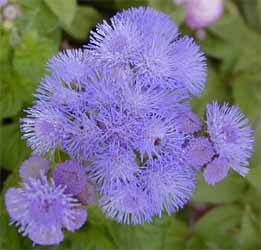
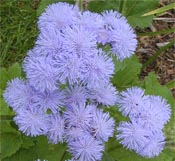
There are approximately 43 species in the genus Ageratum. Ageratum is derived from the Greek “a geras,” meaning non-aging, referring to the longevity of the flowers. These annual or tender perennial herbaceous plants and shrubs are in the plant family Compositae (Asteraceae) are all native to Central and South America. One species, A. houstonianum from Mexico, named for William Houston (1695-1733), a Scottish physician who collected the first plants, is commonly used as a bedding plant. The flowers on this tender annual come mostly in shades of blue but can be pink, lavender or white. Ageratum is one of the few annuals with a true blue flower color. The soft, fuzzy flowers are dainty and feathery, often delightfully fragrant, and usually completely cover the plants. Each flower cluster consists of five to 15 tubular florets.

The species grows to a height of over two feet and reseeds itself liberally. Many varieties offered by nurseries and garden centers are hybrids that are more compact and better behaved. Ageratum grows in neat mounds, flowering from late spring through fall and is one of the more dependable flowering annuals. The oval to heart shaped leaves grow up to 2 inches long.
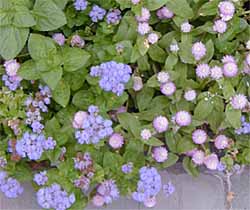
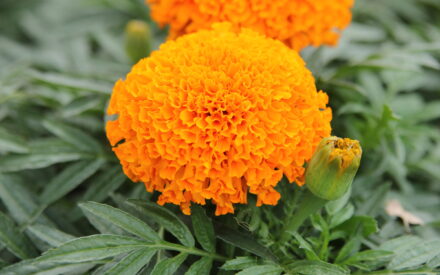
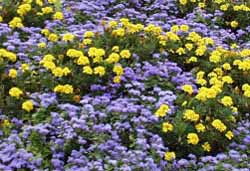
Because of its short stature, it is best used for edging or borders of beds, in rock gardens, and in containers. Blue varieties combine well with pink in the garden. Combine soft blue ageratum with pink begonias for a pastel ground cover, or mass them with short yellow marigolds or celosia for more contrast. The tall blue varieties combine well with sulfur cosmos (Cosmos sulphureus.) Try mixing the powder blue varieties with white petunias, lamb’s ear or dark blue annual lobelia.
Propagating Ageratum
Start ageratum seeds indoors 8 to 10 weeks before the last expected spring frost. Surface sow, barely covering with media or vermiculite or just gently firm seeds into the potting mix, as light aids germination. Germination usually takes 7 to 21 days.
Transplant the seedlings when they are large enough to handle into trays or pots. Move outside to harden off and transplant into the garden when all risk of frost has passed. Plant 6 to 8 inches apart in a sunny spot. Ageratum prefers a moist, well drained soil but tolerates dry conditions. Ageratum generally do not have serious insect or disease problems, although sometimes spider mites can affect the plants, especially in hot, dry weather. On most varieties the old flowerheads turn brown and remain on the plants, but some varieties are self-cleaning. Deadhead as needed to improve the appearance of the plants and prolong blooming. The frost tender plants can be covered on cold nights to extend their life in the fall.
Varieties of Ageratum
There are many different varieties of Ageratum available, ranging from dwarf, tufted plants to tall, upright growers that can be used as cut flowers. Most of the cultivars are propagated from seed and are predominantly F1 hybrids. Some of the more commonly available varieties include:
- ‘Aloha’ series is a F1 hybrid, seed propagated dwarf series that grows 6 to 8 inches tall and 8 to 12 inches wide with large clusters flowers. It is available in ‘Blue’ and ‘White’.
- ARTIST® series is an early blooming vegetative series with an upright, compact, mounding habit that grows 8 to 10 inches tall. Available in Basso Blue, Basso Rose, and Basso White.
- ‘Blue Blazer’ was the first commercial F1 hybrid variety. It features better plant uniformity, vigor, and earlier bloom than open-pollinated cultivars.
- ‘Blue Danube’ was bred using a male sterile parent selected from a population of ‘Blue Carpet’. This variety is uniform, early blooming, and has excellent landscape performance. The compact plants to 6 to 8 inches are covered with mid-blue flowers.
- ‘Blue Horizon’ is a vigorous, triploid F1 hybrid that is suitable for landscape or cut flower use. Purplish-blue 3 inch flower clusters are produced on 30 inch tall stems. Plants flower 12 to 15 weeks from sowing. Making 2 to 3 successive plantings generates continuous blooms from early summer until frost.
- ‘Blue Mink’ is an open-pollinated, tetraploid cultivar with large clusters of powder-blue flowers on 12 to 14 inch tall plants.
- ‘Hawaii’ series is an F1 hybrid series with varieties in soft pink, royal blue, and pure white flowers. It tends to be earlier and longer flowering than other ageratums. The dwarf, very uniform, compact plants to 8 inch tall, covered in a profusion of powder-puff blooms all season long.
- MONARCH MAGIC™ (variety ‘Agerboyuma’, PP 36,798) is a vegetative variety with a spreading habit, growing 6 to 12 inches tall and 8 to 16 inches wide. It is highly attractive to butterflies.
- ‘Red Flint’ is a tall (24 inch), seed propagated variety with an upright growth habit and large clusters of reddish-purple flowers. Makes a good cut or dried flower.
- ‘Summer Snow’ is a F1 hybrid with fluffy white flowers.
- ‘Timeless Mix’ grows 24 to 30 inches tall with long-lasting flowers in shades of blue, pink, red-purple, and white. An excellent mixed color cut flower and has good landscape performance.
- ‘White Bouquet’ grows 18 to 24 inches tall with snow-white blooms. Suitable for use as a cut flower.
– Susan Mahr, University of Wisconsin – Madison
Last Update: Allen R. Pyle, UW-Madison Extension, 2026