Overview
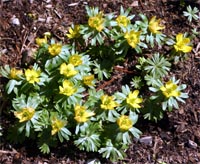
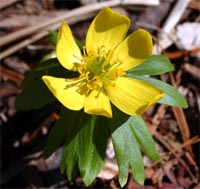
Winter aconite (Eranthis hyemalis) is one of the earliest plants to bloom in spring. This plant in the buttercup family (Ranunculaceae), native to Asia Minor and Europe, has small flowers that resemble tiny buttercups. The solitary, yellow cup-shaped flowers are surrounded by bright green bracts that look like a collar around the blossom. There are six petals in each flower and numerous stamens and pistils in the center. This small tuberous perennial is hardy in zones 3a to 7b.
These low-growing plants form rounded clumps 3 to 6 inches tall and wide. The dark green leaves appear after the flowers fade. Each narrow leaf is divided into several finger-shaped lobes. In summer, the plant goes dormant and the foliage dies back completely.
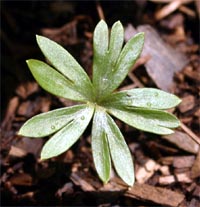
If you have small children or pets that are likely to dig in the garden you may not want winter aconite in your yard as the entire plant, but especially the tuber, is highly poisonous and may cause nausea, vomiting, visual disturbances, and potentially fatal cardiac arrest.
Landscape Use of Winter Aconite
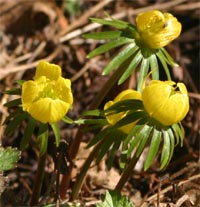
This ground-hugging plant works well in rock gardens, flower beds, and woodland gardens. The flowers first appear in the sunniest spots, just before the first snowdrops (Galanthus nivalis) begin to bloom. These two species can look charming together planted in the border or naturalized in the lawn. Winter aconite is good for naturalizing under trees and large shrubs. They combine nicely with hellebore and echo the flower color of forsythia and witch hazel (Hamamelis). Because of their small size, winter aconite is best planted in groups.
Plant purchased tubers (often called “bulbs” in the trade) in the fall. If the tubers are shriveled, place them in moist sand or peat moss for a few days so they can rehydrate. Plant tubers 1 to 3 inches apart and 2 to 3 inches deep (slightly shallower in heavier soils). The plants prefer humus-rich, well-drained but not dry soil.
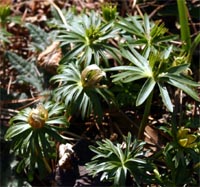
When planted in suitable sites, winter aconite reproduces easily and spreads readily to form large colonies. Its spreading nature has led to it being listed as invasive in some parts of the Northeastern US.
Lift clumps while still green to keep under control, if desired, or when overcrowded. To propagate, divide the clumps after flowering or collect seeds to sow in the fall.
Author: Susan Mahr, University of Wisconsin—Madison
Reviewers: Allen Pyle, Horticulture Outreach Specialist, UW—Madison Extension, Bruce Spangenberg, Horticulture Outreach Specialist, UW—Madison Extension
Revised: September 2026