Overview
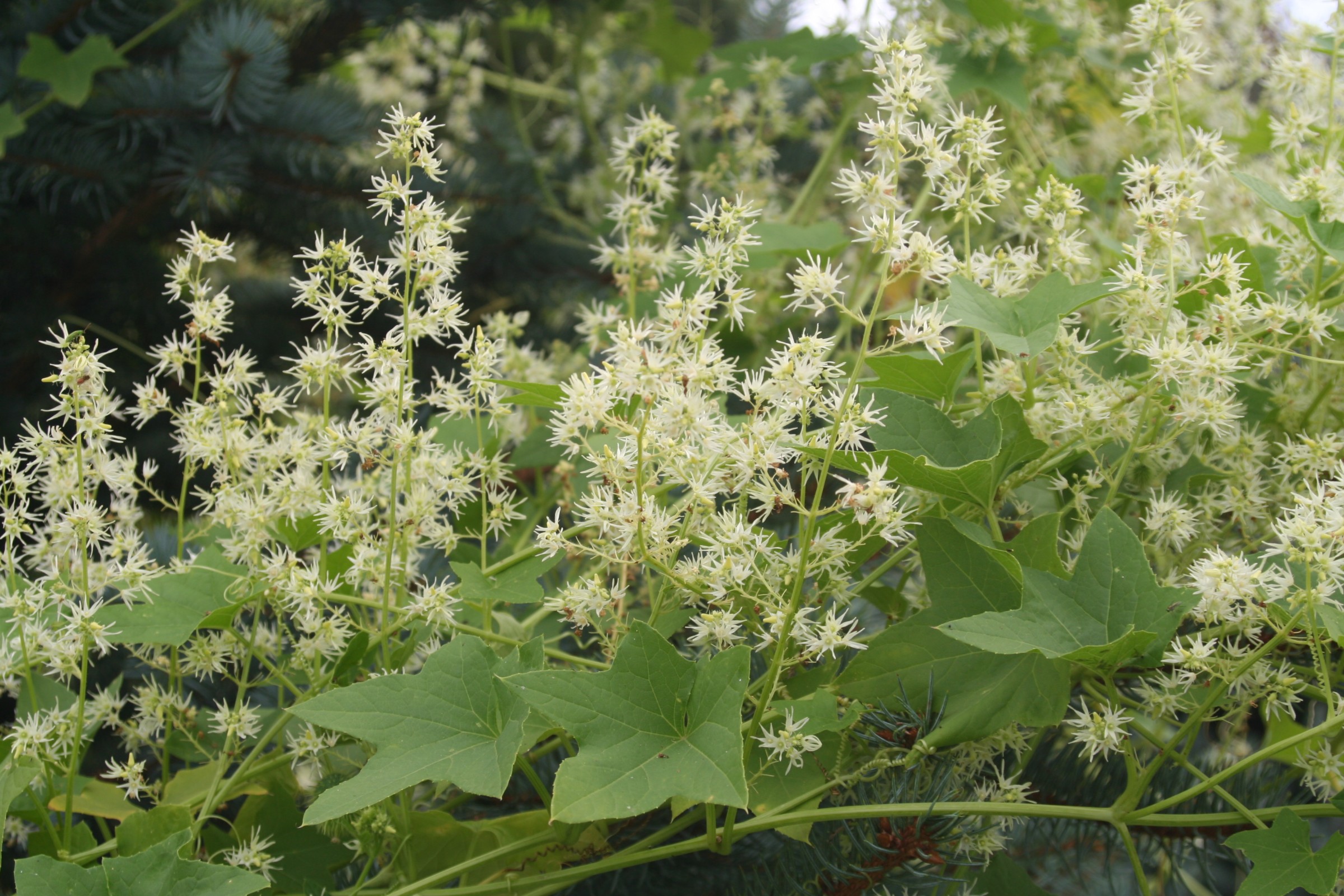
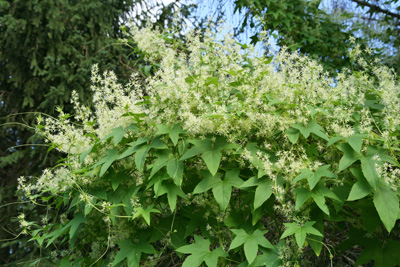
In late summer you may notice trees or shrubs festooned with crowns of white flowers that obviously are not the woody plant blooming. Look closely and you’ll notice the leaves and individual flowers look similar to those of cucumber. This plant is wild cucumber or balsam-apple, Echinocystis lobata. The name Echinocystis comes from the Greek echinos for “hedgehog” and cystis for “bladder”, appropriately describing the spiny fruit.
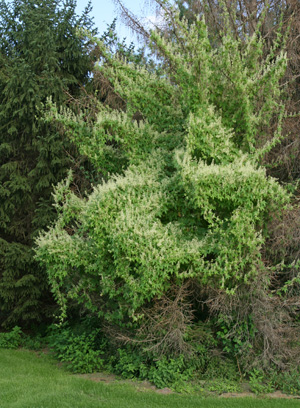
A vining native annual in the cucumber or gourd family (Cucurbitaceae), wild cucumber is often overlooked until it is large and has engulfed the other plants it is growing on. It occurs throughout much of North America, including all of Wisconsin. Its native habitat is along streambeds, swamps, and moist thickets or roadsides.
It is not common in home landscapes but will occasionally be spread from adjacent rural areas.
How to Identify Wild Cucumber
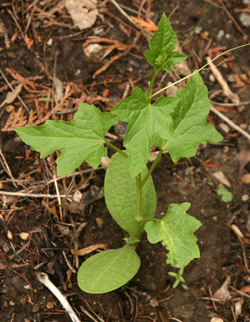
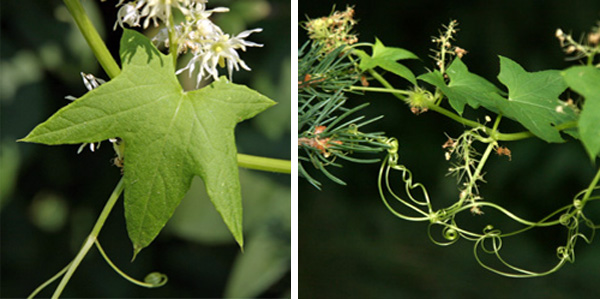
As a fast-growing, warm season annual, wild cucumber grows from seed each year, germinating after the last frost. The large, oval cotyledons look just like that of a regular cucumber. The smooth, fleshy stems are grooved lengthwise. The large, alternate leaves are palmate with 3 to 5 pointed lobes. Each is borne on a long petiole. The branching vines can grow up to 25 or 30 feet long, climbing onto other foliage with curling, 3-forked tendrils that arise from the leaf axils. The tendrils coil when they touch anything to attach onto for support.
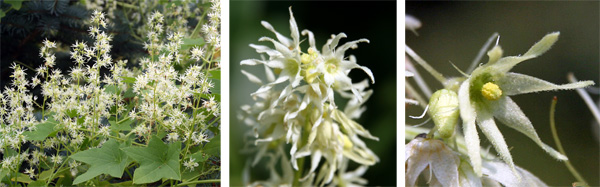
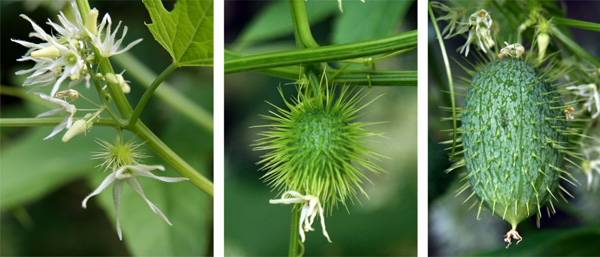
Starting in mid-summer the vines begin to produce fragrant, pale yellowish-white flowers. The plants are monoecious (separate male and female flowers are produced on each plant) and the flowers are pollinated by insects. The numerous male flowers form in clusters on a long, erect raceme from the leaf axils. Each ½ to ¾ inch wide flower has 6 long, thin petals, giving a star-like appearance. The filaments of the three stamens form a column, with the yellow anthers on the end. Female flowers occur singly or in pairs interspersed among the male flowers, with a small, rounded spiny ovary below the yellow-green petals.
Superficially the fruit resembles a small and rounded cultivated cucumber, but covered with prickles. The puffy, spherical to oblong, green pods with long, soft spines grow up to two inches long. Despite the common name, the fruits are not edible and can cause burning reactions in some people. The pods can be used in dried flower arrangements.
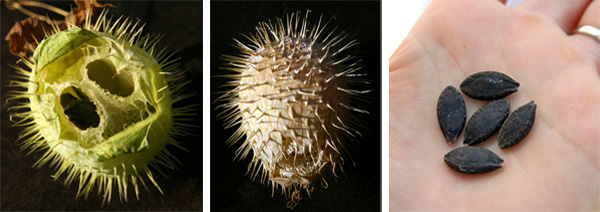
When ripe, the fruit becomes dry and brown and the inflated capsules burst open at the bottom to eject the seeds. Each pod contains four large, flat black or brown seeds, two in each of the two cavities in the pod. To collect seeds, bag the fruits well before maturity, as seeds are forcibly expelled by hydrostatic pressure once the pods are dry.
How to Grow Wild Cucumber
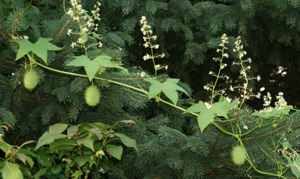
Wild cucumber can be cultivated as an ornamental annual vine and would be great for covering arbors and pergolas, or for rambling horizontally along fences, walls and other low structures. It does best in full sun and rich, moist soil. Seed can be sown directly outdoors as soon as the soil warms or seeds can be started early indoors to be transplanted outside after the last frost. Only a few suppliers offer seed, so you may have to collect your own seed in the fall to grow the following year.
Management of Wild Cucumber as a Weed
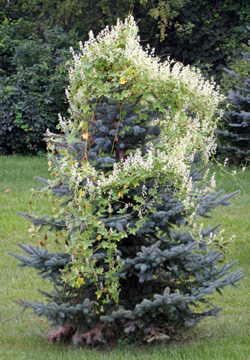
Even though this is an attractive native plant, it is generally considered a weed when climbing on planted trees because of its aggressive growth. It is easily controlled in the home landscape by pulling or hoeing the young plants. Plants will self-seed readily, so controlling before the plants begin to flower and fruit is important for reducing infestations. Chemical control can be used over larger areas, such as shelter belts, but herbicides are very likely to damage the host tree the vines have covered.
Another similar, but less common plant is bur cucumber, Sicyos angulatus, but that plant is easily differentiated by the degree of indentation of the leaf lobes and the fruits. Wild cucumber has deeply lobed leaves and inflated fruits, while bur cucumber has broad, shallowly lobed leaves and the fruit is much smaller and not inflated.
Author: Susan Mahr, University of Wisconsin—Madison
Reviewers: Bruce Spangenberg, Horticulture Outreach Specialist, Allen Pyle, Horticulture Outreach Specialist, UW—Madison Extension
Revised: May 14, 2026