Overview of Papyrus
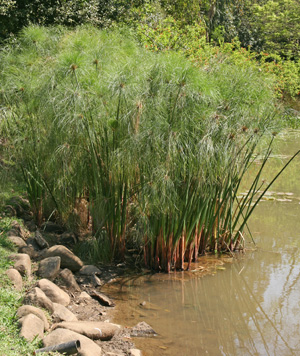
Papyrus is a sedge (family Cyperaceae) and one of about 600 species in the genus Cyperus, which is probably best known as the source of ancient papyrus paper. C. papyrus, also called Egyptian reed or paper reed, is a clump-forming, tender African species hardy in zones 9a to 12b. It is native throughout the wetter parts of Africa, Madagascar, and around the southern Mediterranean. In its native habitat, it occurs in vast stands in swamps, shallow lakes, and lining stream banks and other bodies of water.
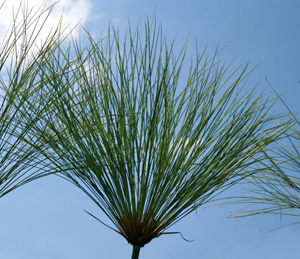
In ancient times, papyrus was widely cultivated in the Nile Delta, but now is nearly extinct there. The starchy rhizomes and culms are edible, both raw and cooked, and the buoyant stems were used for making small boats. Upright stems topped with airy foliage gives this species an ornamental, tiered effect.
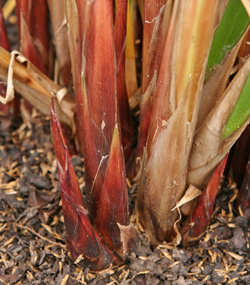
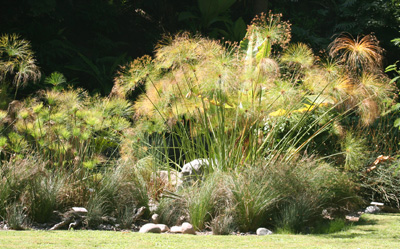
Papyrus is vigorous and can grow 5 to 8 feet tall. This tender, herbaceous perennial produces just a few basal leaves and many strong, deep green, triangular (3-sided) stems (culms) from woody rhizomes. The new rhizomes and culm bases are covered by papery scales, which are actually reduced leaves. The scales are triangular in shape and a reddish brown color. The thick rhizomes creep horizontally along the soil, anchored by numerous roots.
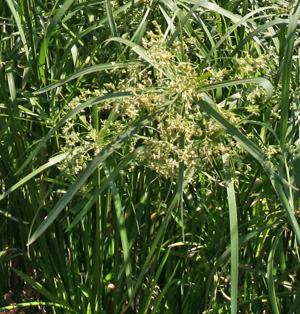
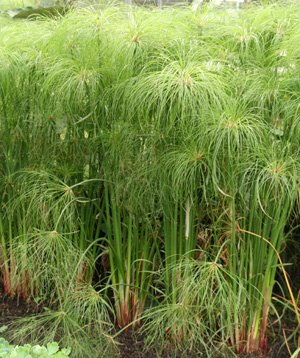
Each straight stem is topped with an umbellate inflorescence. This is a dense cluster of many bright green, shiny thread-like rays. Small, secondary umbels with 3 to 5 rays and narrow, elongated bracts are produced on the ends of the rays. The nondescript, greenish-brown flowers that are produced at the ends are wind pollinated.
Eventually, flowers produce brown, nut-like fruits. The mature fruits are dispersed in water after they drop from the plant. This terminal growth, subtended by papery brown bracts, resembles a feather duster at first and will eventually grow to 4 to 12 inches across. The bracts may become so large that they bend under their own weight as the cluster becomes almost spherical in shape. These are often used by birds as nesting sites in its native habitat.
Landscape Use of Papyrus
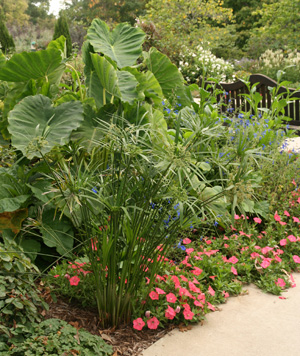
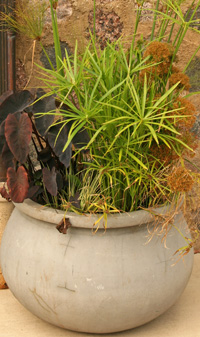
Papyrus can be grown as an annual foliage plant in the ground, in large containers, or in shallow water. The fireworks-like flower heads make a bold and dramatic addition to both the garden and to cut flower arrangements. This plant is well suited for medium to large water features and adds an exotic, tropical look to a sunny corner.
Because of it’s height, papyrus is best used in the middle or back of a bed or container to add drama and contrast to shorter plants. Use it as a tall, vertical accent plant with other tropical plants.
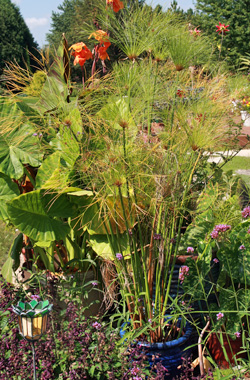
Papyrus can be underplanted with annuals such as petunias or coleus, or used as a specimen or an accent in larger landscape beds.
It is an easy-to-grow plant, but it needs warm temperatures to thrive. It does best in full sun when grown as an annual in the Midwest. Plant in moist to wet soil or cultivate in a container in order to regulate moisture levels more easily. This plant can be potted in a container without drainage holes.
Because of its vigorous growth it can quickly become potbound. Cut off old culms that have browned heads with a sharp knife or pruning shears close to the rhizome. This plant can be fertilized heavily. Propagate by division of the rhizomes in spring.
Because it is of tropical origin, papyrus is sensitive to frost, and should be protected or moved indoors when temperatures are below 40 °F. Plants can be kept over the winter as long as the rhizomes are protected from freezing. Plants will survive – but not thrive – in a bright spot indoors or in a greenhouse over the winter if kept very moist, preferably in standing water (i.e. placing the container in a deep saucer filled with 1 to 2 inches of water). It may become essentially dormant but will resume growth with new culms quickly replacing the old, weathered ones in the spring when the weather warms.
Cultivars of Papyrus
A few varieties of papyrus are available, including selections of other species than C. papyrus. Examples include:
- C. alternifolia is a low-growing species availab le from seed. Grows just 14 inches tall.
- C. glaber ‘Abby’ has a rounded habit, dark green leaves, and light green spikelets. Grows 30 inches tall and 22 inches wide. Seed propagated.
- C. involucratus BABY TUT® is a dwarf, vegetative selection growing 18 to 24 inches tall and wide
- KING TUT® is a vegetative selection that grows 4 to 5 feet tall and wide.
- PRINCE TUT™ is a dwarf, vegetative selection that grows 18 to 30 inches tall and 24 to 36 inches wide, with large inflorescences.
Author: Susan Mahr, University of Wisconsin—Madison
Reviewers: Allen R. Pyle, Horticulture Outreach Specialist, Bruce Spangenberg, Horticulture Outreach Specialist, UW—Madison Extension
Revised: June 2026