Overview
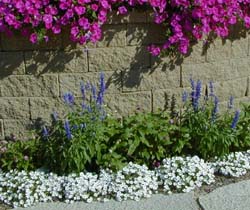
Nierembergia, or cupflower, is a heat-loving, compact, mounding plant that is covered in flowers from early summer through fall. A tender perennial that survives only in zones 7a to 10b, it is easily grown as an annual in colder areas.
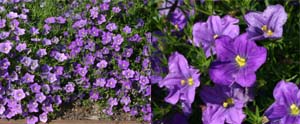
The genus Nierembergia (nee-rem-BERG-ee-uh), native to Argentina, is named for Juan Eusebio Nieremberg, a 17th century Spanish Jesuit theologian and naturalist. The taxonomy of this genus (in the potato family or Solanaceae) is rather confused. Most taxonomists now classify the plant as N. linariifolia, but it is still sometimes listed under older names including N. coerulea, N. gracilis, or N. hippomanica. Cultivars are sometimes listed under N. scoparia (formerly N. frutescens or N. fruticosa). It grows neat, spreading mounds about 12 to 15 inches across. The fine textured foliage is produced on multiple stems, with stiff, linear leaves to 1/2 inch long. The one inch white or bluish-purple star-shaped, saucer-like flowers have lemon yellow centers. Their color does not fade even in the brightest sun.
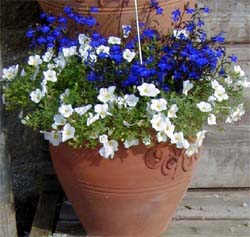
Landscape use of Nierembergia
Use Nierembergia for edging, in borders, rock gardens, or containers, including hanging baskets and window boxes. They thrive in hot environments, spilling out to soften the edges of the stones and hiding the scraggly bases of the other plants.
Nierembergia grows best in organic matter rich, well-drained soil in full sun. Mulch to help retain moisture and keep the soil cool. Plants are drought tolerant once established.
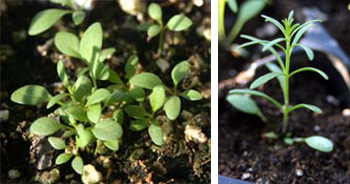
Propagating Nierembergia
Start Nierembergia from seed sown indoors 8 to 10 weeks before the date of average last spring frost. Barely cover the seed; it should germinate within 2 to 3 weeks at 70 °F. Keep moist until emergence, then the plants can be kept on the dry side.
Young plants grow very slowly, but grow more quickly once transplanted. Transplant outdoors 6 to 12 inches apart after hardening off just before the last frost date in moist.
Stem cuttings can be taken in late summer to hold the plants over the winter.
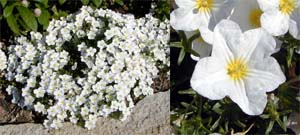
Cultivars of Nierembergia
There are only a few varieties commonly available. These include:
- AUGUSTA® Blue Skies (variety ‘USNRB1201’, US plant patent 21,662) is an early blooming, vegetative selection with lavender and purple flowers and a compact, trailing habit.
- ‘Mont Blanc’ is seed propagated and has pure white flowers and grows 6 to 8 inches tall and 10 to 12 inches wide. It won an All-America Selections Award in 1993.
- ‘Purple Robe’ has vivid purple flowers and a compact habit, growing 4 to 8 inches tall and 6 to 12 inches wide.
- ‘Starry Eyes’ has white flowers with purple eyes and grows 10 to 16 inches tall and 18 inches wide.
Author: Susan Mahr, University of Wisconsin—Madison
Reviewers: Allen R. Pyle, Horticulture Outreach Specialist, Bruce Spangenberg, Horticulture Outreach Specialist, UW—Madison Extension
Revised: August 2026