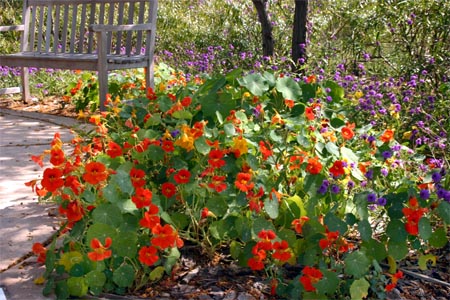
Overview of Nasturtium
Nasturium is an easy-to-grow, tender perennial (zone 9a) grown as an annual in cold climates. It features distinctive leaves and brightly colored flowers. Nasturtium is the common name of two common garden species: Tropaeolum majus, or trailing nasturtium, and T. minus, or bush nasturtium. The common name refers to the fact that it has a mustard oil similar to that produced by watercress (Nasturtium officinale, family Brassicaceae). Early English herbalists referred to nasturtiums as “Indian cress” after conquistadors discovered them in the jungles of Peru and Mexico and brought them back to Spain in the 16th century.
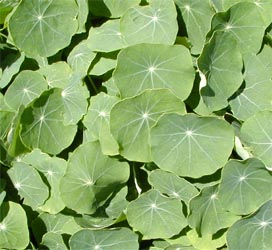
The peltate (shield-shaped) or nearly circular, deep green leaves have light-colored veins radiating from the central petiole. Leaves can be quite large, up to 4 feet across on some plants. Many types have flat, round leaves reminiscent of water lily pads. Some cultivars have leaves that are variegated and speckled with creamy white. Depending on the species and variety, plants either form low mounds or trail up to 3 feet.
The intensely colored flowers traditionally were bright yellow and orange, but now varieties are available in many shades of red, yellow, orange, and cream in both rich, saturated jewel-toned colors and more muted pastel shades.
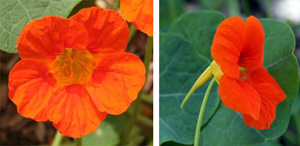
Most varieties flower in a single color, but some varieties are lightly marked with a second color towards the center. They normally have five petals and a funnel-shaped nectar spur in the back. The flowers are typically 2 to 2½ inches wide and produce 3-segmented fruit, each portion with a single large seed. Plants will self-seed readily. In warm, mild climates, it blooms and seeds year round and may be invasive, but reseeding is not a problem in cold climates.
Landscape Uses of Nasturtium
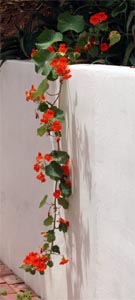
Nasturtium is a welcome addition to any sunny garden, particularly those with an informal design. Monet planted them in the border of the pathway that led to the front door of his home in Giverny, France. The compact varieties remain about 12 inches tall, making them well suited for edging. The rambling habit of trailing types make them useful in hanging baskets and window boxes or cascading down walls. They can also be grown as a groundcover and can be trained to a trellis to create a vertical display. Though trailing types are sometimes labelled as “climbing” nasturtiums, plants lack tendrils and do not climb well by themselves. Both types of nasturtiums can be included in mixed containers but may have to be trimmed back periodically to prevent them from crowding out the other plants. They can also be used to fill in blooming gaps among complementary colored day lilies and roses.
Plant nasturtiums in well-drained soil in full sun. They will grow in partial shade but will not bloom well under those conditions.
Nasturtium has few pests. The most common insect pests are imported cabbageworm (Pieris rapae) caterpillars and aphids. Leafminers may make serpentine trails on the leaves but this doesn’t damage the plant.
Nasturtium flowers and leaves are edible and make an attractive addition to salads. They have a slightly peppery taste reminiscent of watercress, with a spicier flavor when grown in sunnier, hotter weather. They taste better when young; older leaves can be bitter. The flowers are less intensely flavored than the leaves.
Propagating Nasturtium
Seed can be sown directly in the garden in late spring to early summer once all danger of frost has passed or started indoors in peat pots 4 to 6 weeks before the date of the last expected spring frost.
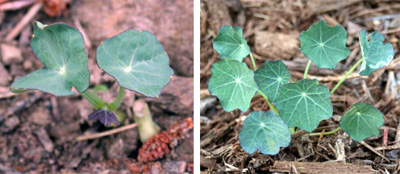
Sow seeds ½ inch deep (they need darkness to germinate) and 10 to 12 inches apart. Soaking the seed for a few hours or overnight before planting can improve germination. Seed typically germinates in a week to ten days depending on soil temperature. Do not fertilize, except on extremely poor soil, as high rates of fertilization promotes leaf growth and reduces flowering. Deadheading or picking the flowers will prolong blooming. Nasturtium will continue blooming until frost. Although they like dry soils and will tolerate drought, water regularly during the growing season to keep plants blooming strongly.

Cultivars of Nasturtium
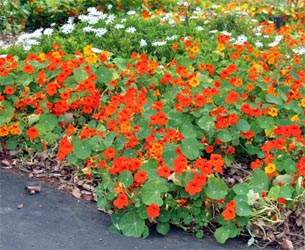
Some readily available bush types (T. minus) cultivars include:
- ‘Alaska’ series has heavily variegated leaves (green mottled with creamy white) on bushy plants with single flowers. Usually sold as a mix of cherry, crimson, orange, salmon, and yellow.
- ‘Baby’ series is an award winning dwarf series with dark green leaves. ‘Baby Gold’ is a 2025 All-America Selections Regional Winner (Northeast, Mountain / Southwest, and Heartland) with gold flowers; ‘Baby Red’ has rich red flowers with yellow throats and is a 2025 All-America Selections Regional Winner (Northeast, Mountain / Southwest, and Heartland); ‘Baby Rose’ has dark rose flowers and is a 2019 All-America Selections Regional Winner (Northeast, Mountain / Southwest, and Heartland); ‘Baby Yellow’ is a 2025 All-America Selections Regional Winner (Northeast, Mountain / Southwest, and Heartland) with soft yellow flowers.
- ‘Black Velvet’ is a compact variety, growing 8 inches tall, with deep maroon flowers.
- ‘Empress of India’ is an older variety with a compact habit, dark green leaves, and brilliant single crimson red flowers. A classic variety that is good in containers.
- ‘Jewel’ series – bushy, dwarf plants with single flowers in red, pink, yellow and orange shades. Unusual fluted petals add interest to containers.
- ‘Peach Melba’ has cream yellow flowers with a irregular orange markings around the throats. It is a dwarf plant that performs well in containers.
- ‘Tip Top’ series is early blooming and grows 10 inches tall. It is available in Apricot, Gold, Scarlet, and a Mix.
- ‘Tip Top Alaska’ series is an improved ‘Alaska’, selected for more consistent leaf variegation and early blooming. It is available in Salmon, Scarlet, Red Shades, and a Mix.
- ‘Tom Thumb’ is compact, growing 6 to 9 inches tall, with large, vivid blooms. Usually offered as a mix with flowers in shades of bright yellow, red and orange. A good choice for containers and smaller gardens.
- ‘Vesuvius’ has brilliant salmon-orange flowers on compact plants that grow 10 to 12 inches tall and wide.
- ‘Whirlybird’ is compact, with medium green leaves and grows 12 to 18 inches tall, with semi-double flowers. Usually offered as a mix with flowers in shades of mahogany, orange, rose, salmon, and yellow. The ruffled flowers lack the typical flower spur so they sit flat on the tops of the stems.
Some readily available trailing types (T. majus) cultivars include:
- ‘Jewel of Africa’ has a trailing habit, variegated leaves and single flowers in a range of colors from orange to peach, red, and yellow.
- ‘Kaleidoscope Mix’ has a trailing habit, extending about 16 inches and single flowers in cream, orange, red, rose, and yellow.
- ‘Troika’ series features large, single flowers and variegated foliage. Vines spread 3 to 4 feet. Available in ‘Cream’ (cream white flowers with maroon spots at the petal bases), ‘Orange’, ‘Red’ (red with large yellow throats), ‘Velvet’ (deep maroon with yellow throats), ‘Yellow’ (golden yellow with red spots at the petal bases), and ‘Mix’.
- ‘Vintage’ (sometimes listed as ‘Vintage Mix’) has large, double flowers in shades of cherry, ivory, orange, red, and bicolors. Grows 1 foot tall and 3 to 4 feet wide.
- Tropaeolum peregrinum, commonly called canary creeper or canary vine, is a climbing, tender perennial vine (zone 9a hardy) grown as an annual in cold climates. It has bright yellow, fringed flowers that look somewhat like bird’s wings and 5-lobed, light green leaves. It is very fast growing and may climb to 8 to 12 feet on a trellis.
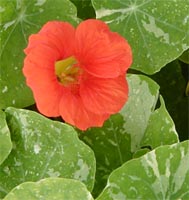
– Susan Mahr, University of Wisconsin – Madison
Last Update: Allen R. Pyle, UW-Madison Extension, 2026