Overview of Helenium
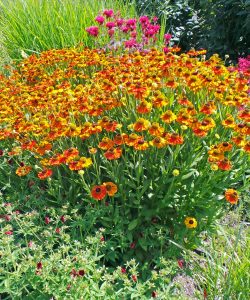
The genus Helenium in the daisy family (Asteraceae) includes more than 40 species of annuals and perennials from the Americas. The types most commonly used as garden plants are H. autumnale and its cultivars and hybrids. With common names of Helen’s flower, sneezeweed (due to the historic use of crushed dried leaves and flowerheads in snuff) or just helenium, H. autumnale is a highly variable perennial native to much of the US and southern Canada, including Wisconsin, that is hardy in USDA zones 3a to 8b. The wild forms with primarily yellow flowers are likely to appeal mainly to native-plant enthusiasts, while the more refined hybrids are well suited to most ornamental gardens. As with many American wildflowers and grasses, Europeans, especially in Germany and the Netherlands, have been instrumental in developing helenium into more vigorous plants with better form, a longer bloom period and a wider palette of more vivid colors in autumn shades of gold, orange, red, and brown. Many modern hybrids include some orange sneezeweed parentage (H. hoopesii, a western species that blooms in midsummer), so that many start blooming earlier than older types and continue until fall.
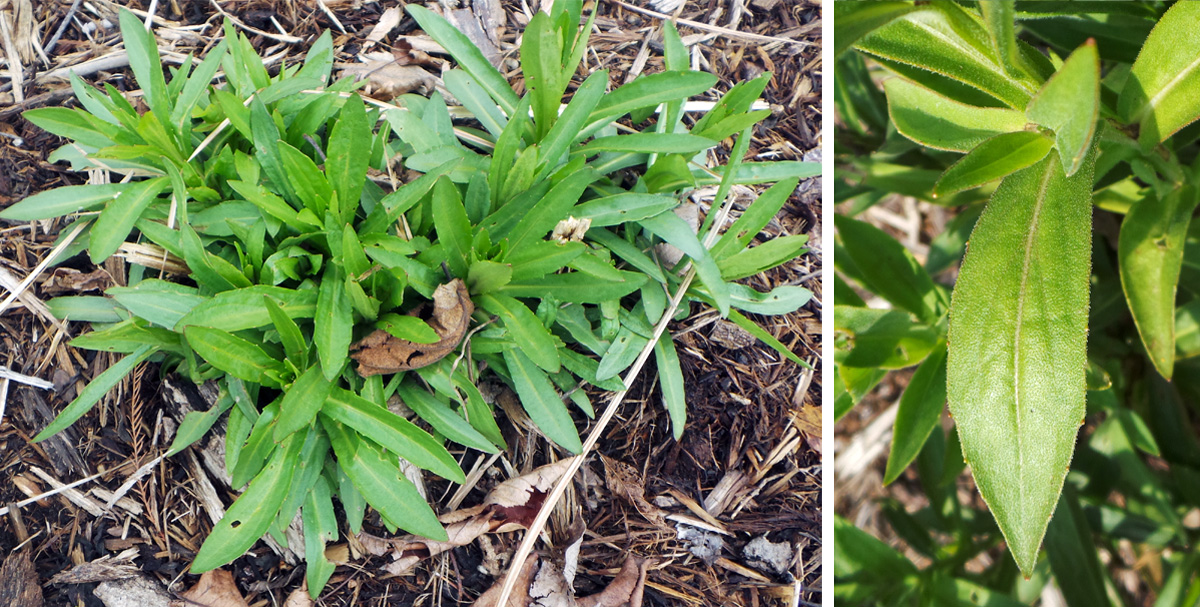
These erect, clump-forming herbaceous perennials grow 2 to 5 feet tall from a crown of resting shoots with shallow, fibrous roots. The alternate, medium green lanceolate to elliptic-oblong leaves to 6 inches long have sparsely toothed to almost entire margins. The base of the leaves often clasp the stems. The rigid, angular, winged, slightly hairy stems branch near the top.
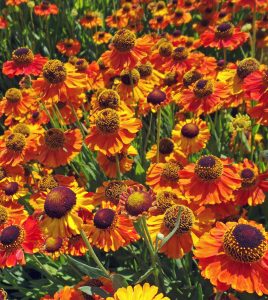
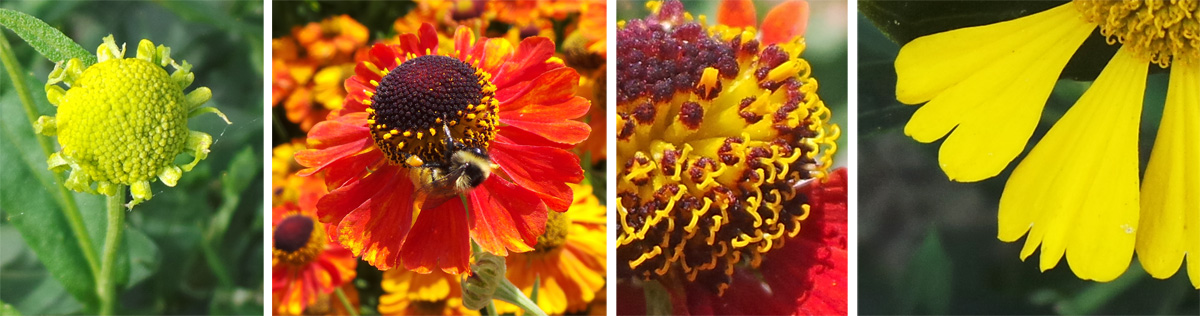
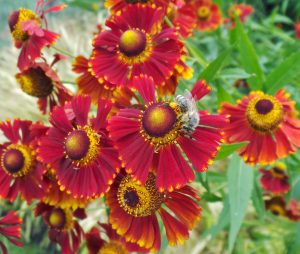
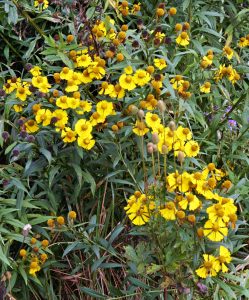
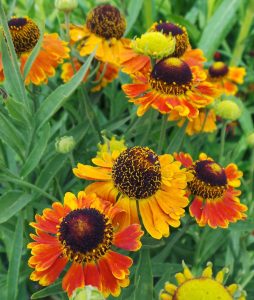
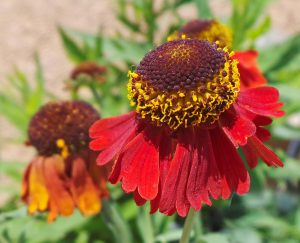
Helenium generally produces abundant velvet-textured flowers in dense terminal clusters over a long period of time. The exact time varies by cultivar, with some blooming as early as June, but most flowering in late summer to autumn (sometimes to first frost). The 1 to 2 inch wide flowerheads have atypical composite or daisy pattern, with ray florets surrounding the central disk flowers. In most helenium, the 11 to 21 ray flowers are relatively short and wedge-shaped with notched ends forming three lobes at the tip. They may be held in a flat plane or droop downwards. The prominent center is subglobose (forming a dome-like knob) so the overall effect of the flower heads is sculptural and elegant. The ray flowers range in color from pale or bright yellow to gold, warm orange, coppery brown and deep red, and sometimes with two or more colors blended together for a washed or stippled effect, or striped or with bands of color. Consistent deadheading promotes more flowers; large groups of plants can be sheared. The flowers are frequently visited by butterflies, bees and other beneficial insects and are excellent for cutting. Because plants bloom into the fall, they make excellent late season pollinator plants. The tiny disk florets are eventually replaced by seeds (achenes that lack tufts of hair) that are often dispersed by water.
Landscape Use of Helenium
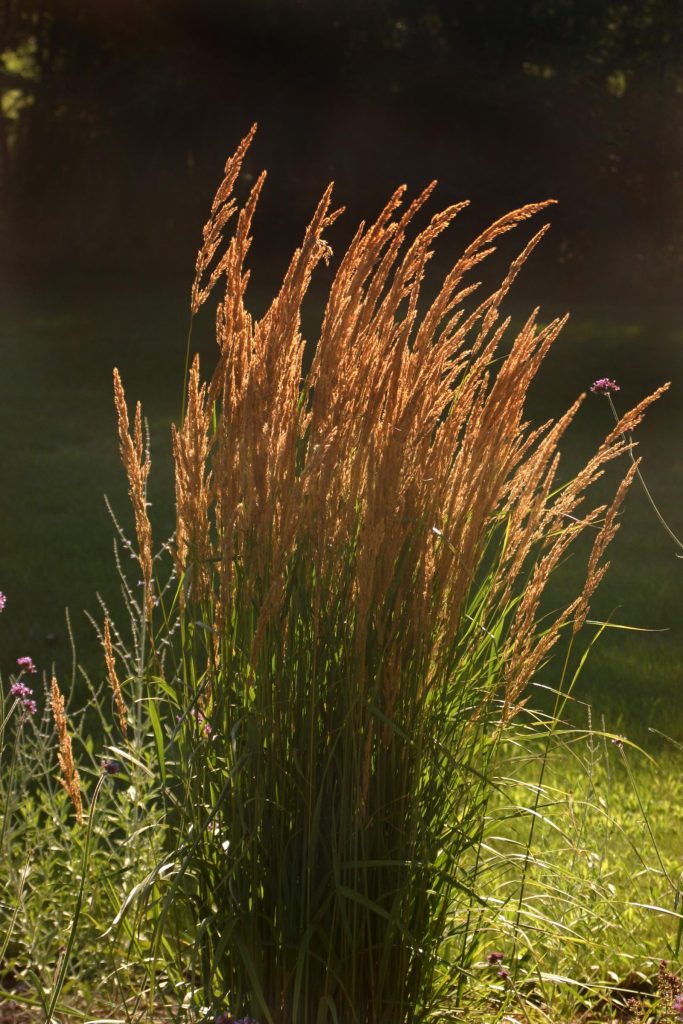
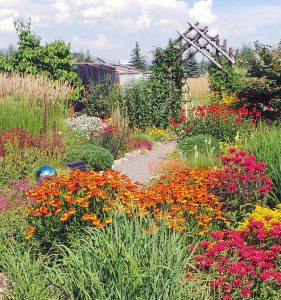
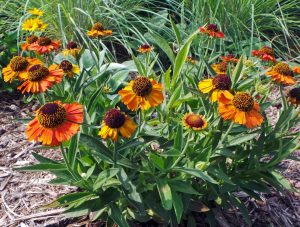
These late-season bloomers can be used in beds, cottage gardens, prairies, meadows, wild gardens, and naturalized areas especially when planted in drifts or masses. Because they like moist soil they can be used in rain gardens. They combine well in informal perennial or mixed beds and borders with ornamental grasses, anise hyssop (Agastache foeniculum), beebalm (Monarda spp.), daylilies, fall-blooming asters (Symphyotrichum spp.), goldenrods (Solidago spp.), leadwort (Ceratostigma plumbaginoides), liatris, purple coneflower (Echinacea purpurea), rudbeckias, and many other perennials. Shorter cultivars would work well with bronze carex (most are tender in Wisconsin) and mix nicely with the airy purple-flowerd Verbena bonariensis.
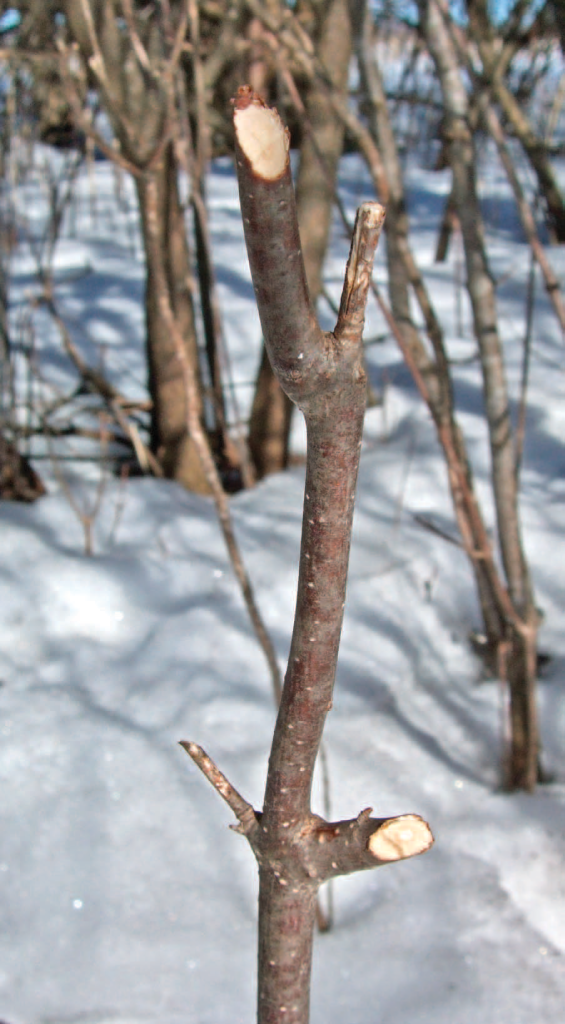
Helenium grows best in full sun in fertile, moist soil, although many of the hybrids are more tolerant of relatively drier soil. Plants require watering during dry periods and may benefit from fertilization in early spring when growth resumes. Avoid excessive fertilization which will promote rampant foliar growth and reduce flowering. Taller types may need to be staked to prevent flopping when they begin to bloom (or use pea staking, or tie plants grown in drifts together with string). Pinching back new growth in late spring will produce shorter, sturdier plants, with more floriferous bloom but flowering will be delayed. Taller types often end up with ragged foliage before they bloom (leaf loss often results when plants dry out too much), so may need to be disguised behind other plants. Cut back the stems after flowering or in early spring before growth resumes.
Propagating Helenium
Clumps do not need frequent division but spindly plants can be divided and replanted. These plants have few pest problems but powdery mildew and leaf spots can affect the foliage. They are not favored by deer or rabbits because the bitter foliage is toxic if ingested in large quantities, and can cause skin irritation in susceptible people.
The species is easily grown from seed but hybrid helenium varieties are propagated from division or tip cuttings made in early spring just as they start into growth. Dig clumps every 3 to 5 years, discarding the old central stalk and separating groups or individual rosettes, to keep the plants vigorous and blooming well.
Cultivars of Helenium
Just a few of the numerous cultivars and hybrids available offering a range of flower form, height, and color include:
- ‘Bruno’ is a midseason bloomer with dark mahogany red-brown flowers on 3 to 3½ foot tall plants.
- ‘Butterpat’ has bright yellow ray flowers and a prominent yellow-green disk on plants 4 feet tall or taller.
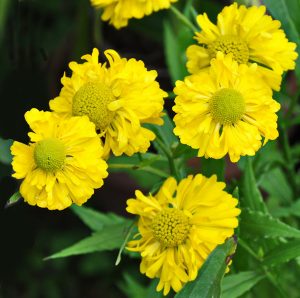
- ‘Double Trouble’ (PP 18,206, expires in June of 2026) is a vegetative cultivar with double, bright yellow, sterile flowers produced from midsummer through early fall. The pure bright yellow frilly ray flowers surround a gold disk. The first double flowered variety.
- ‘El Dorado’ is a vegetative, early flowering cultivar with a long bloom period. Flowers are yellow with slight streaks of red down the petals. Grows 3 feet tall plants.
- ‘Feuersiegel’ (“fiery lightning bolt” in German) is one of German nurseryman Karl Foerster’s very free-flowering releases (1959) with deep yellow flowers marked with forked streaks of red radiating from the light brown disk. The amount of red varies with temperature and light levels, so in some conditions flowers appear a red edged with yellow. Grows 4 feet tall.
- ‘Goldrausch’ (sometimes listed as ‘Gold Rush’) is another Karl Foerster cultivar with golden yellow flowers marked with brown and a green-brown disk on tall plants that reach 4 to 5 feet.
- ‘Helena’ series is seed propagated and grows 3 to 4 feet tall. It is available in ‘Gold’, with solid golden yellow flowers, and ‘Red Shades’ with flowers in a range of bronze, orange, and red shades, and ‘Mix’ which contains both of the above colors.
- Mardi Gras (variety ‘Helbro’) is a vegetative variety with numerous flowers with ray petals in shades of rich orange washed with yellow and red on 2-3 foot tall stiff-stemmed plants. Plants can begin blooming as early as late June into October. Zones 4-8. Introduced by Blooms of Bressingham.
- MARIACHI™ Salsa is a compact and floriferous variety with reddish-orange ray flowers around a brown cone from midsummer through fall on 20 inch tall plants. Mariachi™ Siesta has red-purple ray flowers.
- ‘Hot Lava’ is a very floriferous variety from the Netherlands with long-lasting orange red flowers with upturned petals around disks that begin yellow and change to maroon when mature. Grows 3 feet tall.
- ‘Moerheim Beauty’ is one of the most well-known and popular varieties, developed by Dutch breeder Bonne Ruys in the 1930s. This early bloomer has reddish bronze flowers in a range of shades, with some flecked with gold or copper, maturing to russet, around a dark center on 3½-4 foot tall plants which often need support. If deadheaded thoroughly it will reflower later in the season. It received the Royal Horticulture Society’s Award of Garden Merit in 2001.
- ‘Potter’s Wheel’ is a late season flowering Dutch hybrid with deep cherry red flowers with a narrow gold edge surrounding a maroon center on 2½ foot tall plants.
- ‘Pumilum Magnificum’ is an English variety that has been grown since the late 1890’s with early deep, pure yellow flowers on 2 foot tall plants. Has H. bigleovii parentage and may be short-lived in the landscape.
- ‘Ring of Fire’ is a semi-double flowered Dutch introduction with two layers of orange and yellow petals.
- ‘Rubinzwerg‘ (German for “ruby dwarf”) is a poplar cultivar released by Peter and Bärbel Zur Linden in 1989. It features flowers red petals that have hints of yellow near the cone, flowering from mid-summer to fall. The bushy plants are a little over 2 feet tall.
- ‘Sahin’s Early Flowerer’ is a seed propagated long-flowering hybrid. It starts blooming in mid-summer and continues until frost. Flower color changes from reddish-orange in hot weather to yellow in cool weather and each flower is different from the next.
- ‘Short ‘n’ Sassy’ is a compact vegetative cultivar that grows only 20 inches tall and wide, with golden-orange ray flowers around dark cones from summer to fall.
- ‘Waltraut’ is an older, vegetative variety (introduced by Gustav Deutschmann in Germany in 1947) with some H. bigloveii parentage. It grows about 3 feet tall and has orange flowers flecked with gold that deepen in intensity of orange as they mature. It begins blooming from early July.
Author: Susan Mahr, University of Wisconsin—Madison
Reviewers: Allen R. Pyle, Horticulture Outreach Specialist, Bruce Spangenberg, Horticulture Outreach Specialist, UW—Madison Extension
Revised: May 2026