Overview
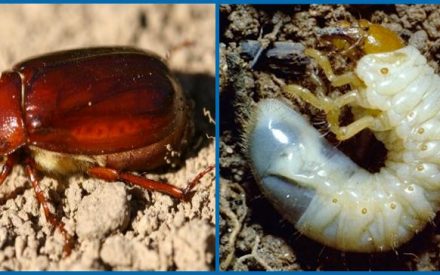
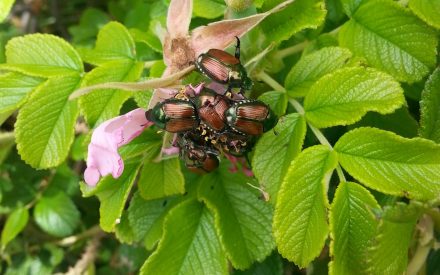
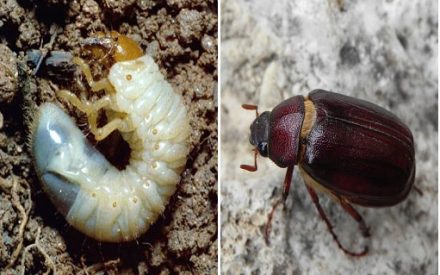
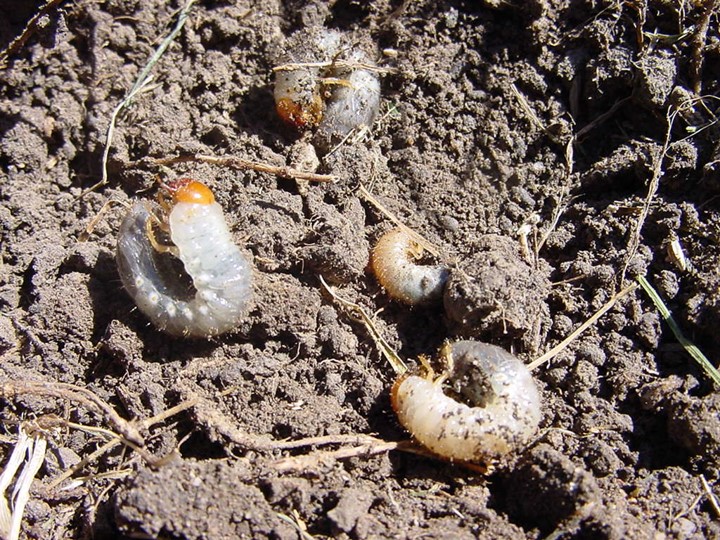
Most white grubs in the Midwest are beneficial scavengers that help break down organic matter in the soil. However, several species of white grubs can be considered turfgrass pests. These grubs are the larval stages of scarab beetles such as Japanese Beetles, May/June Beetles, European Chafers, and Northern Masked Chafers.
How to Identify White Grubs
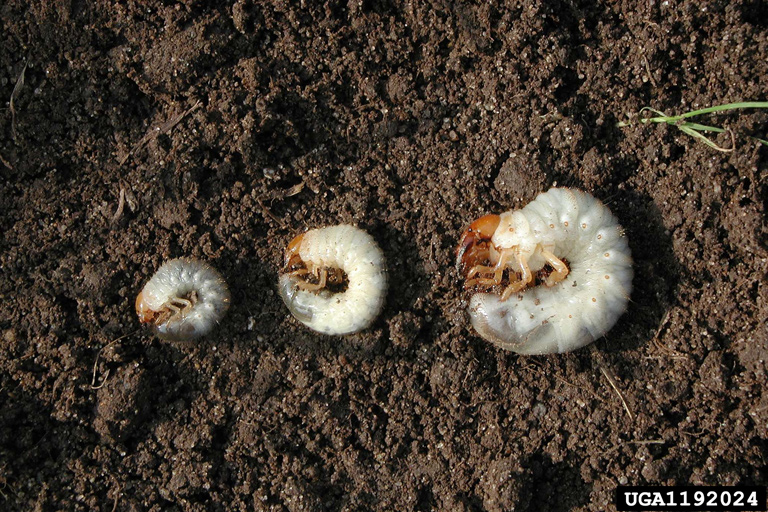
White grubs have pale, C-shaped bodies, brownish-orange heads and three pairs of legs. The head possess strong mandibles (mouthparts), which they use to chew on organic matter, including plant roots. White grubs can vary in size from less than ¼ inch long to over one inch long depending on the species and their stage of development.
Symptoms and Damaged Caused by White Grubs
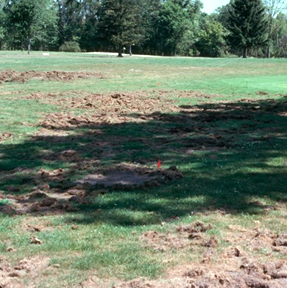
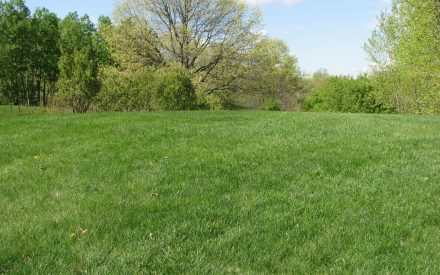
The white grubs occasionally found in turfgrass live in the root zone and feed on plant roots. Most lawns and other turfgrass areas in Wisconsin will be home to a few white grubs, but as long as grubs are present in low numbers and the turf is properly cared for, no noticeable damage occurs. However, when grubs are abundant, they can cause significant damage leading to irregular brownish patches of turf. If damage is severe, the turf can sometimes be rolled backwards like a carpet. Additional damage can also occur when animals (e.g., skunks, raccoons, turkeys, crows, etc.) dig into the turf to feed on the grubs.
How to Manage White Grubs in Turfgrass
Control of white grubs can involve use of non-chemical, chemical and biological methods or a combination of methods.
Non-chemical management
A strong, robust lawn can tolerate some grubs without issue. Good lawn-care practices (e.g., watering, fertilization, mowing) can go a long way to maintaining a robust lawn. Water and fertilize turfgrass areas optimally to help them tolerate white grub feeding. In addition, be sure to mow at the correct height and at the correct frequency to encourage deep root growth. Most turfgrass areas in Wisconsin do not require treatments for white grubs. However, if damage does occur, reseed damaged areas as needed. See Watering Your Lawn, Lawn Fertilization, Lawn Maintenance and Lawn Establishment & Renovation for details on these aspects of turfgrass maintenance.
Chemical management
Consider using insecticides in turfgrass settings where there are existing or anticipated high grub populations, and in settings (e.g., golf courses, sports fields, etc.) where tolerance for grub damage is low. There are two approaches to managing white grubs with insecticides: preventative control and curative control. Preventative insecticides provide long-lasting protection. They are most effective against small grubs, and often work poorly against older, larger grubs. Preventative insecticides should be applied around the time or just before egg-laying by the adult beetles to maximize effectiveness. Curative insecticides typically work for a short period of time and are used when grubs are present and damage is noted (often August – October). See the tables below for available products and their timings of application.
Both granular and liquid formulations of white grub chemical insecticides are available. For all products, you must apply approximately ½ inch of water after application to wash the insecticide into the root zone where grubs are, and maximize effectiveness. Failure to water in treatments will result in poor control.
Note that neonicotinoid insecticides used for grub control can pose risks to bees and other pollinators. However, there are a number of approaches that can be used to reduce risks to bees and other pollinators. See Conservation of Native and Domestic Pollinators in Managed Turfgrass Landscapes for guidance on protecting pollinators in turfgrass areas.
Biopesticides and biological control
Biological insecticides available for grub control include Bacillus thuringiensis galleriae (grubGONE! G), Paenibacillus popilliae (Milky Spore) and Heterorhabditis bacteriphora (Nemaseek). Consult product labels for application instructions and timing. These products often provide limited and highly variable control compared to chemical insecticides. In particular, Paenibacillus popilliae (Milky Spore) has not been found to be effective for white grub control in recent university research.
Insecticides to Manage White Grubs in Lawn and Turfgrass
| Active Ingredient | Trade Name Examples | Insecticide Class | Approach |
|---|---|---|---|
| Carbaryl | — | Carbamate | Curative |
| Chlorantraniliprole | Acelepryn, Scotts GrubEx | Diamide | Preventative |
| Cyantraniliprole | Ference | Diamide | Preventative |
| Clothianidin | Arena and others | Neonicotinoid | Preventative + Curative |
| Dinotefuran | Zylam | Neonicotinoid | Preventative |
| Imidacloprid | Merit and others | Neonicotinoid | Preventative |
| Thiamethoxam | Meridian and others | Neonicotinoid | Preventative + Curative |
| Trichlorfon | Dylox | Organophosphate | Curative |
Optimal Insecticide Application Timing by White Grub Species
Proper timing is important to maximize the effectiveness of grub control products. Treatment timing can vary by white grub species.
| Species | Preventative Approach | Curative Approach* |
|---|---|---|
| Japanese beetle | June – July | August – October |
| May/June beetle | May – Early June | July – September |
| European Chafer | Late May – Mid July | August – October |
| Northern Masked Chafer | June – July | August – October |
Authors: PJ Liesch and Vijai Pandian, UW-Madison Extension
Revised: January 29, 2026
Former item number: XHT1018
Additional Resources
- Japanese Beetle
- Turfgrass Disorder: White Grubs
- Managing Turfgrass Pests in Wisconsin
- Conservation of Native and Domestic Pollinators in Managed Turfgrass Landscapes
- Northern Masked Chafer
- European Chafer
- Watering Your Lawn, Lawn Fertilization
- Lawn Maintenance
- Lawn Establishment and Renovation
- Turf Management website