Overview
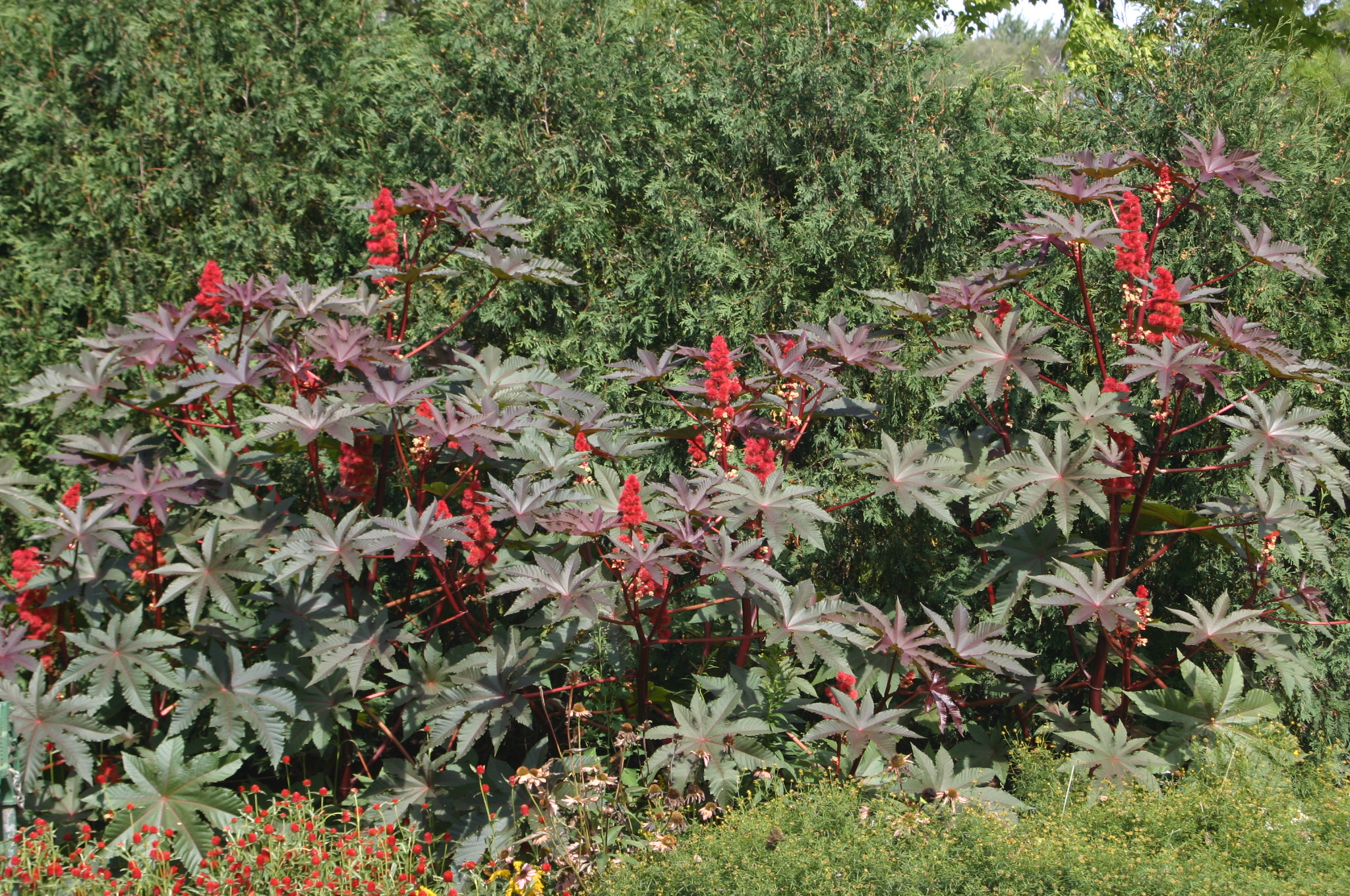
With oversized, tropical-looking leaves and unusual seed pods, castor bean is an exotic addition to the ornamental garden. The only member of the genus, Ricinus communis is in the Spurge Family (Euphorbiaceae). The word ricinus is Latin for “tick”, used for this plant name because of the superficial resemblance of the seeds to a particular species of European tick. Castor bean is native to tropical east Africa around Ethiopia, but has naturalized in tropical and subtropical areas around the world to become a weed in many places, including the southwestern U.S. Plants are typically found in moist, well-drained soils in disturbed areas, such as along river beds and roadsides, and in fallow fields or at the edges of cultivated lands.
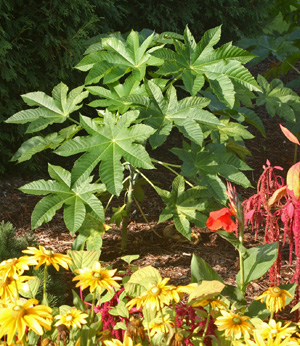
Castor bean is a tender evergreen herbaceous or semi-woody large shrub or small tree. In suitable climates, it can grow to 40 feet tall, developing woody stems over a few years. Because of its rapid, vigorous growth, it is easily grown as a warm season annual in cold climates, where it usually grows 6-10 feet in a single growing season. This fast growing plant tends to grow straight up at first, developing branches later in the season to form a well-proportioned shrub with sturdy stems and a dense canopy. The plant is killed when the temperature drops below 32 °F. Unlike many members of the euphorbia family, castor bean does not have milky latex sap, but has a watery sap.
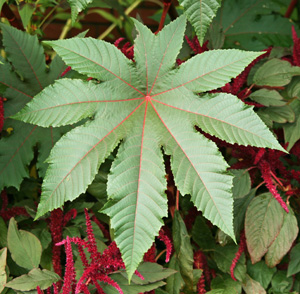
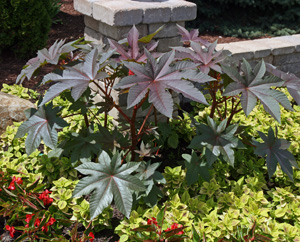
The alternate, star-shaped leaves on long petioles can grow over 2½ feet across. Each palmate leaf has 5 to 11 deeply incised lobes, with serrated edges and prominent central veins. The species has glossy green leaves, but cultivated selections may have black-purplish, dark red-metallic, bronze-green, or maroon leaves, or bright green leaves with white veins.
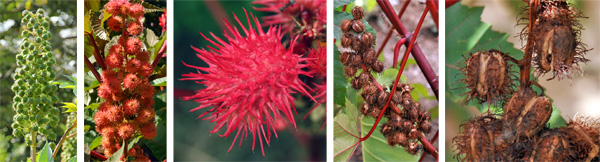
Flowers are produced in dense inflorescences 8-18″ tall at the tops of the stems. The monoecious plants produce male flowers below the terminal female flowers. The flowers do not have petals and are not particularly showy. The ½ inch male flowers each have a cluster of many cream or yellow stamens that shed large amounts of wind-borne pollen. They senesce soon after shedding their pollen. The three conspicuous, star-shaped stigma lobes of the female flowers are bright red with feathery branches.
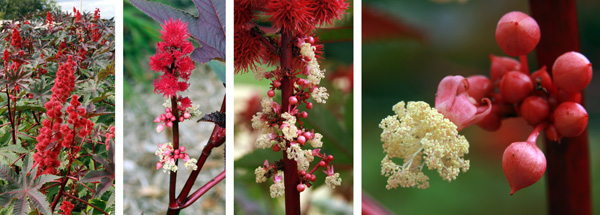
The little spiny ovary of the female flower develops into a fruit or seed capsule about the size of a golf ball after pollination. The seed pods may be green, pink, or red (depending on the variety), but gradually age to brown. Each spherical, seed capsule is thickly covered with soft flexible spines and has three sections that separate when the seeds are mature. Each section contains one seed that is ejected, often with considerable force, when the carpel splits open.
The ½ inch long seeds, or “beans” (they are not true beans), are produced in large numbers where the growing season is long enough (140 to 180 days). The shiny, intricately mottled seeds are quite attractive, each with their own unique design in colors of black, gray, brown, yellow-brown, maroon and white.
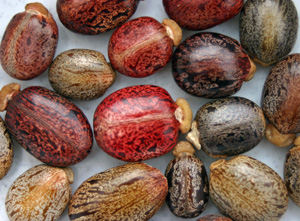
Each seed has a small, spongy caruncle at one end which helps absorb water for germination when planted. Seeds remain viable for 2-3 years. About half the weight of the seed is a thick, yellowish or almost colorless oil that has been used in many industrial applications. The oil was used in ancient times as fuel for lamps, and is now used in paints and varnishes, for water-resistant coatings, in high-performance motor oils, soap, inks, and plastics. Other derivatives are used in polishes, as solid lubricants, in synthetic perfumes and other products. Plants are grown commercially for oil production primarily in India and Brazil, but also in some parts of the U.S. and other countries.
Toxicity of Castor Bean
All parts of castor bean plants are toxic, and the seeds are extremely toxic. Always keep plants out of reach of children (or trim off flowering spike if this is a concern). The toxin in castor seeds is ricin (RYE-sin), one of the deadliest natural poisons. Ingestion can cause vomiting, severe abdominal pain, diarrhea, convulsions, and death. Livestock and poultry can also be affected if they consume seeds or meal from the seeds. Although it is a very potent poison, ricin has been investigated as an anti-cancer agent. Ricin is water soluble, not lipid (oil) soluble, so it is not released during the pressing process that extracts oil, instead remaining in the leftover “seed cake.” This residue is used as a high-nitrogen fertilizer, or after detoxicating, the meal can be used as livestock feed. Since the toxin does not occur in the pure oil, castor oil can be consumed and has been used medicinally as a remedy for everything from constipation to heartburn. It is an effective cathartic or purgative (laxative) and can be used externally as an emollient for dry skin.
Using Castor Bean in the Landscape
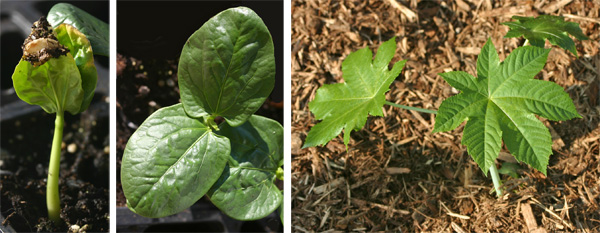
When grown as an ornamental, castor bean seed can be planted directly in the garden in late spring, or started indoors earlier (6-8 weeks before the average last frost) and transplanted outdoors when the weather warms. Nick or scarify the seeds or soak overnight for better germination. Sow the seeds 1-1½ inches deep. Seedlings should start coming up in 1-3 weeks. The young plants grow quite quickly and may need repotting into larger containers before transplanting outdoors. Place the plants outdoors in full sun and deep, rich soil about 4 feet apart. Provide plenty of water and fertilizer to achieve the largest size.
Once established, plants will tolerate drought. Wind can shred the leaves, so they should be placed in a protected spot if possible. Plants can be pruned to limit the size, or may need staking if top heavy; otherwise this plant needs very little maintenance. Castor bean has few pests, although spider mites can sometimes be a problem in hot, dry weather.
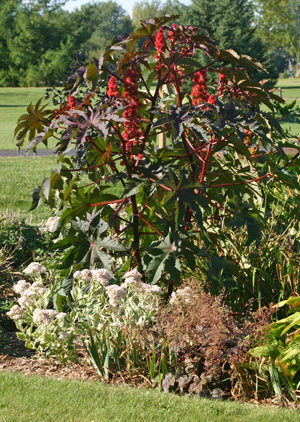
With its large leaves and tall stature, castor bean makes a bold statement in the garden. The coarse texture contrasts well with finely textured plants. Grow castor bean as a specimen for a dramatic focal point in the landscape, or in groups for a tropical effect in the back of beds or near water features. It can be used to create a temporary screen or informal hedge or can be grown in large containers on patios. Castor bean combines well with cannas, bananas and elephant ears for a tropical garden. Or use it as a backdrop for grasses and other large-scaled annuals for a more traditional look.
Recommended Castor Bean Cultivars
A range of varieties have been selected for their leaf or flower/fruit colors, and for oil production. Some of the most common ornamental types include:
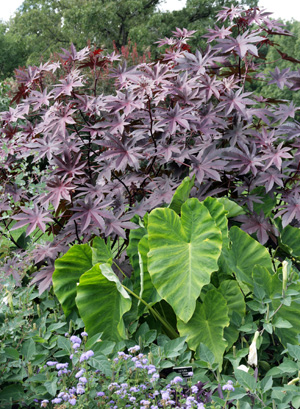
ornamental types selected for different leaf
color and plant height.
- ‘Carmencita Bright Red’ – has red stems and bright red seed pods, along with dark bronze leaves. This well-branched cultivar grows 5-6 feet tall.
- ‘Carmencita Pink’ – has pinkish-red stems and seed pods.
- ‘Carmencita Rose’ – has blue-green foliage and peach-colored seed pods.
- ‘Gibsonii’ – has dark red-tinged leaves and pinkish seed pods, it grows 4-5 feet tall.
- ‘Impala’ – a compact cultivar that grows to 4 feet tall with reddish-purple leaves and stems, with the brightest color on the new growth.
- ‘New Zealand Purple’ – has smaller, reddish purple leaves and less branching than other varieties.
- ‘Red Spire’ – grows 7-10 feet tall, with red stems, bronze leaves, and red seed pods.
- ‘Sanguineus’ – has blood-red stems and leaves.
- ‘Zanzibarensis’ – another tall variety (7-10 feet) with green leaves with white midribs.
Author: Susan Mahr, University of Wisconsin—Madison
Reviewers: Allen Pyle, Horticulture Outreach Specialist, Bruce Spangenberg, Horticulture Outreach Specialist, UW—Madison Extension
Revised: March 30, 2026