Overview of Angel’s Trumpet
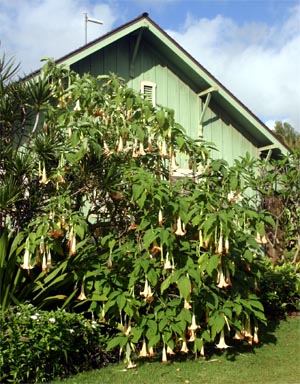
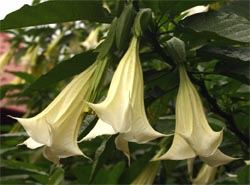
Brugmansia is an exotic, small tender tropical tree in the family Solanaceae, commonly called angel’s trumpet. It produces dramatic, pendant, fragrant, trumpet-shaped flowers. They can reach up to 30 feet tall when grown outdoors in tropical and subtropical climates (more often 15 to 20 feet) but adapt well to container culture, where the plants remain a much more manageable size (4 to 15 feet) through pruning and root restriction.
Brugmansia is native to South America, particularly the Andes, where plants grow on sloping terrain with warm, humid days and cool nights. It is a long-lived perennial in zone 9a and warmer. There are several species (which are not readily available except from specialty nurseries), many of which have been hybridized to create spectacular cultivars.
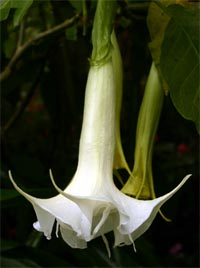
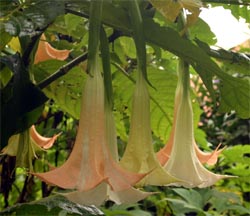
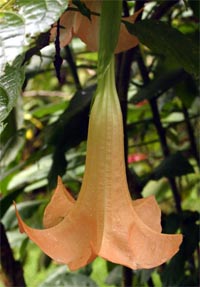
There is great diversity among Brugmansia flowers, and individual blooms range in size from 4 to 24 inches long depending on the species and cultivar. They come in many shades of white, yellow, gold, orange, peach and pink. There are single, double, triple, quadruple and shredded flower forms, in a variety of funnel and trumpet shapes. Some cultivars bloom throughout the growing season, others flower in flushes every 6 to 8 weeks, while some only produce flowers in cool weather. Some varieties produce numerous flowers while others have few flowers. Flowering, flower color, and flower form are affected by light levels, pH, nutrition, stress, temperature, and humidity, so flowering may vary even for the same cultivar depending on the location and conditions where it is grown.
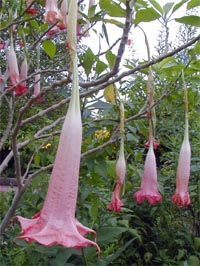
Fragrance varies considerably, too, with intensity ranging from none (B. sanguinea) to overpowering. The intoxicating scents are variously described as musk, lemon, mint, lily, hyacinth, citrus, jasmine, gardenia, and more. Regardless, the fragrance is most noticeable on warm summer evenings.
At one time these plants were included in the genus Datura but taxonomists have divided the two groups into different genera. Brugmansia species are long-lived, woody perennials, eventually reaching heights of over 20 feet in frost-free areas. They have downward to slightly outward-facing, large (6 to 24 inch long) trumpet-shaped blooms, in shades of white, cream, yellow, peach, orange, pink, and red and rarely set seed. In contrast, Datura species are short-lived tender herbaceous perennials (rarely living more than 3 to 4 years even in frost-free areas), usually grown as annuals, and rarely exceed heights over 6 feet tall. Their smaller (2 to 8 inches long) white, cream, yellow, lavender or purple flowers are held upright above the plants and set seed freely.
All parts of Brugmansia are highly toxic due to tropane alkaloid content. Keep plants out of reach of children and pets and never consume any parts of these plants.
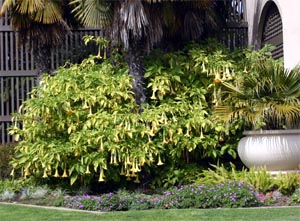
Landscape Use of Angel’s Trumpet
In the upper Midwest, in-ground or potted plants grow well in full sun; in hotter climates they benefit from afternoon shade. Container-grown plants must be brought inside when temperatures begin to cool. In the fall, move plants you wish to keep indoors before the first frost, checking carefully for insect hitchhikers. You may wish to spray the plants to minimize potential pest problems. They can be treated as a houseplant in winter if kept in a greenhouse or other sunny spot; otherwise they will lose most of their leaves. Plants will flower year-round if they get enough light and temperatures are above about 60 °F. Provide moderate amounts of fertilizer and as day length increases, more flowers will appear.
Unless it can be maintained in a suitable location, it is easiest to overwinter Brugmansia by keeping the plant in a cool, poorly lit area (such as a basement) and allowing it to go dormant, watering only as often as necessary to keep the soil barely moist. Let the leaves fall off the stems and check every few weeks to make sure the soil does not dry out too much. If the plants are already in containers it is not necessary to prune them except to fit into their indoor spaces. In the spring, once the danger of frost is gone, move them outside or plant in the ground for the season. Prune and shape at this time.
Plants growing in the ground can be cut back to the soil level to create multiple cuttings in the fall, or they can be dug up and potted for overwintering. Cut-off plants stored over the winter in a cool, dark room might produce roots and can then be potted up when they begin producing leaves the next spring.
Wait until all chance of frost has passed before moving Brugmansias outside again, gradually increasing their exposure to sun and wind over a few days. The plants can then be pruned – hard if necessary – to encourage bushy growth, shape the plant or limit size.
Propagating Angel’s Trumpet
Species can be grown from seed (hybrids cannot) but most people purchase specific cultivars grown from cuttings. This plant is easily propagated from stem cuttings rooted in water or in damp sand or perlite without rooting hormone (although hormone can be used). Use semi-hardwood cuttings (taken from stems that have begun to change color from green to brown) at least the diameter of a finger and 6 to 8 inches long. Cuttings can be taken any time the plant is actively growing, and any part of the trunk or branches can be used. Strip off all leaves and buds except the topmost set of small leaves. Put the cuttings in 2 to 3 inches of water in a brightly-lit, warm place, changing the water every day or two and keeping the level consistent. Alternatively, insert the cuttings a third of their length into the rooting medium, pressing the medium around the cutting, water thoroughly, let drain completely, cover if humidity is low (not necessary when humidity is high) and place in a bright, warm place. Pot up cuttings in medium sized pots when roots are several inches long, usually in several weeks. Water thoroughly but wait until the soil becomes almost completely dry to water again until the plant is established, to prevent root rot. Brugmansia grows quickly, and plants need to be transplanted to a larger container when the roots have filled the smaller pot.
General Care of Angel’s Trumpet
Brugmansia is a very heavy feeder and benefit from regular fertilization – as often as twice a week during the growing season (the more food, the more flowers it will produce). It consumes amazing amounts of water, but it also requires good drainage and does not like to stand in water, so a large plant may require frequent watering. The leaves will droop when it needs watering, and quickly recovers when watered. You may need to water your plant 2 to 3 times daily on hot summer days. The plants will need much less water and fertilizer in the winter (little water and no fertilizer if allowed to go dormant).
These plants are very attractive to several insect pests. Aphids, mealybugs, whiteflies and especially spider mites will ravage the plants if left unchecked. All of these pests are easily controlled with insecticidal soap but this needs to be applied regularly to the underside of the leaves (directly onto the pests) to keep populations under control. The plant will drop its leaves when heavily infested but generally regenerates new leaves quickly (give the plant more fertilizer when this happens). If you are growing your plants year-round (not allowing them to go dormant), be aware that insect pest populations begin to increase as day length increases, so keep on the lookout for infestations on growing plants throughout the winter, but especially in March and April.
Species and Varieties of Angel’s Trumpet
There are many species and hundreds of cultivars and hybrids of Brugmansia that are available to purchase, although many retailers only offer unnamed plants labelled with flower color (e.g. white, pink, yellow). All grow to 3 to 6 feet in containers and bloom primarily in spring, summer, and fall (unless otherwise noted). Some of the more commonly offered or interesting varieties include:
- Brugmansia arborea has the smallest flowers, which are nodding rather than pendant.
- Brugmansia sanguinea is the only species that has true red flowers but it is not fragrant.
- Brugmansia versicolor has beautiful pale apricot flowers. This species from Ecuador has the largest flowers.
- Brugmansia x candida ‘Shredded White’ has double white flowers but the petals are twisted, and divided, with curly tendrils, making the flower look distinctively different. Thought to be a hybrid between B. aurea and B. versicolor.
- Brugmansia x insignis ‘Pink’ is supposedly one of the easiest to bring into flower. The widely flared, 8 to 10 inche flowers are a pale pink at the top and graduate to a deep, salmon-pink at the trumpets flare. This cross between B. suaveolens and a hybrid of B. suaveolens and B. versicolor is a prolific bloomer.
- ‘Charles Grimaldi’ is an old favorite that produces profuse, intensely fragrant blooms of a luminous golden color changing to orange-salmon with maturity.
- ‘Cypress Gardens’ is one of the best for containers. Young plants often flower at 3 feet in height with dozens of trumpets opening at once. The white flowers fade to a light salmon with age. It is most fragrant at night.
- ‘Ecuador Pink’ is a popular variety with one of the deepest pink flowers. It produces flushes of long, pink trumpets with fluted edges every month under optimal conditions.
- ‘Inca Sun’ is a new hybrid that flowers continuously from the spurs and shoots and on very small plants (under two feet). Typical cultivars flower, then stop, grow and flower again, but the flowering mechanism for this hybrid is different so it continues to flower and grow simultaneously. The moderately sized flowers open in tones of light yellowish peach. It grows to 4 to 6 feet in a container.
- ‘Jamaican Yellow’ has very fragrant, lemon yellow flowers.
- ‘Miner’s Claim’ has cream-margined salmon-pink flowers and variegated leaves.
- ‘Peaches and Cream’ has cream white flowers and variegated leaves.
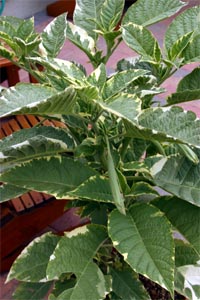
- ‘Sunset’ has pale yellow to light peach flowers and variegated leaves splotched with light green and cream white.
Author: Susan Mahr, University of Wisconsin—Madison
Reviewers: Allen R. Pyle, Horticulture Outreach Specialist, Bruce Spangenberg, Horticulture Outreach Specialist, UW—Madison Extension
Revised: May 2026