Overview of Scarlet Runner Bean
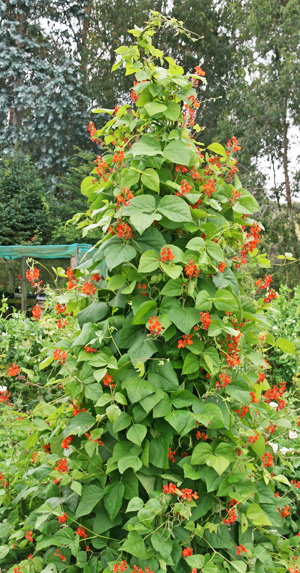
Scarlet runner bean, Phaseolus coccineus, is an herbaceous tender perennial plant native to the mountains of Mexico and Central America, growing at higher elevations than the common bean (P. vulgaris). By the 1600s, this species was being grown in English and early American gardens as a food plant. In the US, it is most commonly grown as an ornamental annual for its showy sprays of flowers. It is commonly grown as a food crop in cool summer parts of Europe.
In mild climates (zones 7a to 11b) it a short-lived perennial vine, forming tuberous roots from which new shoots sprout annually. In Mesoamerica, these starchy tuberous roots are used as food.
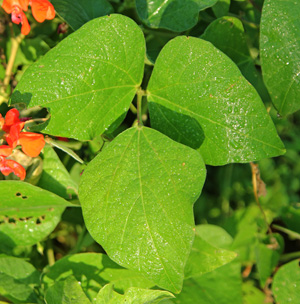
P. coccineus looks very similar to pole bean, with dark green, heart-shaped trifoliate leaves with purple tinged veins on the undersides. The vigorous, rapidly growing vines climb by twining and can reach 15 feet or taller (although they tend to grow 6 to 8 feet tall in most Midwestern gardens), rambling through other vegetation or climbing on a trellis or other support in a garden.
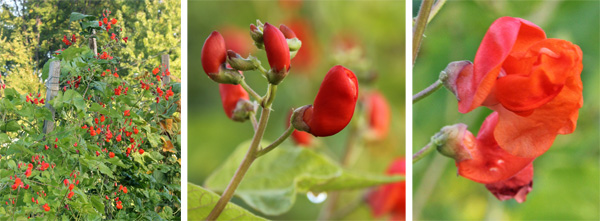
About two months after sowing, plants produce scarlet red, or occasionally white, typical legume flowers with the two lowermost petals combining into a “keel”, the uppermost petal modified into a hoodlike “standard”, and the petals on the sides spreading as “wings.” Flower clusters (racemes) can be up to 20 inches long.
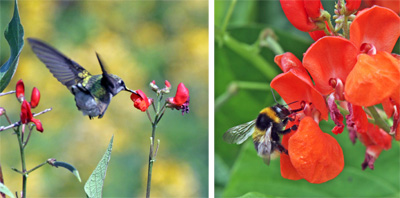
Flowers open at sunrise and fade at sunset. The flowers are highly attractive to hummingbirds and bees. Flowers are followed by typical bean pods up to a foot long. Under ideal conditions, scarlet runner bean is the most productive of all the beans. Fewer pods are set in hot weather, so the best bean production occurs in cooler summers and in the fall. The seeds are about an inch long, with 6 to 10 seeds per pod.
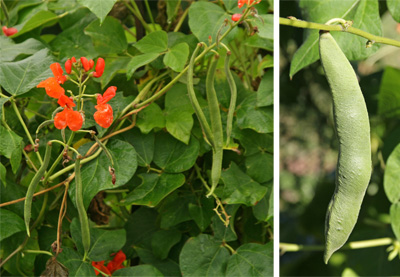
The edible flowers have a bean-like flavor and can be used in salads. The green pods are edible until they become fibrous and can be boiled, steamed, sautéed, or baked (but should be eaten raw only sparingly, as they are mildly toxic when consumed in large quantities). Because they are tougher than many green beans, they are best sliced before cooking. Some people do not like the rough texture of the skins.
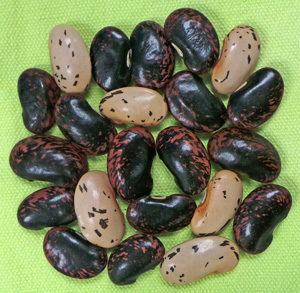
The white or multicolored seeds inside the pods can be shelled and cooked fresh shell beans (like lima beans) while still light pink or they can be dried. The dried seeds, which have a chestnut-like flavor, require a long soaking and cooking time.
The seed color varies from white to shining black to violet-black mottled with deep red or violet-purple mottled in black, although their gray color when cooked is not particularly attractive.
Landscape Use of Scarlet Runner Bean
Scarlet runner bean is often grown as an ornamental for its colorful flowers. Removing the developing pods encourages plants to continue to flower. Use the vining plants as a temporary cover on a chain link fence, as a seasonal privacy barrier, or up a trellis to screen a unattractive view. Grow them on a trellis, tuteur, or a teepee of poles to create a vertical element in a border or bed, or as a focal point in the garden. Combine them with white morning glory or yellow and orange black-eyed Susan vine (Thunbergia alata) for a variety of colors on the support structure.
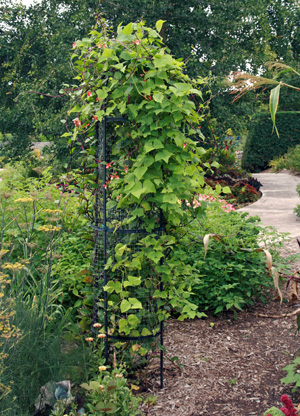
For the best results, grow scarlet runner beans in full sun in soil with plenty of organic matter and average moisture. This species is more cold tolerant than most other bean species, so seeds can be sown before the soil has warmed completely (but the soil temperature is at least 50 °F), but the foliage cannot tolerate frost so don’t plant too early.
General Care of Scarlet Runner Bean
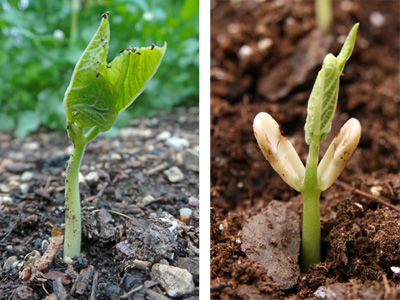
Direct sow in the garden, planting seeds 2 to 3 inches deep and spacing them 4 to 8 inches apart. Unlike common green beans, when the seed germinates, the cotyledons remain underground (hypogeal germination). Germination takes 7 to 14 days. Seed can be started indoors a few weeks before the average last frost and transplant into the garden after hardening off the seedlings. Place supports such as poles, strings or netting near the plants at the time of sowing or transplanting. Protect the young plants from rabbits and slugs. Provide abundant water during flowering and pod expansion; mulching around the plants will conserve water. Do not fertilize heavily as this will promote lush foliage instead of flowers and beans.
Propagating Scarlet Runner Bean
Runner beans readily cross-pollinate, so grow different varieties in isolation to ensure seed is true to type. Typically, 160 to 500 feet between varieties is sufficient to ensure trueness. To save seed, allow pods to remain on the vines as long as possible, preferably until they are completely dry and the seeds inside rattle. If frost threatens, pick mature pods and bring them indoors to complete drying. Although this plant is normally grown as a warm season annual, the tuberous roots can be dug up and stored in cool, damp sand for replanting in spring. Plants grown from overwintered tubers flower earlier than plants started from seed.
Cultivars of Scarlet Runner Bean
A number of cultivars have been selected, but many are not readily available in the United States. Some varieties have been bred for edible use and tender pods. This species is commonly offered as just scarlet runner bean, with no specific variety.
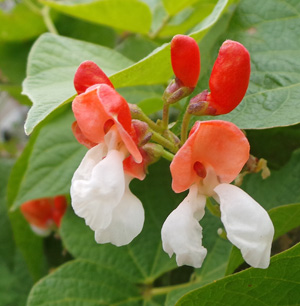
- ‘Black Coat’ (sometimes listed as ‘Black Runner’) has intense tangerine to crimson flowers and jet black seeds. It grows 6 to 7 feet tall and produces short-podded beans about 70 days after sowing.
- ‘Enorma Exhibition Variety’ has extra large pods that can reach 20 inches long. Productive, with excellent flavor.
- ‘Golden Sunshine’ has chartreuse green foliage, vines that reach 5 to 8 feet tall, scarlet flowers. It is productive, with tender pods produced 80 to 85 days after sowing.
- ‘Hammond’s Dwarf’ is a dwarf, bush type that grows just 1.5 to 2 feet tall, with small (4 to 5 inch) pods.
- ‘Hestia’ is a dwarf selection with a compact, bushy habit and bicolor red and white flowers and narrow, stringless pods. It grows just 18 inches tall.
- ‘Lady Di’ has scarlet flowers and long, narrow, dark green stringless pods that are slow develop seeds, giving an extended harvest window before pods become tough. Grows 6 feet tall.
- ‘Moonlight’ has white flowers and large, stringless pods. Highly productive.
- ‘Painted Lady’ has bicolor red and pink or white flowers on vigorous vines that grow 8 to 10 feet tall. The seeds are cream colored streaked with deep brown markings. Produces beans 80 days after sowing.
- ‘Polestar’ has red flowers and produces stringless pods over a long harvest season. Beans are best when picked at 6 to 8 inches long.
- ‘Scarlet Emperor’ is a productive variety with long, stringy pods and black and purple mottled seeds. Pods are produced over a long season. Grows to 9 feet tall.
- ‘Sunset’ has pink flowers and grows about 6 feet tall. Produces beans 65 to 70 days after sowing.
- ‘White Emergo’ (sometimes listed as ‘Sweet White’) has white flowers and pods filled with large, white seeds.
Author: Susan Mahr, University of Wisconsin—Madison
Reviewers: Allen R. Pyle, Horticulture Outreach Specialist, Bruce Spangenberg, Horticulture Outreach Specialist, UW—Madison Extension
Revised: June 2026