Overview
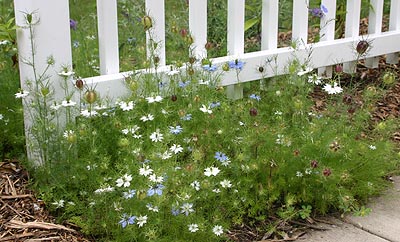
Love-in-a-mist, Nigella damascena, is a charming old-fashioned flower that blooms in spring and early summer. The genus name Nigella comes from the Latin niger (black), referring to the intense black seeds. One of about 15 species in this genus in the buttercup family (Ranunculaceae), N. damascena comes from southern European and northern Africa. In its native habitat it grows in fields, along roadsides and in rocky or waste ground.
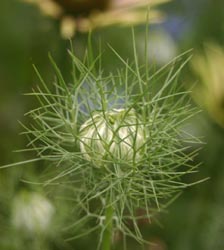
This small to medium sized annual grows 15 to 24 inches tall and up to a foot wide (if not crowded). Plants have finely cut, bright green leaves that resembles fennel leaves. Light green, lacy, finely divided, threadlike bracts form the “mist” surrounding the jewel-like flowers.
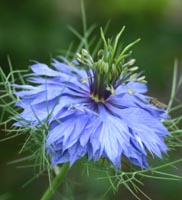
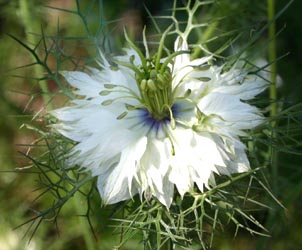
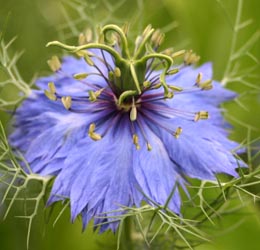
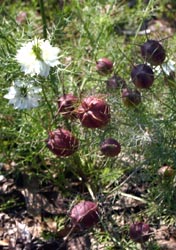
Flowers are usually bright blue to very pale blue but some may be white, pink, or lavender. Each flower is 1½ inches across, with 5 large, petal-like sepals and small, deeply divided petals hidden beneath the stamens. The flower is followed by attractive, balloon-shaped “seedpod” (actually an inflated capsule composed of 5 fused true seedpods) up to 2 inches long and green with purple or bronze stripes.
Landscape Use of Love-in-a-Mist
Love-in-a-mist is attractive in the garden even when the plant is not in bloom, with its handsome foliage and interesting seedpods after flowering.
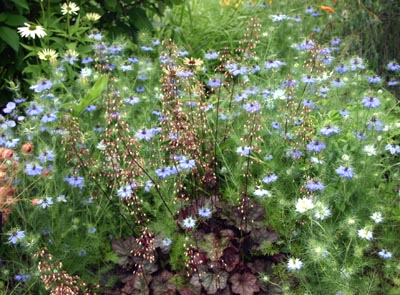
N. damascena works well mixed with other annuals in the informal or cottage garden. It is good for filling gaps in the flower border and for short-term massed bedding. Individual plants can be added to hanging baskets, window boxes or containers where the finely-cut foliage provides nice contrast until the plants begin blooming. Love-in-a-mist can be used for edging, as a mass planting or in combination with silver-leaved plants such as dusty miller or lamb’s ear. They are also good options for an “everlasting” garden by planting with strawflowers, bachelor buttons, bells of Ireland, globe amaranth, and other flowers for drying.
Love-in-a-mist is very easy to grow. The plants do best in full sun in well drained, fertile soil.
Love-in-a-mist tolerates frost so is primarily a spring and fall annual; it does not perform well in hot weather.
N. damascena has a short bloom period (only a month or two). Make successive plantings every three weeks for continuous bloom all summer. Thin the seedlings to 8-10″ between plants when large enough to handle. The plants should begin blooming about three months after planting. Deadheading will prolong flowering (but will eliminate seedpods). Spring-seeding often produces smaller plants with smaller flowers. In many areas, summer or fall sowing will produce seedlings that overwinter to grow earlier and larger the following spring (but then are spent earlier in the season).
Once established, love-in-a-mist readily self-sows. Thin the seedlings while small, if desired, to prevent overcrowding or encroachment on neighboring plants. Deadhead regularly or remove seedpods early to reduce the density of volunteer seedlings. The aromatic seeds have been used, particularly in Turkey, the Middle East and India, for culinary and medicinal purposes, although this species is inferior to N. sativa (black cumin) whose seeds develop a slightly bitter, oregano-like flavor and aroma when ground or chewed.
Both the flowers and the decorative green and burgundy seed pods can be used in fresh or dried floral arrangements. Cut flowers last longer if the leaves are removed from the lower part of the stem. To dry the seed pods, harvest when the stripes are still visible and hang pods upside down in a dry, dark, airy place. You may want to place them in paper bag to contain the seeds. Dividing the pods into small batches in separate bags facilitates more rapid drying than placing them all in one large bag.
Propagating Love-in-a-Mist
Sow the deep black, sharp-cornered seed about ⅛” deep where you want the plants to grow, as love-in-a-mist does not transplant well due to its long taproot. Seeds should germinate within 2 to 3 weeks under most conditions. Begin sowing as soon as the soil can be worked in early spring. Seeds can be started indoors 4 to 6 weeks before transplanting outdoors but they should be sown in plantable peat pots and transplanted with care.
Cultivars of Love-in-a-Mist
The cultivars have larger flowers, often with extra rows of sepals (double flowers), and come in a wider range of colors than the species, which is typically just blue. Some cultivars include:
- ‘Albion’ series was developed for cut flower use. Plants grow 2 feet tall, with double flowers. ‘Albion Black Pod’ has white flowers and dark purple pods. ‘Albion Green Pod’ has white flowers with green pods.
- ‘Delft Blue’ has purple flowers splashed with shades of blue-grey and grows 2 to 3 feet tall.
- ‘Miss Jekyll’ series has semi-double flowers and grows about 20 inches tall. It is available in Dark Blue (sometimes listed as Indigo), Light Blue, White, and Mix.
- ‘Moody Blues’ grows to 30 inches tall, with double flowers in various shades of blue. Good as a cut flower and for mass planting.
- ‘Persian’ series (sometimes called ‘Persian Jewels’) grows to 18 inches tall, with semi-double flowers and striped pods. Available in ‘Mulberry Rose’ with flowers in pink shades, ‘Oxford Blue’ with deep blue flowers, and a mix of these colors plus white.
Author: Susan Mahr, University of Wisconsin—Madison
Reviewers: Allen R. Pyle, Horticulture Outreach Specialist, Bruce Spangenberg, Horticulture Outreach Specialist, UW—Madison Extension
Revised: August 2026