

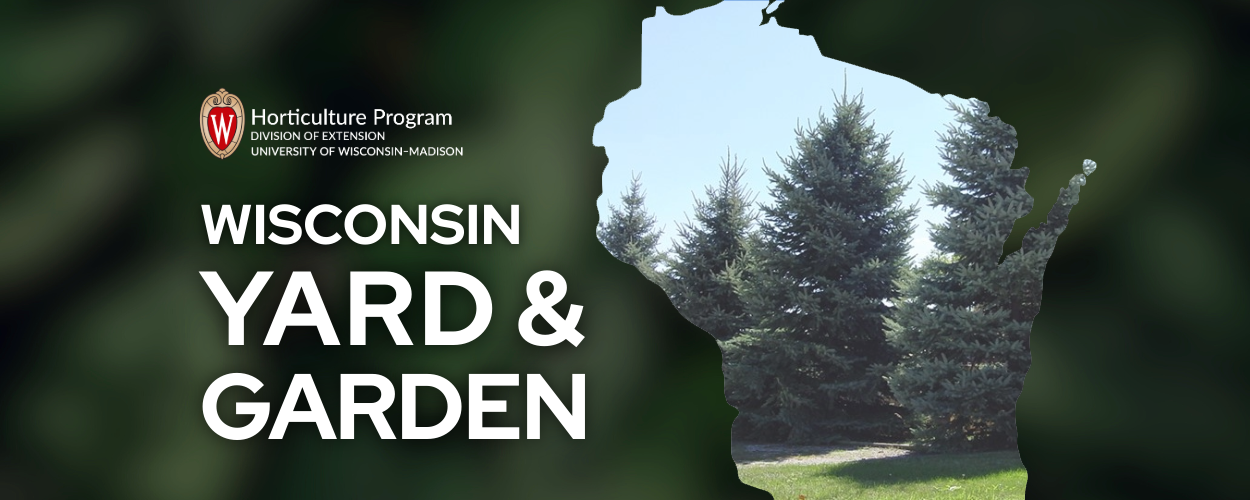
Spruces are among the evergreen conifers that become very prominent in landscapes and forests across Wisconsin as we advance toward winter and gain attention around the holidays. We have both native species, mostly in northern Wisconsin, along with hardy non-natives widely planted statewide. Like most tree species, spruces are not suited for all landscape situations, and it is important to match tree characteristics with site factors.
Spruces feature short needles growing in rows spiraling around twigs. As a group, spruces typically grow tall with a symmetrical form, giving them the classic “Christmas tree” shape, although there are cultivars which vary in size and appearance. Consider spruces to be large, long-lived additions to the landscape, with emphasis on large. Spruces are not a good fit for many smaller residential landscape settings, as they simply get too big. Large properties, farmsteads, windbreaks, and open areas in parks are better options for many spruces.
The most widely recognized spruce planted in residential landscapes and parks is Colorado spruce (Picea pungens), especially varieties and cultivars with various shades of blue needles. Often called Colorado blue spruce, these natives to the Rocky Mountain region have a very formal appearance and are quite showy. Pungens translates to sharp pointed, which is the case with the very sharp and prickly needles on this tree! Oftentimes they are planted too close to homes, sidewalks, and driveways and quickly grow out of bounds.
Norway spruce (Picea abies) is similar in that they also get to be exceptionally large trees typically outgrowing their available space, making them poor choices for smaller areas. Native to Europe and Asia, Norway spruce feature dark green needles and a very distinct growth habit of side branches drooping or hanging down off main lateral branches. Cones are the largest of all spruces, often reaching six inches in length, and hang down from branches.
White spruce (Picea glauca) is native to upland and swampy areas in northern Wisconsin and well suited for planting throughout the state. Needles are noticeably short and pointed, but not sharp, and cultivars vary in color from green to bluish green. Branches will curve upward, cones are the smallest in size of the spruces, and needles have a distinct odor when crushed.
Finally, black spruce (Picea mariana) is native to wetland and some upland areas of northern Wisconsin. Branches are much shorter than other spruces, with lower limbs drooping downward but tips turned upward. Oftentimes the upper crown is very dense and gives these trees an unusual appearance. Some smaller cultivars are used as landscape plantings, but overall, this tree is not commonly planted statewide.

About the Author
Bruce Spangenberg is a Horticulture Outreach Specialist with UW-Madison Division of Extension. Get answers to your lawn, landscape and garden questions anytime at “Ask Your Gardening Question.”