

Easy to grow, very few problems, and attractive multi-season interest. These are all desirable qualities for landscape plants, and ornamental grasses check all these boxes and more! Numerous cool and warm-season grasses, including native and non-native species, are hardy throughout Wisconsin, so there are plenty to choose from.
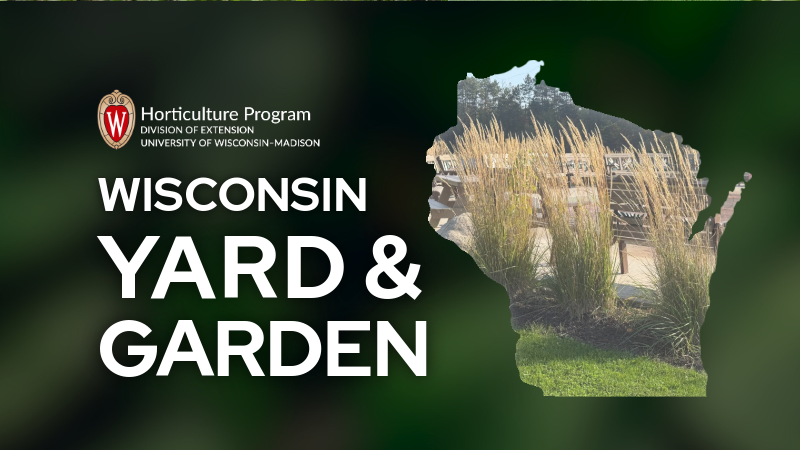
Feather Reed Grass (Calamagrostis x acutiflora) is one of the most popular of the cool-season non-native species, with the cultivar ‘Karl Foerster’ widely used. Cool-season grasses such as feather reed grass flower after their first surge of spring growth, whereas warm-season species flower after the heat of summer. Feather reed grass grows in strong clumps with very upright growth and stiff bronze seedheads that persist all the way through winter. Entire plants turn tan in fall. Full sun locations, as is the case with most ornamental grasses, are best.
One of the few ornamental grasses for shade is Hakone Grass (Hakonechloa macra), a warm-season grass native to Japan that can be planted throughout Wisconsin. Clumps of Hakone grass are wider than tall, with a weeping or pendulous growth habit. The yellowish or olive-green foliage turns orange in fall but does not remain upright over the winter. Plant Hakone grass in light to even heavy shade.
Looking for grasses to provide blue color in the landscape? Both blue fescue (Festuca glauca) and blue oat grass (Helictotrichon sempervirens) are good choices. Blue fescue, ideal for rock gardens, features dense mounds growing six to twelve inches tall, whereas blue oat grass reaches two to three feet in height and will tolerate light shade.
Several native warm-season ornamental grasses are well-suited for Wisconsin landscapes. The extremely popular little bluestem (Schizachyrium scoparium) featureserect clumps of medium-textured, arching foliage reaching two to four feet, and reddish fall color. Flowers will appear in late summer and seedheads often develop a silvery sheen effect, especially when planted in groups. Big bluestem (Andropogon gerardii) gets much taller (4-8 feet) with upright arching foliage and characteristic “turkey-foot” flowers and seedheads in late summer. Big bluestem foliage turns bronze in fall.
Switchgrass (Panicum virgatum) is another native species witherect clumps of medium-textured foliage reaching three to six feet tall with open, airy seedheads from August to September. Cultivars offering improved upright foliage or color include ‘Rehbraun,’ ‘Rotstrahlbusch,’ ‘Heavy Metal,’ ‘Northwind’ (developed here in Wisconsin), and ‘Shenandoah.’
Finally, two shorter native grasses for numerous potential landscape uses are side oats grama (Bouteloua curtipendula) and prairie dropseed (Sporobolus heterolepis). Side oats grama is a very adaptable fine-textured grass with unique single-rowed flowers on erect stalks. Prairie dropseed features arching mounds of fine textured foliage and open, airy seedheads developing in late summer.

About the Author
Bruce Spangenberg is a Horticulture Outreach Specialist with UW-Madison Division of Extension. Get answers to your lawn, landscape and garden questions anytime at “Ask Your Gardening Question.”