Overview of Nodding Onion
There are many ornamental flowering onions that offer a variety of unusual shapes and forms. The nodding onion, Allium cernuum (cernuum means “nodding” in Latin) is an attractive small species native to North America, distributed from New York to British Columbia and south in the mountains and cooler regions from Arizona and North Georgia. It occurs on rocky soils in glades, bluff edges, open woods, dry meadows and prairies throughout its native range. Because of its wide distribution, it is variable in plant size, flower color and bloom time. As with other members of the genus, it has the characteristic, pungent onion aroma. It is hardy in zones 4a to 8b.
The species grows 8 to 18 inches tall, forming attractive clumps. Flat, narrow, grass-like leaves emerge from a slender conic bulb with a brown membranous outer layer. The foliage persists into late summer before dying back. The clumps slowly expand by making new offsets.
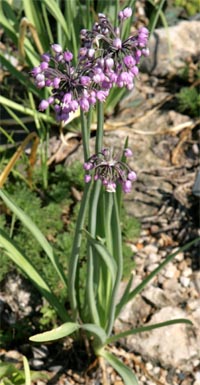
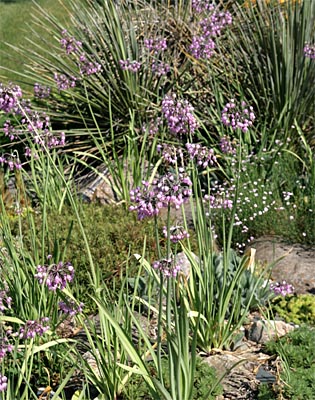
Each mature bulb typically bears a single, leafless flowering stem with loose, pendulous umbels with up to 30 individual light pink to lavender (and occasionally white) flowers. The stems bend sharply downward at the top so that the umbels droop downward. The small bell-shaped flowers have protruding stamens. The plants bloom in early to mid-summer and are attractive to butterflies and bees.
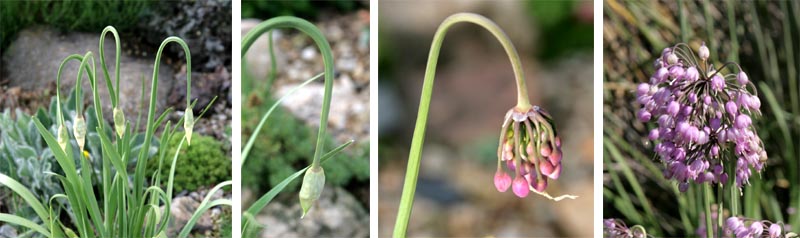
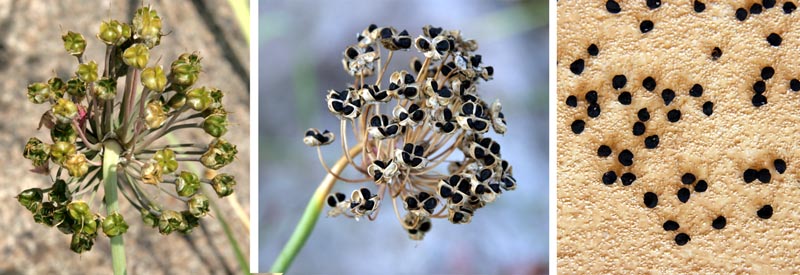
After the flowers fade, a very decorative seed head remains. Spherical crested fruits later split open to release the dull black seeds, each with a honey-comb pattern on the surface.
Landscape Use of Nodding Onion
A. cernuum is a great addition to the rock garden, borders, and cottage gardens. They naturalize well, so look at home in natural landscapes, wild gardens and meadows, but they can also be an attractive addition to more formal gardens. It is most effectively planted in small groups and is best interplanted with other perennials to hide the declining foliage. It will grow up nicely through wild geranium (Geranium maculatum) or other low groundcovers. Try planting it in front of Liatris ‘Kobold’ (a compact variety) or near winecups (Callirhoe involucrata) that will ramble around the bulbs.
Nodding onion is very easy to grow. It prefers well-drained soil in full sun but will tolerate clay soils. It thrives in difficult sites such as hot sun and gravely soil. Divide every third year or when 8 to 10 bulbs appear in the clump.
Like other alliums, A. cernuum has few pests. Young leaves, flowers, and bulbs are edible, but very strongly flavored and best enjoyed in small amounts. Native Americans used the bulbs for medicinal purposes. Allium species are resistant to rodent damage. Elk and deer may graze the new spring growth, but nodding onion is generally considered deer resistant.
Propagating Nodding Onion
This allium will self seed, so deadhead flowers before seed sets to reduce unwanted spread. Plants are easily grown from seed or can be planted as bulbs. Seeds can be sown in a cold frame or indoors well before last frost. Collect seeds when the seed capsules turn tan or straw-colored but before they open and when the seeds are black. Seeds can be stored under refrigeration for up to 3 years. Plants will start blooming in their second or third year after sowing. Plants can also be propagated by removing offset bulblets at the base of the bulbs in early spring or fall.
Cultivars of Nodding Onion
The species is available as seed or plugs from various native plant nurseries. There are few named cultivars and forms available. These include:
- Allium cernuum form albiflorum has white flowers.
- ‘Hidcote’ (sometimes called ‘Major’ or ‘Pink Giant’) is an English selection that is taller than the species, with larger flower heads and rose purple flowers.
- ‘Leo’ grows to 30 inches tall, with dense clusters of white flowers sometimes tinged with pink
- ‘Oxy White’ (formerly listed as A. oxyphilum) is a delicate selection with narrow stems and small flowers.
– Susan Mahr, University of Wisconsin – Madison
Last Update: Allen R. Pyle, UW-Madison Extension, 2026