Overview
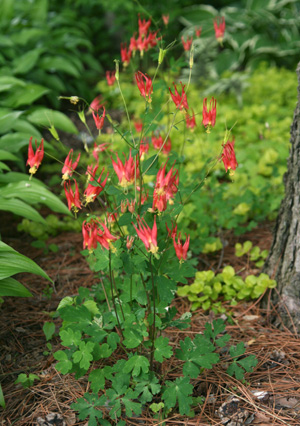
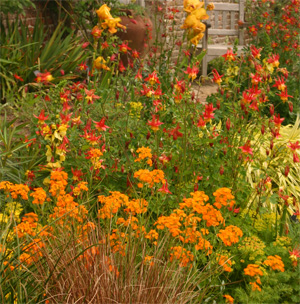
Wisconsin’s native columbine, Aquilegia canadensis – commonly called eastern red columbine, wild red columbine, or Canadian columbine – is at its peak in spring when its dangling blooms offer ornamental interest and food for ruby throated hummingbirds.
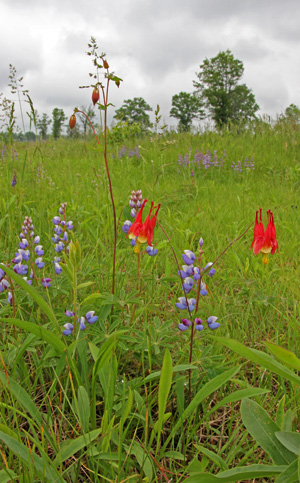
This wildflower in the buttercup family (Ranunculaceae) occurs naturally in open woodlands, clearings, and rocky slopes from Nova Scotia to Saskatchewan and in most states east of the Rockies, and is hardy in zones 3a to 8b. It is an attractive, old-fashioned garden plant.
This erect, sparingly branched herbaceous perennial grows foliage each year from a caudex (a vertical underground stem) and may form woody rhizomes. Height is quite variable, from 6 inches to 4 feet tall, depending on soil, light, moisture, and other conditions.
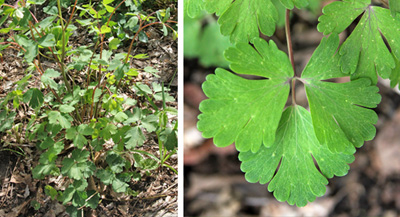
The glaucous, light green to blue-green, three-lobed leaves grow both from the base and along the flower stems. The basal leaves are produced first, forming a mound of foliage. Each compound leaf’s three leaflets are divided into three rounded lobes, which may be further subdivided in threes to look like large rounded teeth. The foliage is quite attractive even when the plants are not in bloom and will turn yellow in fall (if moist enough; the foliage will senesce in mid to late autumn, dying back to the caudex, if dry). Under the right conditions it can develop red and orange coloration.
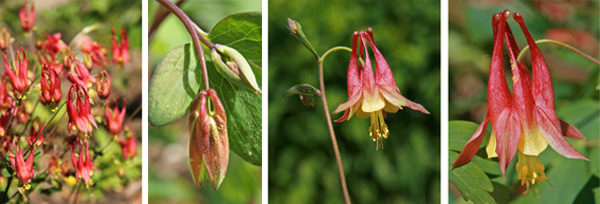
The exact time frame for flowering is determined by weather but typically columbines are in bloom for about a month in May and June in Wisconsin. The showy, 1 to 2 inch long flowers have 5 yellow petals each with a long, upward pointing, red, nectar-bearing spur, 5 spreading red sepals, and many yellow stamens dangling below. The Latin translation of the genus name Aquilegia references the shape of those spurs that supposedly resemble the claws of an eagle. Flowers are a critical food source for returning ruby-throated hummingbirds in spring and are also visited by bumblebees and hawk moths for the nectar and other bees for the pollen. The nodding flowers are held on sturdy stems above the foliage, forming a cloud of blossoms on larger plants.
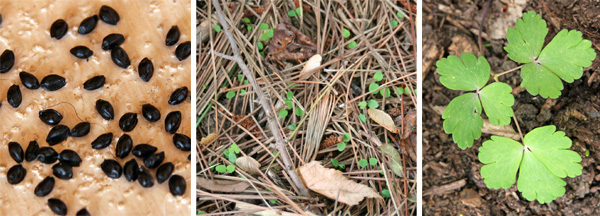
Flowers are followed by 5 pod-shaped follicles with long beaks that contain numerous small, shiny black seeds. Plants self-seed readily.
Landscape Use of Eastern Red Columbine
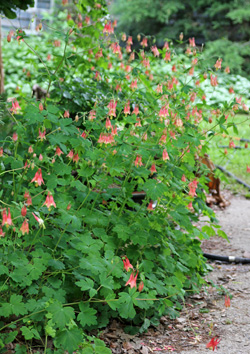
Grow eastern red columbine in light to moderate shade or in full sun as long as it has adequate moisture. Although it does best in fertile, moist soils, it tolerates a wide range of soils as long as they are well-drained. This species will naturalize under the right growing conditions and is perfectly suited to woodland or native plant gardens. It can also be a good addition to borders or cottage gardens. It combines well with spring bulbs, hostas, and astilbe in shade gardens, and with other native woodland plants, such as trillium, wild geranium, and wild ginger, in more naturalized settings.
Columbine is a relatively low maintenance plant. Once established, it tolerates dry soil, although the foliage looks better with regular moisture. Spent flower stalks can be cut off to make the plants look tidier. If the plants are looking really ragged, they can be cut back to the ground in late summer, but the foliage can be left for fall interest if it is still in good shape. Eastern red columbine has few pests but it is a host plant for the columbine duskywing (Erynnis lucilius), a caterpillar that eats the leaves, as well as a few other native insects.
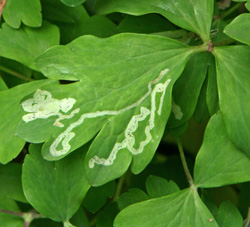
It is sometimes attacked by leaf miners that create serpentine trails in the leaves, but it is generally much less susceptible than other columbine species and hybrids. Typically leaf miner only causes minor cosmetic damage and almost never impacts the health of the plant, whereas they can cause significant damage on other types of columbine. A. canadensis is generally not bothered by deer or rabbits.
Propagating Eastern Red Columbine
This species is readily propagated from seed, blooming in its second year. If planted indoors, seeds need cold moist stratification for 6 to 8 weeks. Seed can be sown outdoors in fall to provide natural stratification. After stratification, seeds germinate in 3 to 4 weeks.
Large plants can be divided in spring. Eastern red columbine is frequently a short-lived plant, but often will self seed to increase or maintain a population. It readily hybridizes with other Aquilegia species.
Cultivars of Eastern Red Columbine
In addition to the unimproved species, a few cultivars are available:
- ‘Canyon Vista’ is a compact variety that grows 12 to 15 inches tall, with red and yellow flowers.
- ‘Corbett’ is a dwarf form with sulfur yellow flowers that grows about a foot tall.
- ‘Little Lanterns’ is a very short German cultivar, growing about 10 inches tall with blue-green foliage and red and yellow flowers like the species.
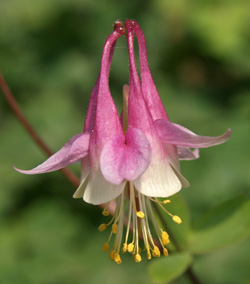
- ‘Pink Lanterns’ has pink and white flowers and grows 12 inches tall. Discovered at the Dyck Arboretum in Kansas.
Author: Susan Mahr, University of Wisconsin-Madison
Reviewers: Allen R. Pyle, Horticulture Outreach Specialist, UW-Madison Extension, Bruce Spangenberg, Horticulture Outreach Specialist, UW-Madison Extension
Revised: September 2026