Overview
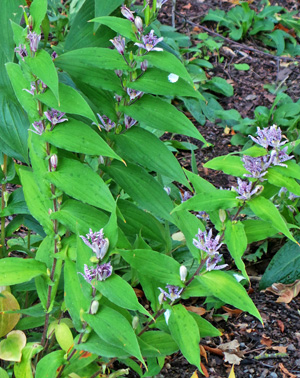
Tricyrtis is a genus in the lily family (Lilaceae) commonly called toad lilies. These perennial herbaceous plants, native to Asia (from the Himalayas to Japan and the Philippines), are generally found in shady conditions on the edge of forests. Of the 16 to 20 species, only two (and their hybrids) used to be commonly grown as garden ornamentals, primarily for their orchid-like blossoms which open in fall after most other plants have finished blooming. In the last two decades or so, many new cultivars and hybrids were developed in Japan and the United States, including forms with variegated foliage and dwarf habits. No longer a botanical curiosity, many Tricyrtis species are commonly available in garden centers and local nurseries with even more offered by specialty nurseries.
Hairy or Japanese toad lily, T. hirta (= T. japonica), is a species native to the Japanese islands of Honshu, Shikoku, and Kyushu that is commonly used for its interesting foliage and orchid-like blooms. In its native habitat it is found growing on shady rocky cliffs and steam banks. It is hardy to zone 4a, whereas many of the other species offered as garden plants may not be hardy in Wisconsin.
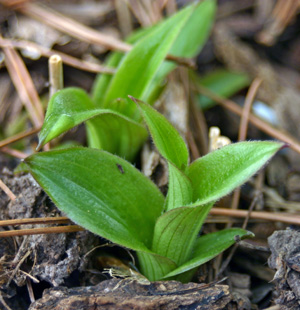
Hairy toad lily grows from creeping rhizomes, forming a clump of foliage that slowly expands over time.
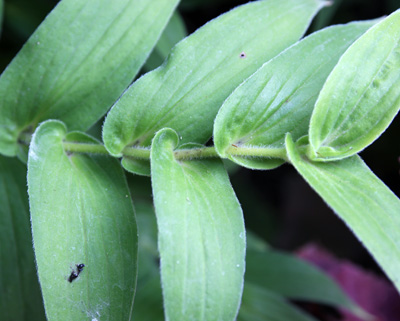
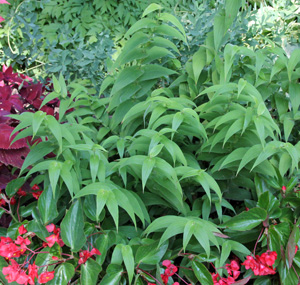
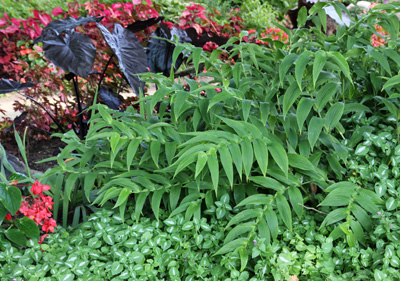
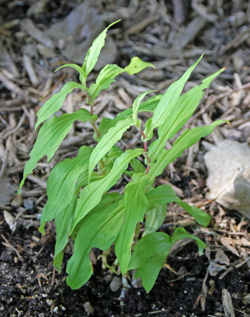
It is a highly variable plant that can reach a height of 1 to 3 feet, emerging late in the spring. It produces arching, unbranched stems with alternate leaves all along the stems in a ladder-like arrangement. The 3 to 6 inch long, light green leaves are oval to oblong with parallel veins and clasping leaf bases. The stems often arch in the same direction, creating a graceful, flowing appearance. As its common name suggests, all parts of the plant are hairy.
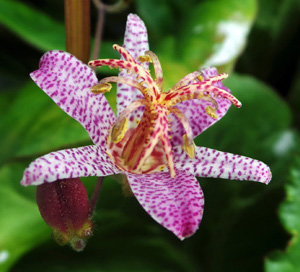
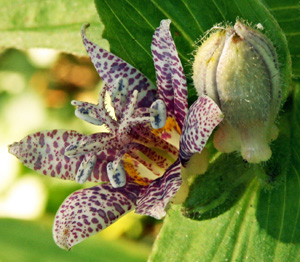
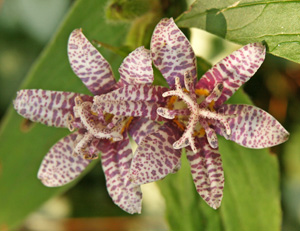
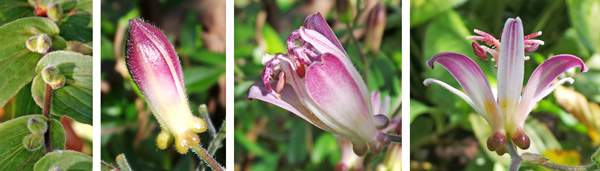
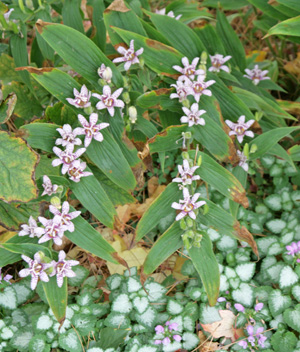
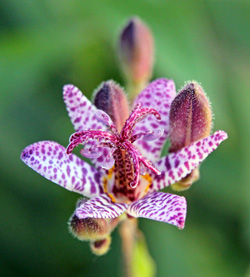
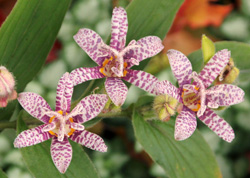
All Tricyrtis have flowers with six showy tepals (similar appearing sepals and petals), pouch-like nectaries at the base of the outer tepals, and six stamens and three styles forming a prominent crown that extends beyond the perianth. The inch-wide, star-shaped flowers of T. hirta are white to pale purple with dark purple spots and a purple stigma. The flowers are produced singly or in small clusters of two to three in the upper leaf axils facing upwards. The flowers open in late summer to early fall, lasting for about three weeks or until a hard frost (both the leaves and flowers are damaged below 28ºF). The cylindrical seed capsules that follow the flowers eventually dry out and split open to release the small, papery disc-shaped seeds.
Landscape Use of Toad Lily
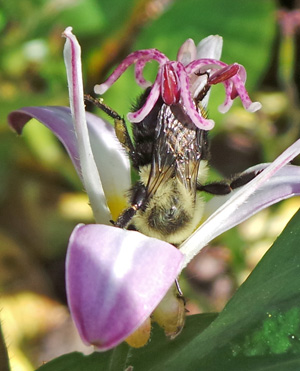
Toad lilies are best planted where their small, unique flowers can be appreciated up close. They make subtle but exotic-looking specimens for the edges of shady borders, woodland paths or in naturalized areas. They are particularly effective in masses, but single plants make a good accent with other shade plants. They combine well with other perennials that also like moist, shady conditions, including anemone, astilbe, ferns, hellebores, hosta, lungwort (Pulmonaria), and trout lilies (Eythronium spp.). Hairy toad lily can be grown in containers and the cut stems used in fresh flower arrangements. Bees and other insects will visit the flowers.
Grow toad lilies in part to full shade and moist soil rich in organic matter. This plant tolerates sun in cool climates as long as it is kept moist. With insufficient moisture leaves will become spotted and brown along the edges and plants may go dormant prematurely and not bloom in drought conditions. Plants will grow taller in moist soils and remain shorter in drier conditions. If possible, site them in a sheltered location to protect the late-blooming flowers from early frosts. Plants can be covered during light frosts to protect the flowers and prolong bloom. Many of the toad lilies will self-seed and naturalize in ideal growing conditions.
Hairy toad lily has few pest problems, although slugs may damage the young growth and rabbits may eat the leaves and flower buds. Deer, however, do not prefer this plant. The fungal disease anthracnose leaf spot can affect some cultivars, but can be managed by increasing air circulation around the plants, minimizing overhead irrigation and removing fallen and symptomatic leaves to reduce the amount of spores in the leaf litter surrounding the plants. An aphid-borne mosaic virus that produces irregular spots and flower coloration also occurs.
There are numerous cultivars of T. hirta, as well as many hybrids between this species and others, especially T. formossana, which is only hardy to zone 6a. Many of these are of unknown parentage, and even those listed as cultivars may be hybrids among species.
Cultivars of Toad Lily
Since T. hirta and T. formosana readily cross in the garden, many plants sold commercially as these species may actually be hybrids; such hybrids tend to be more vigorous than either parent and are generally hardy to zone 5a. Some more common selections include:
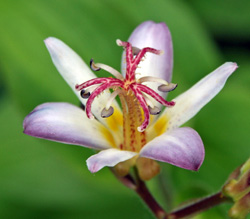
- ‘Alba’ or ‘Albescens’ is not a single clone but includes any seed-grown, white-flowered plant, so the vigor and flower quality can vary considerably, with some having pure white flowers while others are actually marked with pale green spots. Plants sometimes develop open crowns due to lax or fallen stems.
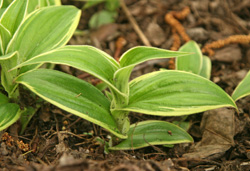
- ‘Albomarginata’ is a strongly variegated cultivar with leaves edged in creamy white on 18” arching branches and purple flowers in early fall.
- ‘Lightning Strike’ is a Japanese selection with bright golden foliage variably streaked with green and light lavender flowers on the 16 to 25 inch tall, arching stems in early fall.
- ‘Minazuki’ is a Japanese selection with a compact habit, golden leaves that develop green borders as they mature. It produces pale lavender flowers on 20 inch tall stems.
- ‘Miyazaki’ is a seed strain selected for its shorter, gracefully arching habit. With good moisture it is very floriferous, opening its numerous purple and white spotted flowers almost all at once in late summer and early fall. It has been the most successful of the toad lilies grown at Rotary Botanical Gardens in Janesville, WI, where the profusion of flowers prominently stands out in the garden. It was given an excellent rating in a 10-year research trial at the Chicago Botanic Garden because of its superior floral display, robust habit, winter hardiness and disease resistance. This cultivar had the best floral show of the 24 types studied in that trial, with more than 80% of the flowers open at once.
- ‘Miyazaki Gold’ is a smaller (only 1 foot tall), variegated form with pronounced, soft yellow edges on the leaves.
- ‘Moonlight’ is an all-gold (often with tiny green lines) sport of ‘Variegata’ with purple flecked, white flowers that grows 15 to 20 inches high.
- ‘Raspberry Mousse’ is a newer Dutch cultivar with dark red-purple blotches (which may actually be virus induced)
- ‘Sinonome’ is a hybrid of T. hirta and T. formosana that forms a large, upright clump and terminal clusters of purple and white speckled flowers. It is hardy to zone 5a and is generally not affected by anthracnose.
- ‘Tojen’ (sometimes spelled ‘Togen’) is a vigorous hybrid between T. hirta and T. formossana (sometimes labeled T. stolonifera) that produces terminal clusters of interesting flowers: the outer tepals are white with lavender margins and the inner tepals are clear white, without spotting. It is a tall plant with large, bright green leaves on burgundy stems. It is hardy to zone 5a, is resistant to anthracnose, and does not reseed.
- ‘Variegata’ has lavender flowers and creamy edges on the leaves that fade to light green by the end of the summer.
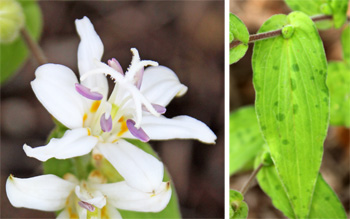
- ‘White Towers’ is a more upright, vigorous selection of T. hirta (but often listed as T. latifolia or as a hybrid) with spots on the leaves when young. It has pure white flowers in the upper leaf axils and terminals that bloom earlier than most other toad lilies.
Propagating Toad Lily
The species can be grown from seed (although they may not come true if other Tricyrtis plants are in the area, as species and cultivars can cross). Plants can be propagated by division in early spring when still dormant or from cuttings taken in late spring through early summer before the flower buds develop. Cuttings root readily from the nodes, even in plain water. Sow fresh seed, or provide cold, moist stratification for three months for stored seed.
Author: Susan Mahr, University of Wisconsin-Madison
Reviewers: Allen R. Pyle, Horticulture Outreach Specialist, UW-Madison Extension, Bruce Spangenberg, Horticulture Outreach Specialist, UW-Madison Extension
Revised: October 2026