

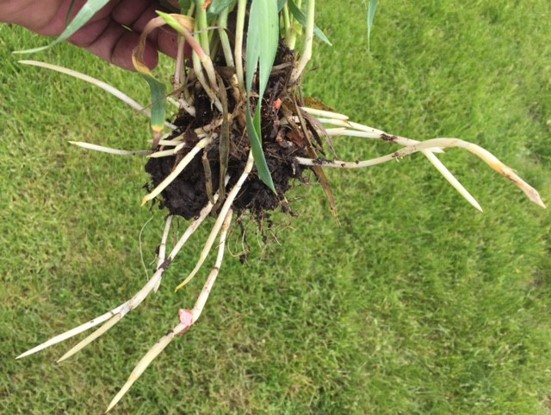
Most gardeners have their short-list of chronic, difficult to control weeds. Whether it is caring for a perennial bed, growing crops like raspberries and vegetables, or managing lawns, quackgrass is highly likely to be included on that list for Wisconsin gardeners.
Quackgrass is best identified as a weedy grass with coarse (wide) leaves that when pulled up, has long whitish underground horizonal rhizomes often referred to as “runners.” Look carefully at these rhizomes and notice roots developing at each swollen node, or growing point, on them. Quackgrass is a perennial which readily spreads when these rhizomes are broken, either by unsuccessfully pulling them up or when cultivating the soil, which is why it can be such a headache to deal with.
Another characteristic to identify quackgrass is auricles. Look near the base of leaf blades where they attach to stems for long, slender clawlike auricles that clasp or wrap around the stem. Combine these with the distinct long rhizomes and the identity of quackgrass is easily confirmed as compared to other weedy grasses like crabgrass. Flowers and the seedhead will be a tall spike with two rows of spikelets.
Quackgrass (Elymus repens) originally came to the United States from Europe as a contaminant in agricultural products such as hay or straw sometime in the 1600-1700s. The common name has nothing to do with ducks. Instead, the term “quack” is derived from the German term “queck,” meaning lively or quick. In times of famine, quackgrass seeds and roots have been used in Europe as an alternative flour source. Quackgrass is also believed to have allelopathic qualities by releasing chemicals that inhibit growth of other plants.
Unfortunately, there is no effortless way to manage quackgrass plants in home landscapes and gardens. Digging them out by hand is the best option, but getting all the rhizome is difficult. Avoid simply tilling them under, as rhizomes will not die and if broken, the problem gets worse as pieces regrow into more quackgrass plants. Burying quackgrass plants with mulch is unlikely to kill them, as they emerge through it.
As far as herbicide use on quackgrass, the only materials available are nonselective, meaning they will damage or kill all types of plants on which they are sprayed. Thus, there is no way to spray a perennial bed, groundcover planting, or lawn area to only control quackgrass growing in it. Nonselective herbicides that do not leave plant-inhibiting soil residues can be used on areas being prepared for new plantings, or on lawns that can be reseeded afterwards. Always read, understand, and follow all label directions when considering any pesticide application.

About the Author
Bruce Spangenberg is a Horticulture Outreach Specialist with UW-Madison Division of Extension. Get answers to your lawn, landscape and garden questions anytime at “Ask Your Gardening Question.”